
I physically broke my first coffee grinder on a Tuesday morning, and honestly, it was entirely my fault.
I had recently purchased a cheap, plastic hand grinder with a fragile ceramic burr off the internet for twenty dollars. For the first few months, it worked perfectly fine. I was using it to grind dark-roasted, generic supermarket coffee. Those mass-produced beans were puffy, brittle, and shattered with almost zero resistance.
But then, my palate started to evolve, and I decided to buy my very first bag of premium specialty coffee.
It was a beautiful bag of washed Heirloom beans from the Yirgacheffe region of Ethiopia. The label proudly displayed a bunch of information I didn’t understand at the time, including the acronym “2,200 MASL.”
I eagerly poured fifteen grams of the pale brown beans into the plastic hopper of my cheap grinder. I grabbed the handle and gave it a confident twist.
It felt like I was trying to grind gravel.
The handle barely moved. I gritted my teeth, gripped the plastic cylinder tighter, and forced the handle around in a violent circle. There was a loud, sickening crack. A chunk of the white ceramic burr snapped off completely and fell into the glass catcher below.
I was furious. I stared at the beans, fully convinced the roaster had scammed me and sold me a bag of stale, petrified rocks.
I took the bag back to the shop the next day and demanded an explanation. The barista didn’t apologize. Instead, he smiled, looked at the bag, and gave me my very first lesson in agricultural physics.
Those beans weren’t stale rocks. They were just grown incredibly high up a mountain.
Here is the honest, fascinating story of what makes coffee from high altitudes so special, why they destroyed my cheap grinder, and why climbing the mountain is the ultimate cheat code for finding the best flavor in the world.
Decoding the Acronym
Before that broken grinder incident, I used to ignore the random numbers printed on specialty coffee bags. I thought they were just useless inventory codes.
I quickly learned that the acronym MASL stands for Meters Above Sea Level.
In the specialty coffee industry, this is not just a geographical footnote. It is arguably the most important piece of data on the entire bag. It is a direct promise of quality, density, and flavor.
Coffee is an incredibly sensitive plant. It reacts violently to its environment. If you take a coffee seed and plant it at sea level in a hot, tropical jungle, the plant will behave one way. If you take the exact same genetic seed and plant it 2,000 meters up a freezing mountain, it will behave entirely differently.
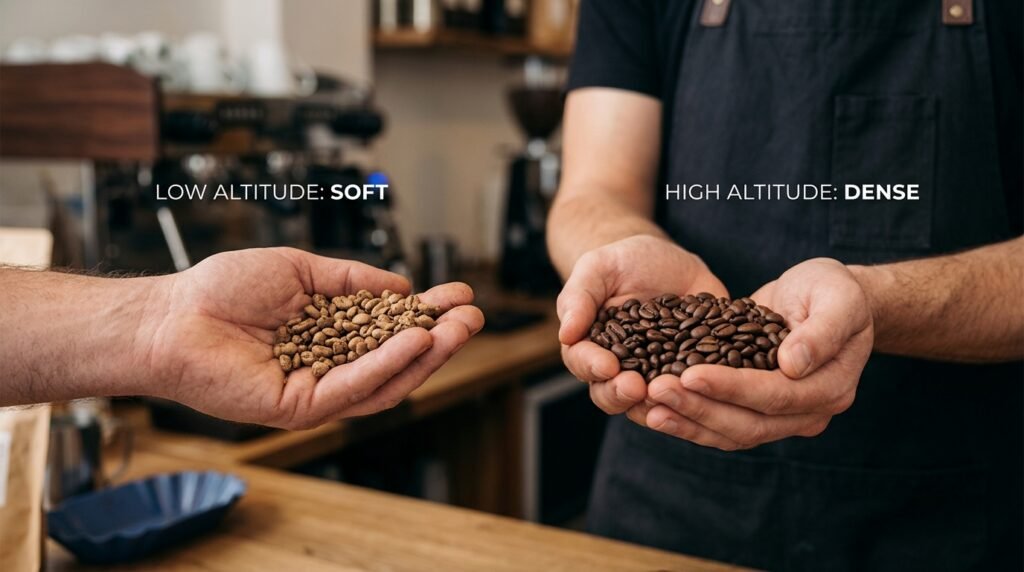
The barista explained that my cheap grinder broke because it was designed for low-altitude, soft commercial beans. It simply wasn’t built to handle the sheer, rock-hard density of a high-altitude Ethiopian seed.
But why do they get so hard? The answer lies in the struggle for survival.
The Science of the Struggle
When a coffee tree is planted at a low elevation (anything under 1,000 meters), it lives a very easy, comfortable life. The air is warm all day and warm all night. Because the plant is comfortable, it grows rapidly.
The coffee cherries on a low-altitude tree ripen extremely fast. Because they grow so quickly, the seed inside the fruit is porous, soft, and relatively large.
But when a coffee tree is planted high up in the mountains—say, 1,800 to 2,200 MASL—its life becomes a daily struggle.
During the day, the mountain sun is intense, providing plenty of energy for photosynthesis. But when the sun sets, the thin mountain air cannot hold the heat. The temperature plummets, often getting dangerously close to freezing.
The coffee plant literally shivers. To survive the freezing night, it slows its metabolism down to an absolute crawl.
Because the plant is constantly pausing its growth every single night, the coffee cherry takes months longer to ripen on the branch. This agonizingly slow maturation process is the ultimate secret to world-class coffee.
Packing in the Sugars
When a fruit grows slowly, it has time to develop complexity.
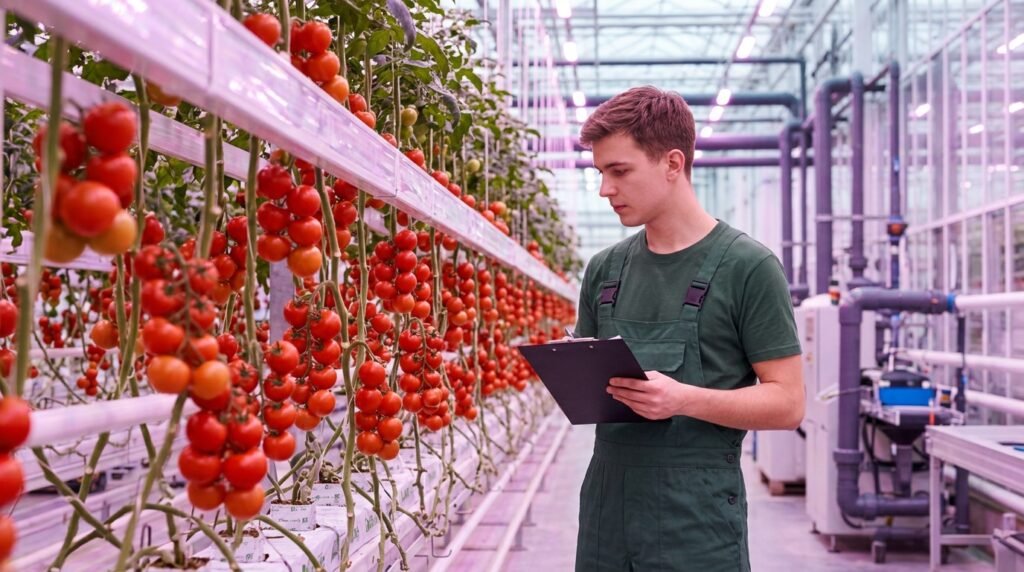
Think about a tomato grown rapidly in a massive, heated commercial greenhouse versus a wild heirloom tomato grown slowly in a cool, nutrient-rich garden. The slow-grown tomato will always be sweeter, denser, and more vibrant.
The exact same biological rule applies to coffee.
Because the high-altitude cherry takes so long to mature, the plant is forced to push massive amounts of complex organic acids and dense natural sugars deep into the seed to keep it alive.
Understanding this biological reaction to the cold is exactly (Why Some Coffee Origins Taste Sweeter Than Others). The extreme mountain temperature swings physically bake the sweetness into the cellular structure of the bean.
As the plant packs more and more sugars into the seed, the cellular walls become incredibly tight. The bean becomes tiny, heavy, and hard as a rock.
That intense, rock-hard density is exactly what shattered my cheap ceramic grinder. It wasn’t a defect; it was a physical badge of honor proving that the coffee had survived the freezing African nights.
The Acidity Advantage
The density and the sugars are wonderful, but the true hallmark of a high-altitude coffee is its acidity.
If you drink a low-altitude coffee from a warm climate, it will usually taste very earthy, nutty, and sometimes a bit muddy. There is no “spark” to the flavor.
But high-altitude coffees are famous for their explosive, bright, and vibrant acidity.
Because the cool mountain air allows the plant to develop complex organic acids (like malic and citric acid), the resulting cup of coffee doesn’t taste like dirt. It tastes like fresh fruit.
When you brew a high-altitude coffee from Kenya, that acidity translates directly into the sharp, mouth-watering flavor of pink grapefruit and blackberries. When you brew a high-altitude coffee from Colombia, it translates into the crisp, sweet snap of a red apple.
This acidity is the spine of the beverage. It lifts the flavor up and makes the coffee feel refreshing and alive. It is the defining characteristic that separates a generic morning chore from a luxurious culinary experience.
The Natural Pesticide (And Why It Matters)
There is another fascinating, hidden benefit to high-altitude farming that drastically improves the taste of your coffee, and it has to do with bugs.
At low elevations in the tropics, the air is thick with insects, beetles, and pests that want to eat the sweet coffee cherries. To defend itself, the coffee plant has a brilliant natural weapon: Caffeine.
Caffeine is technically a natural pesticide. It is highly toxic to insects. So, low-altitude coffee plants pump massive amounts of caffeine into their seeds to kill the bugs that try to eat them.
The problem for us humans is that caffeine is incredibly bitter. A bean packed with excess caffeine will always taste harsh and metallic.
But when you climb up to 2,000 meters above sea level, the air becomes too thin and too cold for most tropical pests to survive. The bugs simply do not exist up there.
Because there are no bugs attacking the tree, the high-altitude coffee plant doesn’t need to pump its seeds full of bitter caffeine.
The result? High-altitude Arabica coffees are naturally lower in caffeine than their low-altitude counterparts, which means they are naturally significantly less bitter. They are sweeter, smoother, and much more elegant.
Redefining Your Equipment
After the barista explained all of this to me, I realized that if I was going to explore the high-altitude peaks of the coffee world, I needed to upgrade my tools.
You cannot extract the complex, dense sugars of a mountain-grown bean with cheap equipment.
I went home and threw my broken ceramic grinder in the trash. I invested in a high-quality manual grinder with sharp, stainless steel burrs. When I poured my replacement bag of Ethiopian Yirgacheffe into the new grinder, the steel sliced through the dense little pebbles effortlessly.
The difference in my cup was staggering. Because the steel burrs created perfectly uniform grounds, the hot water was able to extract all the delicate peach and jasmine notes hidden inside those hard seeds.
Realizing that dense beans require precision tools is exactly (How Grind Size Affected My Coffee More Than I Expected). If you use a bad grinder on a high-altitude bean, you will end up with giant boulders and microscopic dust, completely ruining the delicate floral flavors the mountain worked so hard to create.
The Changing Landscape
As I began exclusively seeking out coffees grown above 1,500 MASL, my appreciation for the farmers grew immensely.
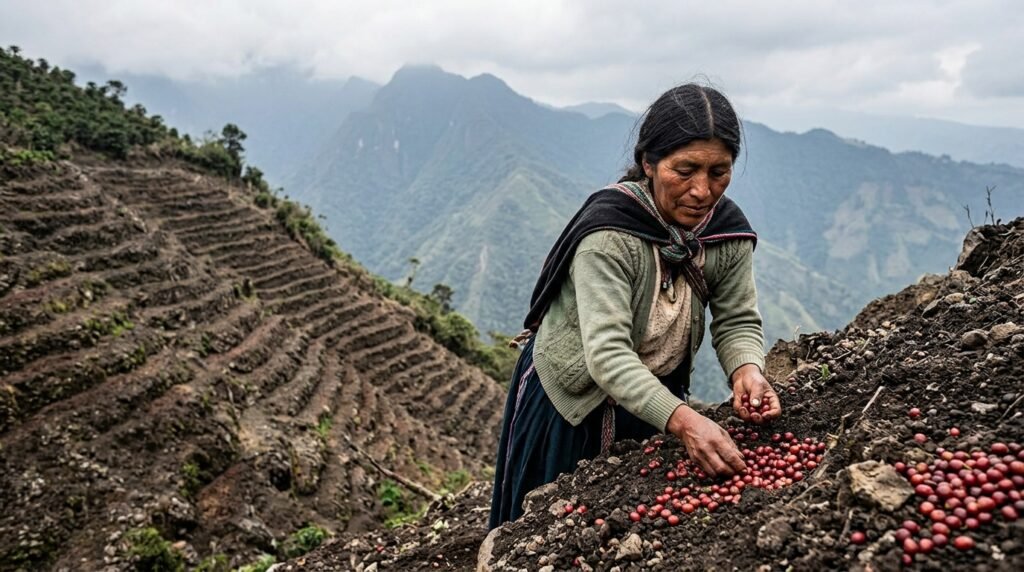
Farming at high altitudes is incredibly difficult, dangerous work. The slopes are often so steep that tractors and machinery cannot be used. Every single coffee cherry has to be hand-picked by humans walking up and down treacherous volcanic inclines.
Furthermore, these high-altitude havens are under massive threat.
Because these specific microclimates rely on cold nights, they are extremely vulnerable to global temperature shifts. Unpacking this environmental fragility is precisely (How Climate Affects the Taste of Coffee (My Discovery)), as it highlights how global warming is physically pushing coffee farmers higher and higher up the mountains just to find the cool air they desperately need.
Eventually, they will run out of mountain.
Knowing this makes every cup of high-altitude coffee feel like a fleeting, precious gift. It is an agricultural miracle that requires the perfect alignment of soil, sun, and freezing night air.
Reading the Label Like a Pro
Today, I never buy a bag of coffee blindly. I use the altitude as my ultimate filter.
When I walk into a specialty coffee shop, I ignore the marketing adjectives on the front of the bag. I immediately turn the bag around and scan the fine print for the MASL number.
If I see a number between 1,000 and 1,400 MASL (often from Brazil or lower parts of Central America), I know I am going to get a sweet, heavy, comforting cup with low acidity and big chocolate notes.
If I see a number between 1,500 and 1,800 MASL (like many coffees from Colombia, Guatemala, or Costa Rica), I know I am going to get a perfectly balanced cup with a crisp, refreshing fruit acidity and a sweet caramel body.
But when I see a number over 1,900 MASL—when I see 2,100 or 2,200 printed on a bag from Ethiopia or Kenya—my heart skips a beat. I know I am holding a bag of incredibly dense, rock-hard seeds that have battled the freezing elements to produce the most vibrant, floral, and intensely sweet flavors on earth.
Elevate Your Morning
If your coffee currently tastes like flat, boring, bitter dirt, you are probably drinking a low-altitude commercial blend.
You deserve to taste the mountain.
The next time you are shopping for coffee, look for the elevation. Look for a single-origin coffee that proudly advertises a high MASL number. Invest in a decent grinder that can handle the density of the beans.
When you take that first sip, and the bright, mouth-watering flavor of fresh berries, crisp apples, or sweet peaches hits your tongue, you will finally understand the hype. You will realize that the best flavors in the world are hidden high up in the clouds, and the climb is absolutely worth the effort.

My name is Daniel Carter, I am 35 years old, and I live in the United States. I have been passionate about aquariums for many years, and what started as a simple hobby quickly became a lifelong interest in aquatic life, fish behavior, and responsible tank care.
Through TheBrightLance, I share real experiences, practical knowledge, and honest lessons learned from maintaining different types of aquariums. I enjoy testing equipment, studying fish behavior, improving maintenance routines, and helping beginners avoid common mistakes.
My goal is to make aquarism easier, more ethical, and more enjoyable for everyone — whether you are setting up your very first tank or looking to refine your techniques.