
I have a confession to make: I am a terrible gardener.
A few summers ago, long before my specialty coffee obsession fully took over my life, I decided I was going to grow my own heirloom cherry tomatoes on my apartment balcony. I bought expensive soil, beautiful ceramic pots, and carefully planted the seeds.
When July arrived, the city was hit with a brutal, unrelenting heatwave. It was over ninety degrees for three straight weeks. The sun baked my little balcony mercilessly from dawn until dusk.
I watered the plants every day, assuming the massive amount of sunlight would give me the sweetest, most incredible tomatoes of my life.
When it was finally time to harvest them, I eagerly plucked a bright red tomato off the vine and popped it into my mouth.
It was awful. The skin was incredibly tough and leathery, and the inside tasted like warm, bland water. There was absolutely zero sweetness. There was no bright, acidic snap. It was just a mealy, tasteless disappointment.
I mentioned this failure to a friend who actually works in agriculture. He laughed and immediately diagnosed the problem.
“Tomatoes need cool nights,” he explained. “If the plant is hot all day and hot all night, it goes into survival mode. It grows too fast and builds a thick skin to protect itself from the sun, but it never has the chance to actually develop complex sugars. You baked all the flavor right out of them.”
That conversation haunted me. But it wasn’t until a year later, sitting in my kitchen and staring at a bag of expensive single-origin coffee beans, that the profound truth of his statement finally clicked.
Coffee is not a factory product; it is the seed of a fruit. Just like my tragic balcony tomatoes, a coffee tree is entirely at the mercy of the sky.
Here is the honest, eye-opening story of how climate affects the taste of coffee, and how learning to read the “weather report” on a bag of beans completely changed how I buy and brew my morning cup.
The Myth of the Uniform Tropics
Before my balcony gardening disaster, I had a very cartoonish view of where coffee came from.
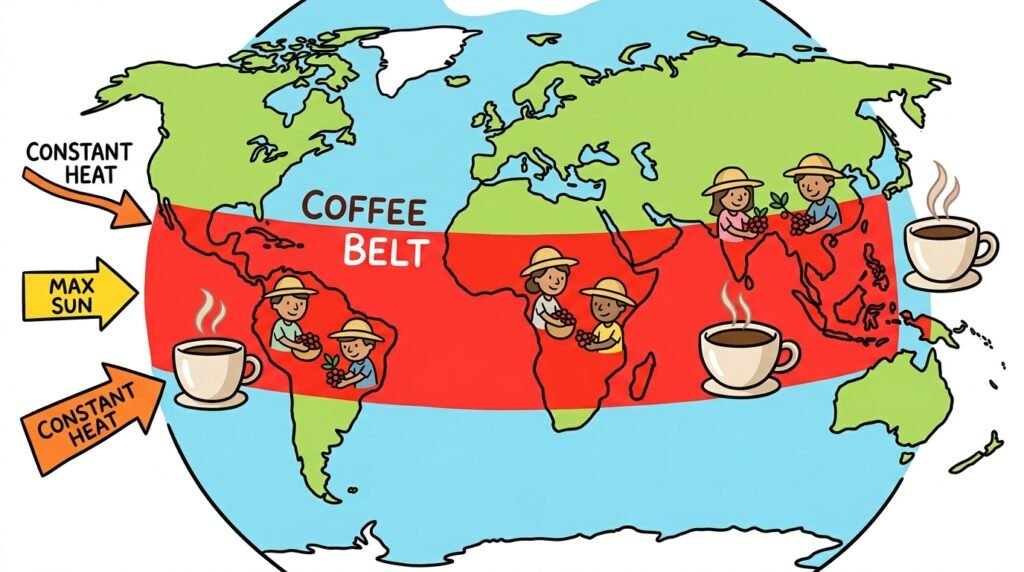
I knew that coffee only grew between the Tropics of Cancer and Capricorn—a thick band around the equator often called the “Coffee Belt.” Because of this, I assumed the weather in all coffee-producing countries was exactly the same: constantly hot, constantly sunny, and constantly humid.
I thought a coffee farm in Brazil experienced the exact same weather as a coffee farm in Ethiopia or Indonesia.
That assumption was the reason I couldn’t understand why coffees from different parts of the world tasted so radically different. I was completely ignoring the existence of microclimates.
The Coffee Belt isn’t a uniform sauna. It is a wildly diverse geographical zone filled with towering, freezing mountain peaks, dense, rain-soaked valleys, and dry, windy plateaus.
Realizing that the local weather dictates the final flavor of the bean was a massive paradigm shift. Grasping this agricultural reality is the core of (What I Discovered About Coffee Farming Around the World), because it forced me to respect farmers as masters of their specific, unpredictable environments.
The Thermostat of Flavor: Diurnal Temperature Variation
The first major climate lesson I learned brought me right back to my failed cherry tomatoes.
In the specialty coffee world, temperature is everything. But it isn’t just about how hot it gets; it is about the swing between the high and the low. Botanists call this “diurnal temperature variation.”
When you look at a bag of high-quality coffee, you will almost always see the altitude printed on the label, usually as MASL (Meters Above Sea Level).
Altitude is actually just a cheat code for temperature.
If a coffee tree is planted at a low altitude (like 800 meters) in a tropical climate, it is hot during the day, and it stays warm at night. The coffee cherries grow incredibly fast. Because they mature so quickly, the seed inside doesn’t have time to develop a dense cellular structure. The resulting coffee often tastes flat, earthy, and lacks any exciting sweetness or acidity.
But when you plant a coffee tree high up in the mountains—say, 2,000 meters above sea level in the Ethiopian Guji region—the climate changes drastically.
The days are warm and sunny, allowing the plant to photosynthesize. But when the sun goes down, the mountain air becomes freezing cold.
The coffee plant shivers. It slows its metabolism down to survive the freezing night. Because of this extreme temperature swing, the coffee cherry matures at an agonizingly slow pace.
This slow growth is the holy grail of flavor. It forces the plant to push massive amounts of complex organic acids and dense, natural sugars deep into the seed over a long period of time. Understanding this biological reaction to the cold is exactly (What Makes Coffee From High Altitudes So Special?). The freezing mountain air is the literal reason my favorite Ethiopian coffee naturally tastes like sweet peaches and bright lemon zest.
The Rain Dictates the Recipe
Temperature builds the sugars, but rainfall decides how those sugars are processed.
Once a coffee cherry is ripe and picked from the branch, the farmer has to dry the seed inside so it doesn’t rot. How they choose to dry it is completely dependent on the humidity and rainfall of their specific climate.
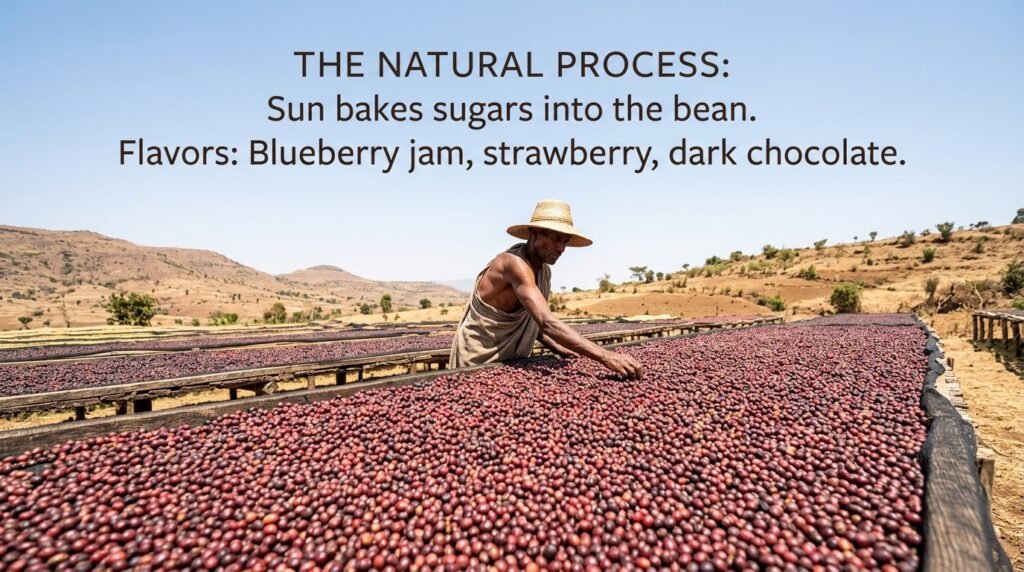
If a farmer lives in a region with a predictable, long, dry season—like parts of Brazil or Ethiopia—they can use the “Natural” process. They simply lay the whole, freshly picked fruit out on massive patios under the hot sun.
Because the air is dry, the fruit slowly shrivels up like a raisin without turning to mold. As it bakes in the sun, all those heavy, sticky fruit sugars ferment and seep directly into the coffee bean. This creates a coffee that is intensely heavy, sweet, and bursting with flavors like blueberry jam, strawberry, and dark chocolate.
But what happens if a farmer lives in a climate where the dry season doesn’t exist?
Look at the island of Sumatra in Indonesia. The climate there is defined by relentless, suffocating humidity and constant rain. If a farmer in Sumatra tried to lay whole coffee cherries out in the sun to dry, they would rot and turn into a fungus-covered disaster in a matter of days.
The climate forces their hand.
To survive the constant rain, Indonesian farmers invented a process called “Wet-Hulling.” They strip the fruit and the protective parchment layer off the seed while it is still wet and squishy. This exposes the naked bean directly to the humid jungle air, forcing it to dry much faster before the rain can destroy it.
This violent, climate-driven process physically alters the bean. It completely destroys the bright, fruity acidity and amplifies deep, savory, earthy flavors. That is why Sumatran coffee tastes like cedar wood, dark spices, and pipe tobacco.
The rain literally dictates the recipe.
The Canopy of Clouds
The amount of direct sunlight a coffee plant receives also drastically alters the chemistry of the bean.
Coffee is naturally an understory plant. In the wild, it grows underneath the thick canopy of larger forest trees, receiving only dappled, filtered sunlight.
In the pursuit of massive yields, many commercial coffee farms clear-cut the forests and plant coffee trees in direct, blistering sunlight. This forces the plant to produce a massive amount of cherries quickly, but just like my balcony tomatoes, the extreme sun bakes the complexity right out of the fruit. The resulting coffee is often bitter and one-dimensional.
But in places like Colombia, the climate offers a natural defense mechanism.
The steep slopes of the Andes mountains are often draped in a thick, persistent layer of cloud cover and morning fog. This cloud cover acts like a giant, natural umbrella. It diffuses the harsh tropical sun, bathing the coffee plants in soft, gentle light.
This diffused light reduces the physical stress on the plant leaves. It allows the coffee cherry to ripen evenly and gently, preserving the delicate, complex flavor compounds.
When you drink a brilliant, balanced, caramel-sweet cup of Colombian coffee with that signature crisp apple finish, you aren’t just tasting the volcanic dirt. You are tasting the protective shadow of the mountain clouds.
The Wind and the Skin
There is one more climatic factor that surprised me the most: the wind.
When coffee trees are exposed to heavy, persistent winds—like the ocean breezes that sweep across the mountains of Costa Rica or the high-altitude gusts in certain African regions—the plant has to physically defend itself.
To protect the seeds from drying out in the wind, the coffee tree will actually grow a thicker, tougher skin on the outside of the coffee cherry.
This might sound like a minor botanical detail, but it has a massive impact on flavor. A thicker skin means there is more mucilage (the sticky, sugary fruit pulp) trapped between the skin and the seed.
When that cherry is processed, there is simply more sugar available to ferment and seep into the bean. Wind-stressed coffees often present a deeper, more pronounced sweetness and a heavier, creamier body in the final cup.
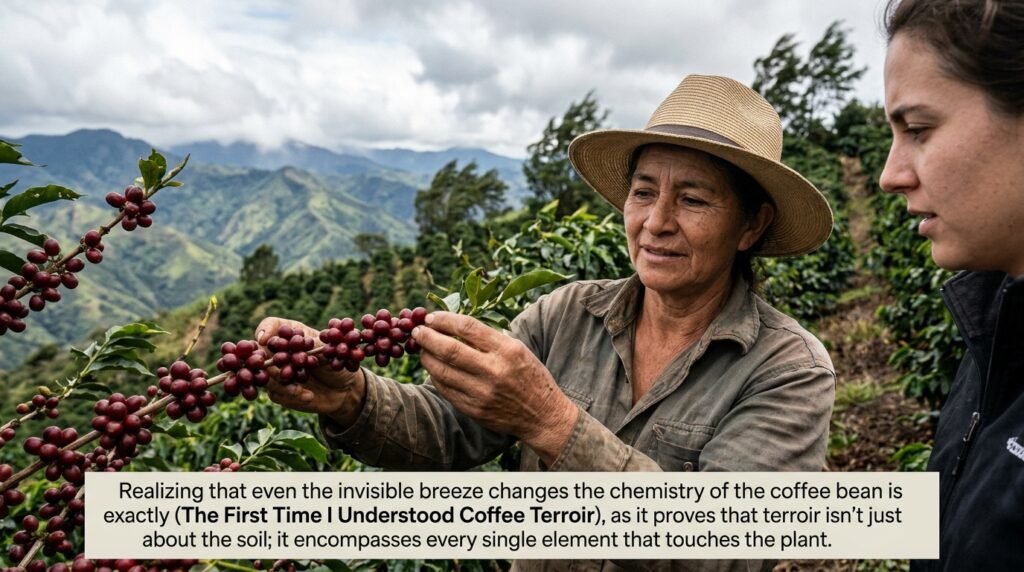
Realizing that even the invisible breeze changes the chemistry of the coffee bean is exactly (The First Time I Understood Coffee Terroir), as it proves that terroir isn’t just about the soil; it encompasses every single element that touches the plant.
A Shifting Reality
Learning about how intimately coffee is tied to the climate also brought a sobering realization to my morning routine.
Coffee is an incredibly fragile crop. Because it requires such highly specific microclimates—the perfect balance of cold nights, adequate rainfall, and diffused sunlight—it is highly vulnerable to global climate change.
As global temperatures slowly rise, the “sweet spot” for growing specialty coffee is being pushed higher and higher up the mountains. In some regions, the freezing nights that create those complex sugars are becoming warmer. In other regions, the predictable dry seasons required to naturally process the beans are being interrupted by unseasonal, heavy rains.
The pristine, high-altitude flavors that we take for granted today are becoming harder and harder for farmers to produce.
This reality completely changed how I value the coffee in my mug.
When I buy a beautiful, floral bag of Ethiopian Guji, I no longer complain about the twenty-five-dollar price tag. I realize that I am paying for an agricultural miracle that managed to survive the elements. I am paying for a farmer’s ability to navigate an increasingly unpredictable sky.
Tasting the Weather Report
My disastrous attempt at growing balcony tomatoes taught me a harsh lesson about agriculture, but it ultimately made me a much better coffee drinker.
I no longer view a bag of coffee as a static product. I view it as a liquid weather report.
When I wake up and brew a cup, I am actively trying to taste the climate.
If the coffee is bright, sharp, and intensely fruity, I can almost feel the freezing, high-altitude mountain air that forced the plant to build those sugars.
If the coffee is heavy, earthy, and deeply spicy, I can visualize the dense, humid jungle rain that forced the farmer to wet-hull the beans.
If the coffee is perfectly balanced, with a heavy chocolate body and a clean, sweet finish, I can see the thick morning fog rolling over the volcanic slopes, protecting the cherries from the harsh sun.
The next time you open a bag of specialty coffee, I challenge you to look beyond the brand name and the tasting notes. Look at the origin. Look at the altitude.
Close your eyes, take a sip, and try to imagine the sky above the farm.
When you learn to taste the climate, your morning coffee transforms from a simple caffeine fix into a profound connection with the earth. You will never look at a cloudy day, a cold night, or a cup of black coffee the exact same way again.

My name is Daniel Carter, I am 35 years old, and I live in the United States. I have been passionate about aquariums for many years, and what started as a simple hobby quickly became a lifelong interest in aquatic life, fish behavior, and responsible tank care.
Through TheBrightLance, I share real experiences, practical knowledge, and honest lessons learned from maintaining different types of aquariums. I enjoy testing equipment, studying fish behavior, improving maintenance routines, and helping beginners avoid common mistakes.
My goal is to make aquarism easier, more ethical, and more enjoyable for everyone — whether you are setting up your very first tank or looking to refine your techniques.