
For endless moments, I operated under a massive delusion about what the word “fresh” actually meant.
If you had asked me a few years ago if I drank fresh coffee, I would have confidently said yes. I would have proudly pointed to the heavy, vacuum-sealed foil brick of pre-ground coffee sitting on my pantry shelf.
I loved opening those bags. I loved the loud whoosh sound it made when you broke the seal and the air rushed in. In my mind, that sound was the ultimate guarantee of quality. I thought the factory had perfectly preserved the coffee, trapping the freshness inside until the exact moment I was ready to brew it.
I was so incredibly wrong.
I didn’t realize that the vacuum seal wasn’t trapping freshness; it was just embalming a product that had lost its vibrant life months ago. I was confusing an industrial packaging technique with actual agricultural vitality.
It wasn’t until I had my very first experience with truly freshly roasted coffee that the illusion completely shattered. That single morning changed everything for me. It rewired my senses, ruined supermarket coffee for me forever, and taught me that time is the single most important ingredient in a great cup of coffee.
Here is the honest story of my first encounter with real freshness, the science behind why it blew my mind, and why I will never go back to the foil bricks.
The Illusion of the Supermarket Aisle
Before I tell you about the awakening, you have to understand the baseline of mediocrity I was living in.
Every morning, I would scoop dark, dusty grounds out of a plastic tub or a foil bag. I would put them in a standard drip machine, press a button, and wait. The resulting liquid was always exactly the same: dark, heavy, slightly metallic, and aggressively bitter.
I drank it with a heavy pour of milk to mask the harshness. I thought coffee was just a bitter delivery vehicle for caffeine.
I didn’t know that coffee beans are packed with delicate, volatile aromatic compounds and trapped carbon dioxide. I didn’t know that from the moment the beans leave the roasting machine, oxygen begins to attack them, causing those beautiful flavors to evaporate into the air.
Most importantly, I didn’t know that supermarket coffee is often roasted months—sometimes over a year—before you actually buy it. By the time I was breaking that satisfying vacuum seal, the coffee was already a ghost.
Looking back at those years of drinking stale, flat liquid, I realize there is a massive gap in consumer education. Realizing how much I was missing is exactly (What I Wish I Knew When I Started Drinking Coffee), because I had spent a decade paying for a product that was essentially expired before I even brought it home.
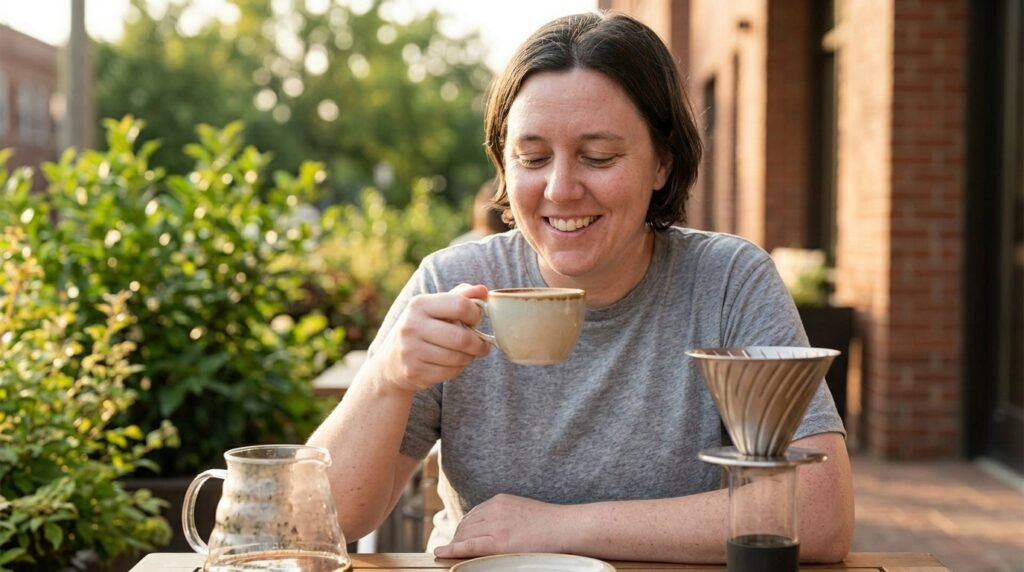
The Visit to the Local Roaster
My perspective shifted completely by accident. I had run out of my usual supermarket brand and decided to stop by a local specialty coffee shop on my way to work to buy a bag of whole beans.
When I walked into the shop, I noticed a massive, cast-iron roasting machine sitting behind the counter. The entire room smelled like caramelized sugar, toasted almonds, and something deeply sweet and fruity.
I walked up to the retail shelf and picked up a small, unassuming paper bag with a one-way valve on the front.
I instinctively looked for the “Best By” date. I couldn’t find one.
Instead, there was a small sticker on the back of the bag. It read: Roasted On: October 14th.
I checked my phone. It was October 16th.
I was holding a bag of coffee that had been raw, green agricultural seeds just forty-eight hours prior. It was so fresh that I could actually feel a slight puffiness to the bag, caused by the beans actively releasing their natural carbon dioxide.
I bought the bag, feeling a strange mix of excitement and skepticism. I also picked up a cheap, manual burr grinder, realizing that pre-ground coffee stales exponentially faster than whole beans. I wanted to do this right.
The Visual Revelation
The next morning, my alarm went off. Instead of my usual rushed, mindless routine, I felt a genuine sense of anticipation.
I walked into the kitchen and opened the bag of freshly roasted beans.
The first thing I noticed was the visual difference. The beans I was used to seeing were pitch black, shiny, and covered in a thick layer of oil. They looked like they had been cooked in a deep fryer.
These beans were completely different. They were a beautiful, warm, matte brown color. They looked like polished mahogany. There was absolutely no oil on the surface, which meant the roaster hadn’t burned the delicate cellular structure of the seed.
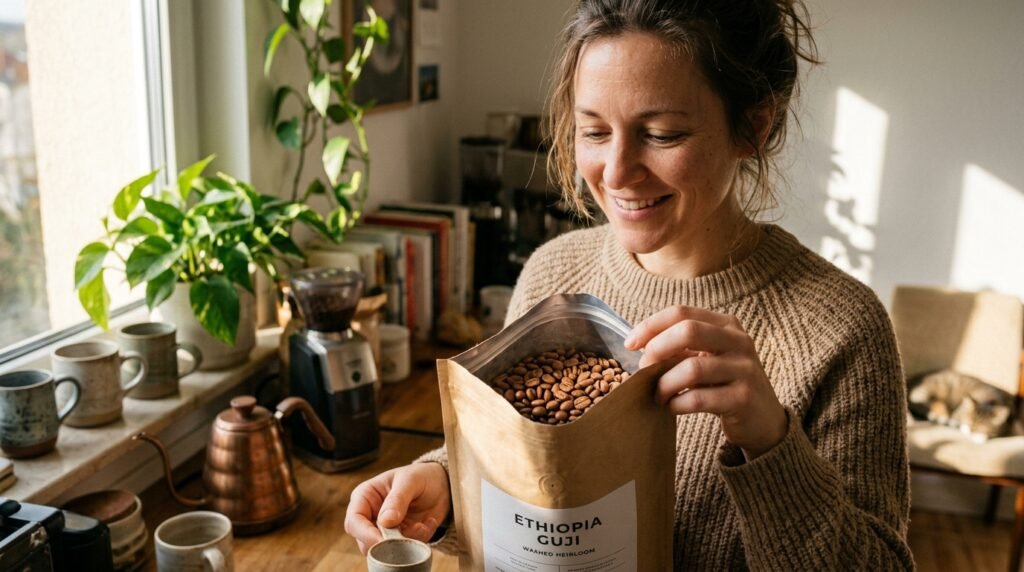
The label told me they were a washed Heirloom variety from the Guji region of Ethiopia. I didn’t know much about Ethiopian coffee at the time, but the visual purity of the beans alone told me this was going to be a completely different experience.
The Aromatic Explosion
I pulled out my digital kitchen scale, measured out exactly fifteen grams of the Ethiopian beans, and poured them into the top of my new manual hand grinder.
As I started turning the crank, the ceramic burrs began to crush the beans.
What happened next is a moment I will never forget.
The physical friction of breaking open those freshly roasted beans released a wave of aroma that violently filled my entire kitchen. It wasn’t a subtle smell. It was an explosion.
My kitchen didn’t smell like smoke or roasted wood. It smelled vividly and intensely like a blooming garden. The scent of jasmine flowers, ripe peaches, and sweet brown sugar hit my nose so powerfully that I actually stopped grinding just to close my eyes and take a deep breath.
It was intoxicating.
For my entire life, coffee had smelled like a waiting room or a cheap diner. This smelled like a high-end bakery and a fruit orchard combined. Recognizing the sheer power of this aromatic explosion was essentially (The Simple Trick That Made My Coffee Taste Better), because without those volatile, fresh compounds locked inside the bean, a great cup of coffee is biologically impossible.
I finished grinding the beans and transferred them to my simple V60 pour-over cone. The dry grounds smelled so good I almost didn’t want to pour water over them.
The Magic of the “Bloom”
I had a gooseneck kettle of water heated to exactly 205 degrees Fahrenheit (about 96 degrees Celsius).
I started a timer on my phone and slowly poured just enough hot water to saturate the dry grounds.
Suddenly, the coffee came alive.
The bed of coffee grounds rapidly swelled, bubbled, and expanded upward, almost doubling in size. It looked like a chocolate soufflé rising in an oven, or a miniature volcano erupting in my filter.
I stared at it in absolute fascination. I had never seen coffee behave this way.
I later learned that this physical reaction is called “The Bloom.” When coffee is freshly roasted, it is packed with carbon dioxide gas. When hot water hits the grounds, that gas is rapidly expelled, pushing the water away and causing the coffee to bubble and heave.
If coffee is stale—if it has been sitting on a supermarket shelf for six months—all of that gas has already evaporated. When you pour hot water over stale coffee, it just sits there, flat and lifeless, like wet sand.
Watching the bloom was a visual confirmation of freshness. I was interacting with a vibrant, active, living ingredient. The coffee was literally breathing.
After letting it bloom for forty-five seconds, I slowly poured the rest of the water in gentle circles, watching the beautiful, clear, ruby-red liquid drip into my glass carafe below.
The First Sip
I poured the brewed coffee into my favorite ceramic mug.
Habit almost made me reach for the refrigerator to grab the milk carton, but I stopped myself. I had to taste this pure. I had to know what a two-day-old roast actually tasted like.
I sat down at my kitchen table. The house was completely quiet. I blew on the hot liquid gently, letting it cool just enough so it wouldn’t burn my palate.
I took a slow, deliberate sip.
My brain struggled to comprehend the sensory input it was receiving.
There was absolutely no bitterness. There was no harsh, ashy scrape at the back of my throat. I didn’t wince.
Instead, the liquid was incredibly delicate, almost like a fine black tea. And the flavor was staggering. The aroma of peaches and jasmine that had filled my kitchen during the grind had somehow perfectly translated directly into the cup.
It was naturally, beautifully sweet. As the liquid washed over my tongue, I could taste the bright, juicy acidity of a ripe stone fruit. It finished clean, leaving a lingering, pleasant floral taste in my mouth.
I put the mug down and just stared at it.
I had never tasted anything like it. It was elegant. It was complex. It was an absolute culinary masterpiece, and I had brewed it myself in my own kitchen simply by ensuring the raw ingredient was fresh.
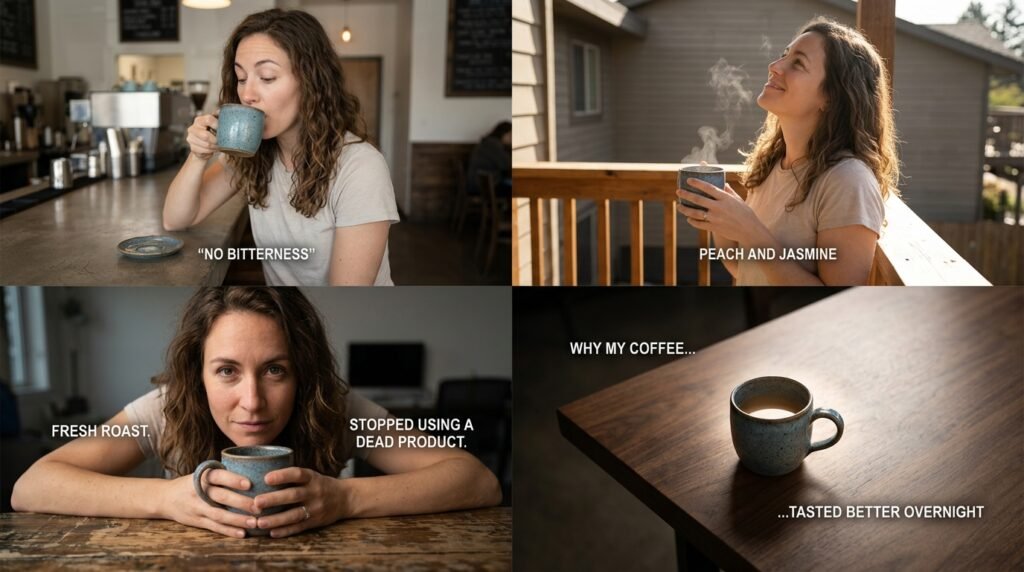
The complete elimination of bitterness and the sudden appearance of fruit notes was the exact reason (Why My Coffee Started Tasting Better Overnight). I hadn’t magically become a master barista in one day; I had simply stopped using a dead, oxidized product.
The Aftermath: Ruined for Life
I sat at my kitchen table and drank the entire cup black. I didn’t look at my phone. I didn’t check my emails. I just sat there and experienced the flavors as the coffee slowly cooled, noticing how the peach notes became even sweeter as the temperature dropped.
When I finished the mug, I stood up, walked over to my pantry, grabbed the vacuum-sealed foil brick of supermarket coffee, and threw it directly into the trash can.
There was no going back.
Once your palate experiences the clarity, the sweetness, and the vibrant, bubbling life of freshly roasted specialty coffee, the old stuff becomes completely undrinkable. You realize that you have been settling for a flat, lifeless imitation of what coffee is actually supposed to be.
That morning changed my entire perspective on my daily routine.
Coffee stopped being a chore. It stopped being a mindless caffeine delivery system. It became a ritual. It became a daily celebration of agriculture, chemistry, and timing.
Your Invitation to Freshness
If you are currently trapped in the cycle of buying massive tubs of coffee from the grocery store, I completely understand. The convenience is tempting, and the marketing is designed to make you feel like you are buying a quality product.
But I promise you, you are missing out on an entirely different world of flavor.
You don’t need expensive equipment to experience this. You don’t need a thousand-dollar espresso machine.
All you need to do is change your buying habits.
Find a local specialty coffee roaster in your area. Walk in and look for a bag of whole beans that has a “Roasted On” date from the last week. If you don’t have a local roaster, go online. There are hundreds of incredible specialty roasters who will roast your coffee on a Monday and ship it to your door by Wednesday.
Invest in a cheap, manual hand grinder so you can grind the beans exactly when you need them.
The first time you grind those fresh beans and the aroma of jasmine, chocolate, or berries hits your nose… the first time you pour the hot water and watch the coffee bloom and bubble… and the first time you take a sip of that sweet, complex, bitter-free liquid…
You will finally understand.
Your first experience with freshly roasted coffee will ruin the cheap stuff for you forever. And trust me, it is the most delicious mistake you will ever make.

My name is Daniel Carter, I am 35 years old, and I live in the United States. I have been passionate about aquariums for many years, and what started as a simple hobby quickly became a lifelong interest in aquatic life, fish behavior, and responsible tank care.
Through TheBrightLance, I share real experiences, practical knowledge, and honest lessons learned from maintaining different types of aquariums. I enjoy testing equipment, studying fish behavior, improving maintenance routines, and helping beginners avoid common mistakes.
My goal is to make aquarism easier, more ethical, and more enjoyable for everyone — whether you are setting up your very first tank or looking to refine your techniques.