
For many moons, my coffee-buying process was completely geographically blind.
If you had stopped me in the supermarket aisle ten years ago and asked me where my coffee came from, I probably would have looked at the bag, shrugged, and said, “The supermarket?”
I didn’t care about the origin. I thought coffee was a universal, standardized product, like sugar or flour. I assumed that a coffee bean grown in South America was biologically identical to a coffee bean grown in Africa or Asia.
I would look at the shiny foil bags on the shelf, and I would base my decision entirely on the marketing adjectives. If a bag said “Rich, Bold, and Dark,” I put it in my cart. If it said “100% Arabica Mountain Blend,” I assumed I was buying the absolute pinnacle of luxury.
I never stopped to ask which mountain. I never stopped to ask what type of Arabica.
I was completely ignoring the two most important factors that dictate how a cup of coffee will actually taste.
Today, if a bag of coffee does not tell me exactly what country, what region, and what specific type of plant it came from, I will not buy it. Period. It took a massive sensory awakening for me to realize that coffee is an agricultural product, and treating it like a generic factory commodity was ruining my mornings.
Here is the honest story of why I now pay attention to coffee origin and type, and how learning a little bit of geography completely transformed my daily ritual.
The Delusion of “100% Arabica”
To understand my shift in perspective, you have to understand the trap I was stuck in.
For years, I believed that the phrase “100% Arabica” printed on a bag was a guarantee of spectacular flavor. I thought it was the finish line of coffee quality.
Nobody told me that Arabica is just a massive, umbrella species of plant.
Saying a coffee is “100% Arabica” is like saying a bottle of wine is “100% Grapes.” Or saying a dog is “100% Canine.” It is technically true, but it tells you absolutely nothing about the specific characteristics, the flavor, the quality, or the history of the product inside.
There are thousands of different sub-varieties of the Arabica plant. Some of them have been genetically engineered to produce massive yields in flat, low-altitude farms, prioritizing profit over flavor. These beans often taste woody, flat, and earthy.
Other varieties are ancient, delicate, and highly susceptible to disease. They produce very few cherries, but the flavor inside those cherries is explosive, complex, and incredibly sweet.
By simply buying “Arabica” without looking at the specific type, I was playing a blind lottery. And most of the time, because I was buying cheap supermarket blends, I was losing.

The African Epiphany
The moment my geographical ignorance shattered happened in a small specialty coffee shop.
I had ordered a black pour-over, completely unaware of what I was about to drink. When the barista handed me the mug, I took a sip and physically froze.
The liquid didn’t taste like the heavy, bitter, burnt toast flavor I had associated with coffee my entire life. It tasted vibrant. It was incredibly sweet, with an acidity that reminded me of biting into a crisp peach. The finish was intensely floral, almost like a high-quality jasmine tea.
I went back to the counter, bewildered, and asked the barista what on earth he had just given me.
“It’s a washed Heirloom variety,” he said. “From the Guji region of Ethiopia.”
That sentence changed my life. I realized that the magic in my cup wasn’t because of a fancy brewing machine or a secret syrup. The magic was in the dirt. It was in the genetics.
Because Ethiopia is widely considered the birthplace of coffee, the plants there grow wild in dense, high-altitude forests. They aren’t generic farm hybrids; they are ancient “Heirloom” varieties that have naturally adapted to the environment over centuries.
That single cup taught me that a coffee’s origin is its identity. The realization of this concept was essentially (The First Time I Understood Coffee Terroir), proving to me that the soil, the climate, and the altitude directly dictate the flavor in the mug.
If I wanted to experience those incredible peach and jasmine notes again, I couldn’t just buy any bag of “Arabica.” I had to specifically seek out Ethiopian Guji. I had to pay attention to the map.
Why Origin Matters: The Concept of Terroir
Once I had my Ethiopian epiphany, I became obsessed with understanding the “why” behind coffee origins.
I started reading books, talking to local roasters, and doing side-by-side tastings in my own kitchen. I learned about a concept borrowed from the wine industry called terroir (pronounced ter-wahr).
Terroir encompasses all the environmental factors that affect a crop’s phenotype. It includes the mineral composition of the soil, the amount of annual rainfall, the angle of the sun hitting the mountainside, the ambient temperature, and the specific altitude.
Coffee is essentially a sponge for its environment.
A coffee tree growing in the volcanic, ash-rich soil of a high-altitude farm in Guatemala is going to absorb an entirely different set of nutrients than a coffee tree growing in the red, loamy, iron-rich dirt of Kenya.
Because of terroir, coffees from different origins have distinct, predictable flavor profiles.
When I buy a bag of coffee from Central America (like Costa Rica or Honduras), I know the terroir usually produces a very balanced, clean cup with notes of green apple, milk chocolate, and brown sugar.
When I buy a bag from Indonesia (like Sumatra), the humid climate and unique local processing methods create a heavy, syrupy body with earthy, spicy, and woody notes.
And when I buy my beloved East African coffees (like Ethiopia or Kenya), the extreme altitudes and ancient plant types produce wild, juicy, fruit-forward flavors like blueberry, tomato, and jasmine.
By paying attention to the origin printed on the label, I was no longer guessing. I was curating my morning experience based on the global map of flavor.
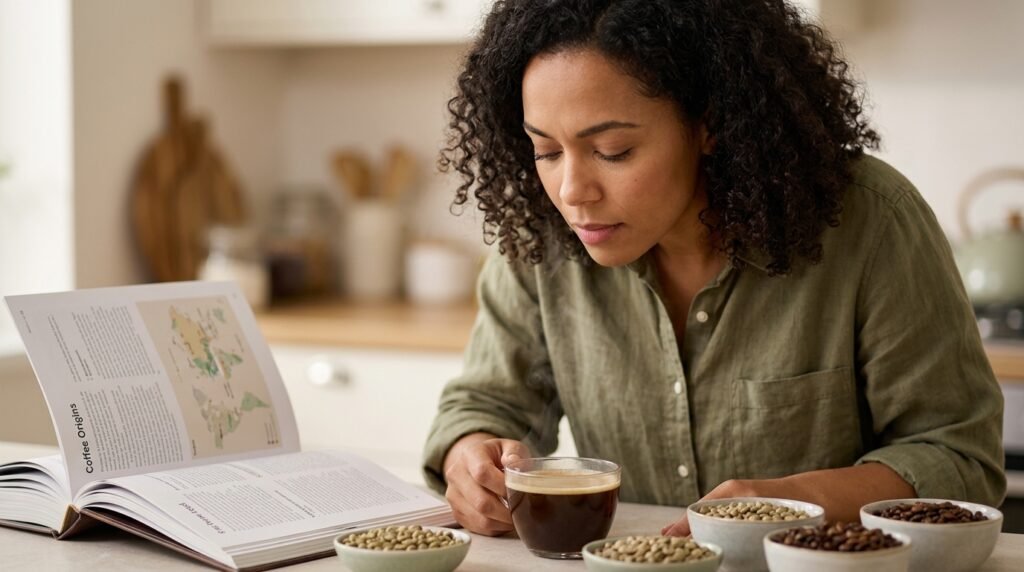
Why Type Matters: The Genetics of the Seed
Geography is only half of the equation. The other half is the specific botanical type (or varietal) of the coffee plant.
Even if you have the perfect terroir, the genetics of the seed will ultimately decide how the coffee tastes. This was a completely foreign concept to me until I started intentionally comparing bags from the same country.
I once bought two different bags of coffee from the exact same region in Colombia. They were grown at the same altitude, by farms just a few miles apart, and they were processed the exact same way.
But they tasted completely different.
One tasted like sweet caramel and toasted nuts. The other tasted remarkably floral and delicate, almost like an Ethiopian coffee.
I looked closer at the labels. The first bag was a “Caturra” varietal. The second bag was a “Gesha” varietal.
The environment was the same, but the plant genetics were different. Experiencing this firsthand and understanding (How Coffee From the Same Plant Can Taste So Different) made me realize that farmers are essentially artists, choosing specific plant varieties to paint different flavor profiles on the canvas of their land.
Gesha, for example, is a highly prized, delicate varietal originally from Ethiopia but famously grown in Panama and Colombia. It is known for its intense floral aromas. Bourbon is an older varietal known for its buttery, complex sweetness. Typica is known for a very clean, sweet cup.
When I now read a coffee label, seeing the varietal listed tells me two things. First, it gives me a massive clue about how the coffee will taste. Second, it proves that the roaster and the farmer care deeply about agricultural transparency. They aren’t hiding behind generic labels; they are proud of the specific botany they have cultivated.
The Problem with Commercial Blends
Once I understood the immense value of origin and type, I looked back at my old supermarket coffee habits with a sense of horror.
Mass-market commercial coffee companies despise the concept of terroir.
Their entire business model is based on absolute consistency. They want a bag of their coffee bought in New York to taste exactly the same as a bag bought in Los Angeles, 365 days a year.
But coffee is a seasonal agricultural product. A farm in Brazil might have a drought one year, drastically changing the flavor of its crop. How do massive companies maintain an identical flavor profile year after year?
They blend everything together, and they roast it incredibly dark.
They will buy massive shipping containers of cheap, low-grade beans from five different countries. They mix the African beans with the South American beans and the Asian beans. By throwing all these different origins into one massive vat, they completely cancel out any unique, beautiful terroir characteristics.
Then, they roast the beans until they are black and oily. The dark roast destroys whatever remaining origin flavors existed and replaces them with the flavor of burnt carbon.
When you buy a massive, generic tub of dark roast coffee, you are not tasting an origin. You are tasting a factory process.
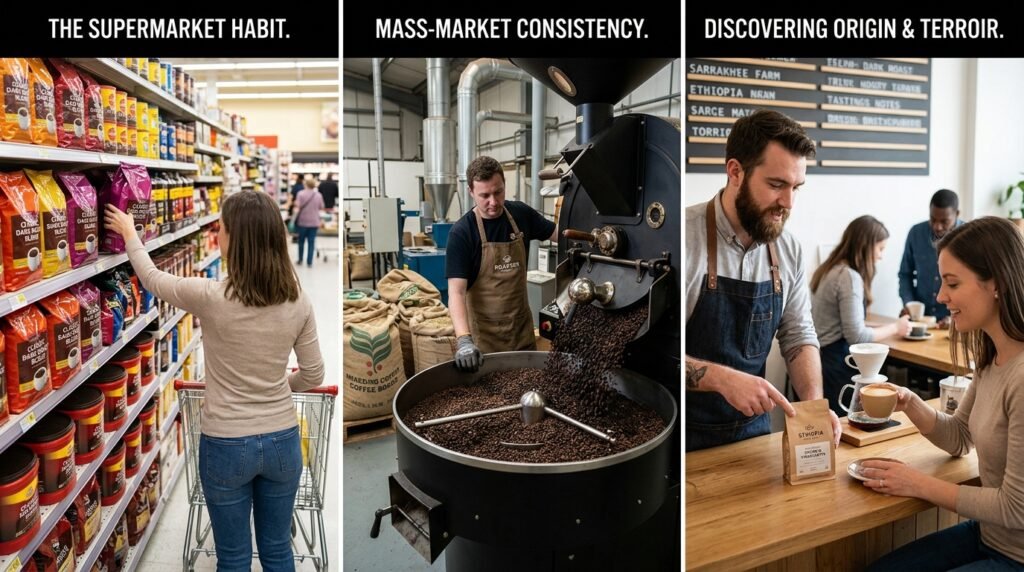
Building a World Map in My Kitchen
Today, my coffee shelf looks like a small United Nations of agriculture.
I intentionally buy single-origin coffees because I want to taste the specific, unadulterated flavor of a single farm. I want to honor the hard work of the farmer who cultivated that specific varietal on that specific mountainside.
I use origin and type to match my mood.
On a slow Sunday morning, when I have the time to sit and dissect every subtle flavor note, I will always reach for a light-roast, naturally processed Ethiopian Guji Heirloom. I want that complex, wild, fruity acidity.
But on a rainy Tuesday, when I am tired and just want a warm, comforting hug in a mug, I will look toward South America. This specific comfort is exactly (Why Brazilian Coffee Feels So Balanced to Me), as the classic Bourbon varietals from the Minas Gerais region consistently deliver heavy, rich notes of peanut butter, milk chocolate, and dense caramel.
I no longer view these coffees as competitors. I view them as different tools for different sensory experiences.
How to Start Exploring
If you are reading this and you currently buy your coffee based purely on the brand name or the roast level (Light, Medium, Dark), I highly encourage you to shift your focus to the map.
You don’t need a certified palate to start noticing the differences. You just need to pay attention.
The next time you need coffee, avoid the supermarket. Go to a local specialty coffee roaster. Look at their retail wall and buy two distinctly different single-origin bags.
Buy one bag from East Africa (Ethiopia, Kenya, Rwanda) and buy one bag from Central or South America (Guatemala, Colombia, Peru).
Make sure the bags list the specific region and the specific varietal.
Brew them side-by-side on a weekend morning. Don’t add any milk or sugar. Just let them cool slightly, take a sip of the African coffee, and then immediately take a sip of the American coffee.
The contrast will absolutely blow your mind. You will instantly feel the bright, tea-like fruitiness of the African bean clash beautifully against the heavy, chocolatey foundation of the American bean.
Once you experience that contrast, the illusion of “generic coffee” will be broken forever.
You will start chasing new countries. You will start hunting for new varietals. You will realize that coffee is an incredible, diverse agricultural journey. And just like me, you will never buy a bag of coffee without checking its origin and type ever again.

My name is Daniel Carter, I am 35 years old, and I live in the United States. I have been passionate about aquariums for many years, and what started as a simple hobby quickly became a lifelong interest in aquatic life, fish behavior, and responsible tank care.
Through TheBrightLance, I share real experiences, practical knowledge, and honest lessons learned from maintaining different types of aquariums. I enjoy testing equipment, studying fish behavior, improving maintenance routines, and helping beginners avoid common mistakes.
My goal is to make aquarism easier, more ethical, and more enjoyable for everyone — whether you are setting up your very first tank or looking to refine your techniques.