
For most of my life, I lived under a very comfortable, very false assumption about coffee.
I thought coffee beans were basically just tiny, brown, magical pebbles that factories produced in massive quantities. I never really thought about where they came from before they ended up in those vacuum-sealed foil bags at the grocery store.
If I pictured a coffee farm at all, I imagined fields of brown beans growing on stalks, like corn or wheat. I assumed the beans were harvested, put in a bag, and shipped directly to my kitchen.
I had absolutely no idea what I was drinking.
Nobody ever sat me down and explained the reality of the coffee industry. Nobody told me about the agriculture, the chemistry, or the incredible journey that happens before a single drop of liquid hits my mug.
It wasn’t until I started diving deep into the world of specialty coffee that the curtain was finally pulled back. And let me tell you, what I discovered completely blew my mind.
It changed the way I shop, the way I brew, and the way I taste my morning cup. Here is the honest truth, and everything that nobody ever told me about coffee beans.
Secret #1: It Is Not a Bean. It Is a Seed.
This is the fundamental truth that shatters everything else. The very word “bean” is a lie.
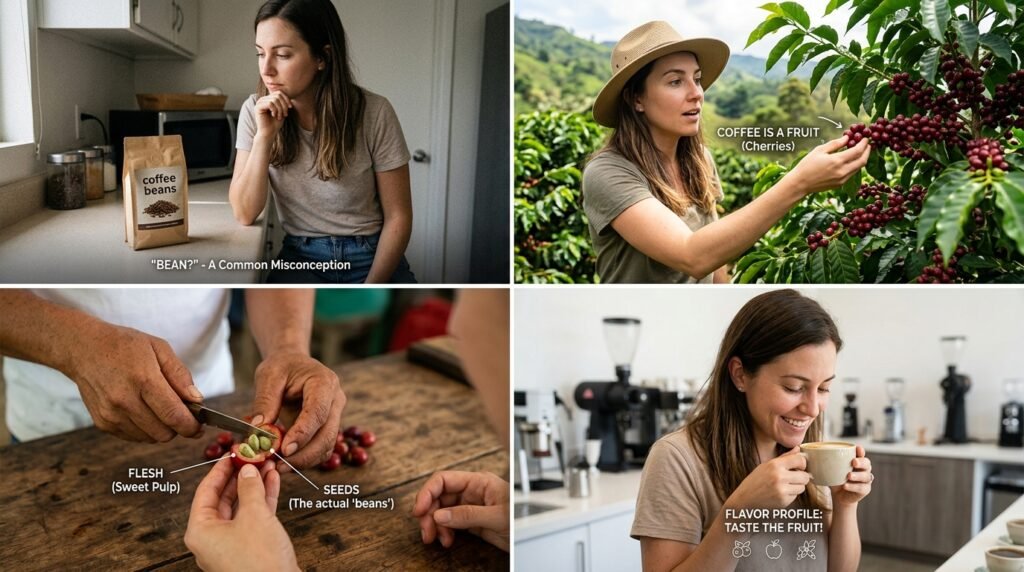
Coffee is not a legume. It is a fruit.
Specifically, the coffee plant is a beautiful, leafy shrub that produces small, round fruits that look remarkably like cherries. They start out green and hard, and as they ripen, they turn a deep, vibrant red (and sometimes yellow or orange, depending on the variety).
Inside the center of this sweet, fleshy fruit are two small seeds placed flat against each other.
Those seeds are what we mistakenly call “coffee beans.”
When I first learned this, I felt a little foolish. How had I gone decades drinking a beverage every single day without knowing what plant it came from? But realizing this simple botanical fact changes your entire perspective on flavor.
If you think of coffee as a dry bean, you expect it to taste dry, earthy, and nutty. But if you think of coffee as the seed of a sweet, tropical fruit, you suddenly understand why specialty coffee can taste so wildly different.
The seed absorbs the sugars and organic acids of the fruit as it grows. That is why a high-quality coffee doesn’t just taste like “coffee.” It can taste like ripe blueberries, crisp green apples, sweet strawberries, or delicate jasmine flowers.
When I stopped looking for the taste of roasted wood and started looking for the taste of the fruit, my whole world opened up. It was a slow process of sensory education, but learning (How I Started Recognizing Good Coffee Without Being an Expert) was mostly about unlearning the idea that coffee is just a bitter brown pebble.
Secret #2: Dark Roast is Usually a Disguise
Growing up, I was taught that “Dark Roast” and “French Roast” were the ultimate signs of strong, high-quality coffee.
The darker the bean, the stronger the caffeine, and the more sophisticated the drinker. Or at least, that is what the marketing departments of giant commercial coffee brands wanted me to believe.
Nobody told me what dark roasting actually does to a coffee bean.
Here is the harsh reality: commercial coffee companies buy massive quantities of low-grade commodity coffee. These batches are often filled with defective beans. They contain unripe seeds, seeds that have been eaten by insects, and seeds that have started to mold.
If they roasted these cheap beans lightly, you would be able to taste all of those terrible, sour, defective flavors.
So, what do they do? They roast them into oblivion.
They crank up the heat and cook the beans until they turn dark black and start sweating oil. When you burn something that heavily, you completely destroy its natural agricultural flavor. You burn away the fruit, the sweetness, and the acidity.
All you are left with is the taste of carbon, ash, and the roasting process itself.
It’s like taking a cheap, low-quality piece of meat and burning it to a crisp on a grill so you can’t tell how bad it is.
I was shocked when I discovered this. For years, I thought I loved the taste of “strong” coffee, when in reality, I just loved the taste of burnt agricultural runoff.
When you buy high-quality, specialty-grade coffee with zero defects, the roaster doesn’t want to hide the flavor. They want to highlight it. That is why the best coffees in the world are usually roasted light or medium. The roaster treats the bean with respect, applying just enough heat to caramelize the natural sugars without destroying the origin characteristics.
Secret #3: The Origin Changes Everything
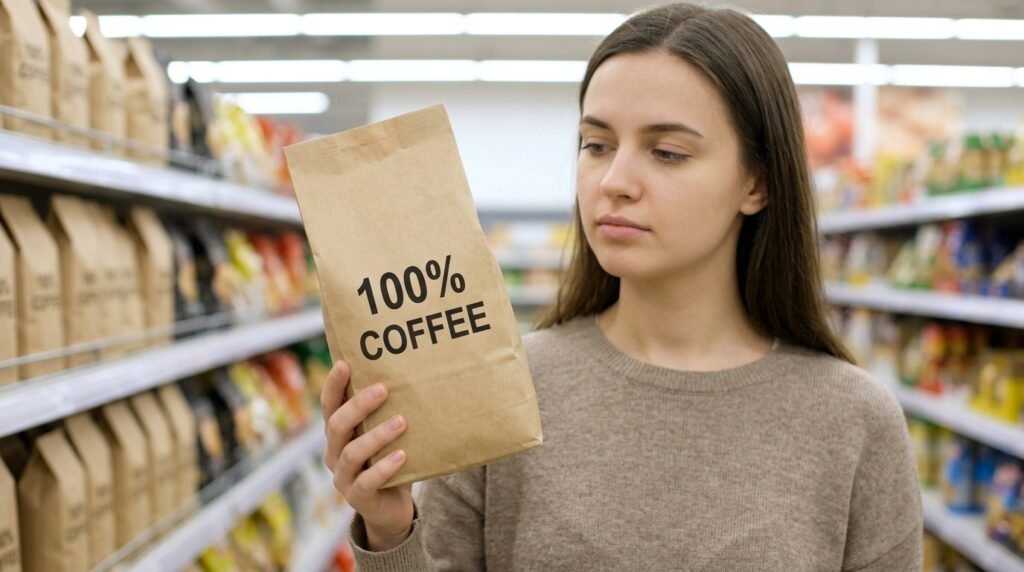
Because I didn’t know coffee was a fruit, I certainly didn’t know that where the fruit was grown mattered. I used to buy bags that just said “100% Coffee” on the front and assume that was enough information.
Nobody told me that coffee is just like wine. It is heavily influenced by terroir—the environment in which it is grown.
The volcanic soil of Central America, the high-altitude mountain air of East Africa, the monsoon seasons of Indonesia… all of these environmental factors physically alter the chemical makeup of the seed inside the coffee cherry.
I vividly remember the cup that changed my mind. It was (The First Time I Tried Ethiopian Coffee (And Loved It)), and it completely shattered my understanding of what a bean could taste like.
The barista had brewed me a cup using an Heirloom variety of beans from the Guji region of Ethiopia. Because Ethiopia is the birthplace of coffee, the plants there grow wild in dense, high-altitude forests. The bean I tasted hadn’t been genetically modified for high yields; it was a pure, ancient botanical variety.
That cup tasted like a vibrant, juicy blueberry pie mixed with a floral black tea. It was elegant. It was naturally sweet. It had absolutely zero bitterness.
I compared that memory to a bag of beans I later bought from Brazil, which tasted entirely different—heavy, comforting, like milk chocolate and peanut butter.
Both were coffee. Both were roasted perfectly. But their origins made them taste like two completely different beverages. If nobody tells you to look at the country, the region, and the altitude printed on the bag, you will miss out on the greatest joy of drinking coffee: traveling the world through your mug.
Secret #4: Beans Go Stale Faster Than You Think
Here is a secret that supermarkets desperately want to keep hidden: coffee is a fresh agricultural product, and it goes bad.
For years, I would buy a massive plastic tub of pre-ground coffee, open it, and leave it sitting in my pantry for two or three months. I never noticed a difference in flavor because, to be brutally honest, the coffee was dead long before I ever brought it home.
Nobody told me about the enemy of coffee: oxygen.
When a coffee bean is roasted, it is full of beautiful, volatile aromatic compounds and trapped carbon dioxide. These are the elements that give coffee its incredible smell and complex flavor.
But from the moment the bean leaves the roasting machine, it starts to lose those compounds.
When you buy whole beans from a local specialty roaster, you generally have a “magic window” of about 7 to 30 days after the roast date where the coffee tastes its absolute best. After a month, the flavors start to fall flat. The vibrant fruit notes fade away, leaving a dull, generic, woody taste.
But the real tragedy happens when you grind the coffee.
When you crush a coffee bean into hundreds of tiny particles, you expose a massive amount of surface area to oxygen. The staling process instantly accelerates from days to minutes.
Experts agree that once a coffee bean is ground, it loses nearly 70% of its unique aromatic flavors within 15 to 30 minutes.
Let that sink in.
The pre-ground coffee I was buying at the supermarket had been roasted months ago, ground in a massive factory, and sat in a warehouse before it ever reached the shelf. It wasn’t just stale; it was a ghost.
Looking back at my years of drinking bitter sludge, there is a lot (What I Wish I Knew When I Started Drinking Coffee), especially regarding how quickly beans lose their magic. Learning to buy whole beans and grinding them right before brewing was the single biggest upgrade I ever made to my morning routine.
Secret #5: It Is One of the Hardest Crops to Harvest
When you buy a bag of cheap coffee for $6, you never really think about the human labor involved. I certainly didn’t. I assumed machines just drove through flat fields and harvested the beans automatically.
Nobody told me how incredibly labor-intensive coffee farming actually is.
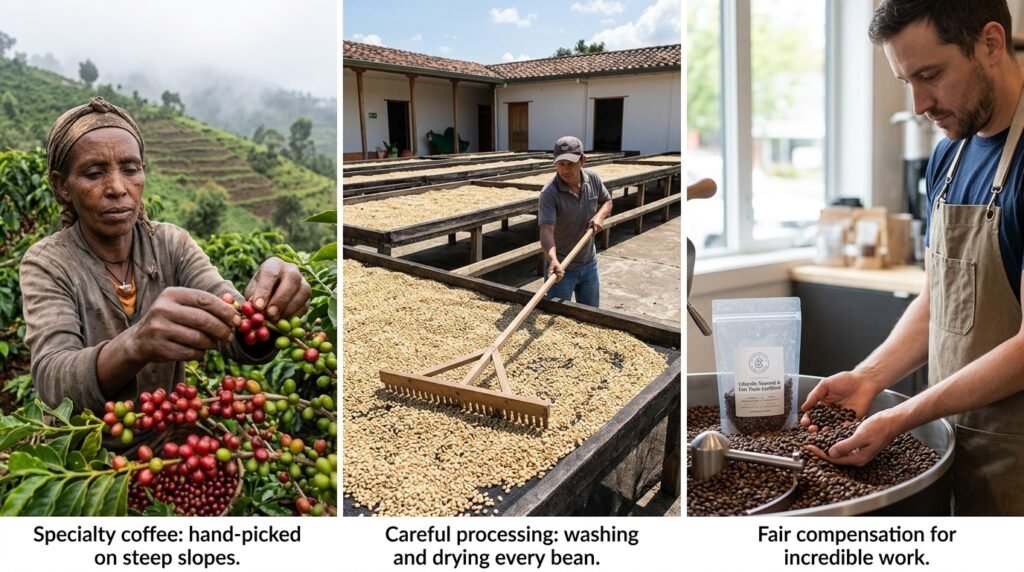
The best coffee in the world—Arabica coffee—is extremely fragile. It demands high altitudes, usually growing on steep, treacherous mountainsides where tractors and heavy machinery simply cannot go.
This means that almost all specialty coffee is harvested entirely by hand.
But it gets even more complicated. Unlike an apple tree where the whole crop might ripen at the same time, coffee cherries ripen at different rates on the exact same branch. You will have a bright red, perfectly sweet cherry sitting right next to a hard, green, bitter one.
If a farmer wants to produce specialty-grade coffee, they cannot just strip the branch. A human being has to walk up a steep mountain, inspect the trees, and meticulously pick only the perfectly red cherries, leaving the green ones to ripen for another week. They have to return to the same tree multiple times throughout the harvest season.
It takes roughly 2,000 coffee cherries—hand-picked by a human being—to produce just one single pound of roasted coffee.
When I finally learned this, I felt a deep sense of guilt for all the times I complained about a bag of specialty coffee costing $20.
In reality, when you consider the hand-picking, the washing, the fermenting, the drying on raised beds, the oceanic shipping, and the meticulous roasting… $20 is a miracle. It is arguably underpriced for the amount of physical human effort contained inside the bag.
Understanding this completely shifted my mindset. I stopped looking for the cheapest coffee I could find and started looking for roasters who practice ethical, transparent sourcing. I want to know that the farmer who climbed that mountain was paid a fair, living wage for their incredible work.
Secret #6: The Packaging Lies (Most of the Time)
The final thing nobody told me about coffee beans is that the coffee industry is largely unregulated when it comes to marketing buzzwords.
I used to walk down the aisle and see bags proudly proclaiming things like “Premium Blend,” “Gourmet Roasted,” or “100% Pure Mountain Coffee.” I thought these labels actually meant something. I thought there was a board of directors ensuring that only the finest beans got the “Gourmet” stamp.
There isn’t. Those words are legally meaningless.
Any commercial roaster can sweep the lowest-grade, defective beans off a warehouse floor, roast them black, throw them in a shiny bag, and print “Premium Gourmet” in gold letters on the front.
If you truly want to find good coffee beans, you have to ignore the marketing adjectives and look for the hard facts.
A high-quality bag of coffee won’t yell at you about being “Premium.” Instead, it will quietly give you the data. It will list the specific country and region (not just “South America”). It will list the altitude the beans were grown at. It will list the processing method (Washed, Natural, Honey). Most importantly, it will have a “Roasted On” date stamped clearly on the bag, rather than an arbitrary “Best By” date that is set for a year in the future.
The Awakening in the Cup
It has been years since I finally learned the truth about coffee beans, and the journey has been nothing short of spectacular.
I no longer wake up and mindlessly push a button on a plastic machine. I wake up, select a bag of fresh beans, and appreciate the fact that I am about to brew the seed of a high-altitude tropical fruit.
I weigh my beans, I grind them fresh, and I smell the incredible aromas that have been locked inside since the roasting process.
Every cup is a small miracle of agriculture and human effort.
It is a shame that so many of us go through life thinking that coffee is just a bitter, generic powder designed to keep us awake at our desks. There is an entire world of flavor, history, and science hidden inside that tiny seed.
If nobody has ever told you these secrets before, I hope reading this has sparked a little bit of curiosity.
The next time you make a cup, take a second to look at the beans. Think about the mountain they grew on. Think about the hands that picked them. Treat the coffee with the respect it deserves, and I promise you, the flavors you discover will change your mornings forever.

My name is Daniel Carter, I am 35 years old, and I live in the United States. I have been passionate about aquariums for many years, and what started as a simple hobby quickly became a lifelong interest in aquatic life, fish behavior, and responsible tank care.
Through TheBrightLance, I share real experiences, practical knowledge, and honest lessons learned from maintaining different types of aquariums. I enjoy testing equipment, studying fish behavior, improving maintenance routines, and helping beginners avoid common mistakes.
My goal is to make aquarism easier, more ethical, and more enjoyable for everyone — whether you are setting up your very first tank or looking to refine your techniques.