
There is a moment that every specialty coffee drinker eventually faces. It usually happens when you are visiting a relative, staying at a budget hotel, or eating at a late-night diner.
You are offered a cup of “regular” coffee.
You smile politely, accept the thick ceramic mug, and take a sip. And immediately, your brain sends a warning signal to your body.
What is this?
This happened to me recently at a family gathering. I took a sip of the dark, pre-ground coffee brewing in the corner of the kitchen. It was the exact same brand of coffee I used to drink religiously every single morning for over a decade. I used to love it.
But now? It tasted like burnt tires, old wood, and harsh chemicals. I actually had to force myself to swallow it.
I looked down at the black liquid in my mug and realized something profound. The coffee hadn’t changed. The company was still roasting it exactly the same way they had been since the 1990s.
The coffee hadn’t changed at all. I had changed.
My tastebuds had been completely rewired. Switching to high-quality, freshly roasted beans didn’t just upgrade my morning routine; it fundamentally altered my palate, my sensory perception, and my relationship with flavor.
Here is the honest, step-by-step story of how my taste changed after drinking better coffee, and why my palate can never go back to the way it was before.
Phase 1: The Sugar Dependency
To understand how much my taste has changed, you have to understand where I started.
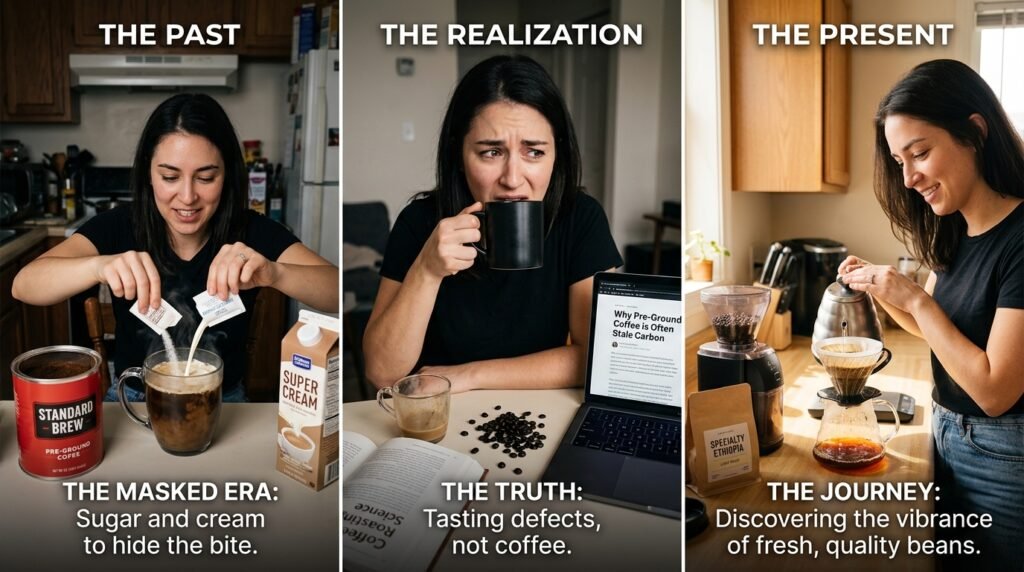
For years, my definition of a “good” cup of coffee was essentially a warm coffee-flavored milkshake. If I am being completely honest with myself, I didn’t actually like the taste of coffee. I liked the taste of sugar, cream, and vanilla syrup, with a slight background bitterness of caffeine.
If I accidentally took a sip of my coffee before adding my usual three packets of sugar and heavy splash of milk, I would physically wince. It was aggressive. It was harsh.
I assumed that this harshness was just the natural flavor of coffee. I thought coffee was supposed to be intensely bitter.
But as I started researching specialty coffee, I learned a hard truth. I was using sugar and milk to mask defects.
Commercial, commodity-grade coffee is often roasted incredibly dark to hide the fact that the beans are old, stale, or of poor quality. When you roast a bean until it is oily and black, you destroy its natural agricultural flavors and replace them with the flavor of the roasting process itself—which is carbon and ash.
Realizing that the stale, pre-packaged grounds were the source of this terrible bitterness was exactly Why I Gave Up Pre-Ground Coffee entirely. I realized I wasn’t fighting the natural taste of the bean; I was fighting the taste of stale carbon.
Phase 2: Weaning Off the Sweetness
When I bought my first bag of freshly roasted, light-medium specialty beans, I knew I had to make a change.
If I spent $22 on a beautiful bag of single-origin coffee, drowning it in milk and artificial sweeteners felt like a crime. I wanted to taste what I was paying for.
So, I made a deal with myself. I would slowly wean myself off the sugar.
The first week, I dropped from three packets to two. The coffee tasted less like a dessert and more like a beverage, but it was still comforting.
The second week, I dropped to one packet of sugar and switched from heavy cream to a tiny splash of whole milk. This was harder. The bitterness was more pronounced, but something strange started happening. Because the sugar wasn’t overwhelming my tongue, I started noticing other things. I noticed a slight nuttiness. I noticed a hint of chocolate.
By the third week, I eliminated the sugar entirely. It was just coffee and a drop of milk.
And then came the final step. The black cup.
Phase 3: The Ethiopian Epiphany
The first time I drank a specialty coffee completely black, without a single drop of milk or crystal of sugar to hide behind, it was a revelation.
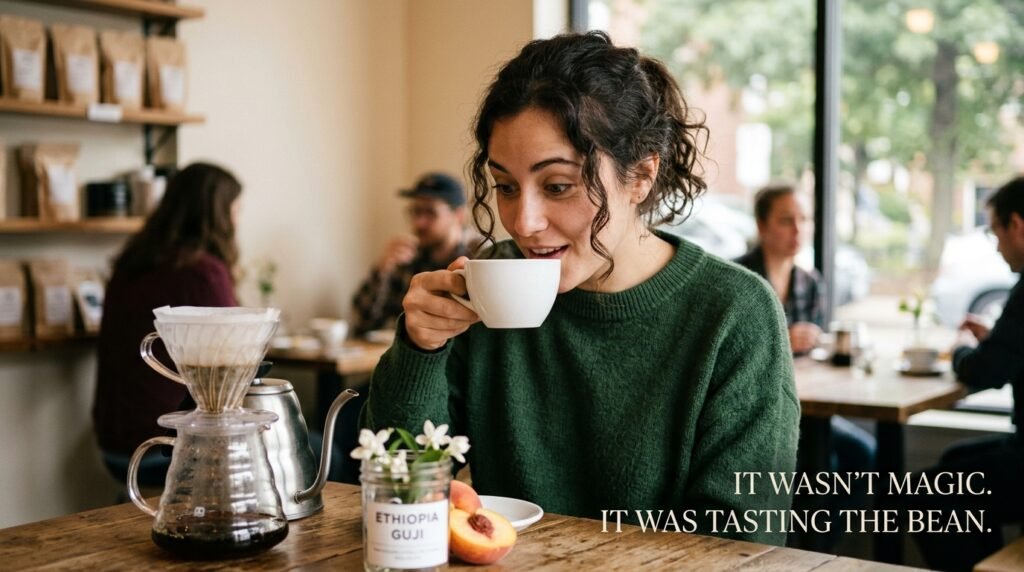
I remember the exact cup that broke my sugar habit permanently. It was a washed Heirloom variety from the Guji region of Ethiopia.
I carefully brewed it using a V60 pour-over, letting it cool for just a minute before taking my first sip.
My brain braced itself for the harsh, battery-acid bitterness I had grown up with. But it never came.
Instead, the liquid was delicate. It was incredibly smooth. And most shockingly of all, it was naturally sweet. It didn’t taste like white processed sugar, but it had the distinct, vibrant sweetness of fresh fruit.
As the coffee washed over my palate, I could vividly taste notes of jasmine flowers, ripe peaches, and a clean, black-tea-like finish.
I was stunned. How could a black cup of coffee taste like flowers and fruit?
This was the exact moment my palate broke wide open. I realized that coffee is the seed of a cherry. It is agricultural. When grown at high altitudes, harvested at peak ripeness, and roasted carefully by an expert, it contains over 1,000 distinct flavor compounds—more than double the complexity of a fine wine.
I remember looking at my cup and realizing exactly Why My Coffee Started Tasting Better Overnight. It wasn’t magic. It was simply the first time in my life I was actually tasting the bean, rather than tasting the roast or the additives.
Phase 4: Redefining “Acidity”
As my palate continued to develop, I had to unlearn a lot of coffee vocabulary. The biggest hurdle was the word “acidity.”
In the world of cheap, commercial coffee, acidity is a bad word. It usually means the coffee is sour, harsh, and going to give you heartburn. When I heard a coffee described as “acidic,” I ran the other way.
But as I drank more specialty coffee, my tongue learned the difference between sourness and vibrancy.
In the specialty coffee world, acidity is highly prized. It doesn’t mean sour. It means bright, crisp, and alive.
Think about biting into a fresh, crisp, green apple. That sharp, mouth-watering snap that makes the flavor pop? That is good acidity. Now think about drinking milk that has been left on the counter for three days. That is bad acidity (sourness).
Once my tastebuds adapted, I started craving that bright, fruity acidity. I found myself gravitating towards lighter roasts from African countries like Kenya and Ethiopia, specifically because of their vibrant, juicy profiles.
My palate had shifted from wanting heavy, dark, comforting flavors to wanting complex, bright, and challenging flavors.
Phase 5: Becoming Hyper-Sensitive
About six months into my specialty coffee journey, I noticed a side effect I hadn’t anticipated.
My palate hadn’t just changed for coffee; it had changed for everything.
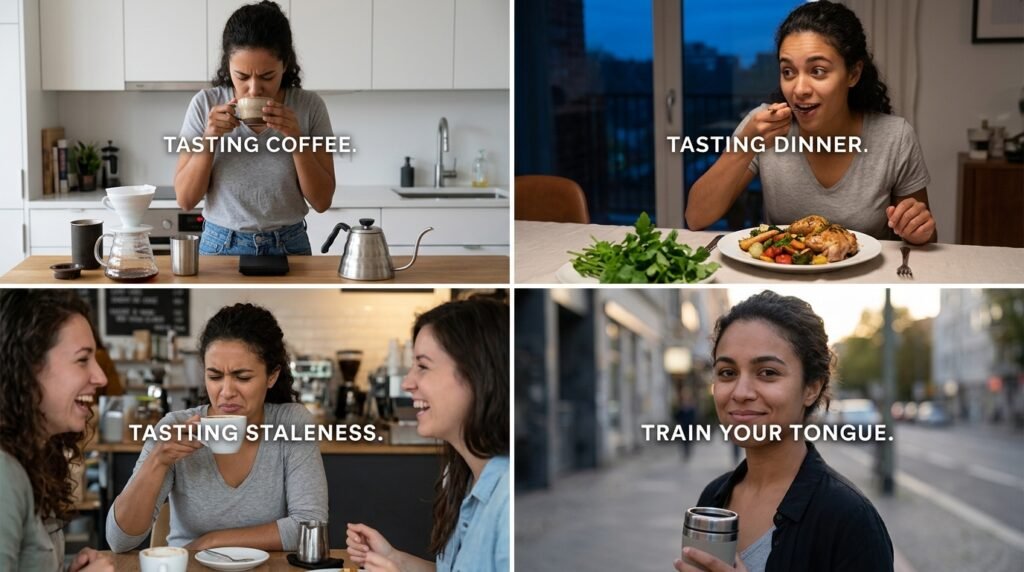
Because I was spending ten minutes every morning actively trying to identify subtle flavor notes in my mug—asking myself, Is this blueberry or blackberry? Is this almond or pecan?—my brain was getting a daily workout in sensory analysis.
I started noticing the nuanced flavors in dark chocolate. I started picking up on the subtle herbs in my dinners. I found that heavily processed, artificially sweetened foods suddenly tasted cloying and fake to me.
This realization that What Drinking Better Coffee Taught Me About Flavor extended far beyond my morning routine was mind-blowing. By training my tongue to find the delicate jasmine notes in a Guji pour-over, I had accidentally trained my tongue to appreciate the complexity of all food and drink.
But with this hyper-sensitivity came a downside.
I became acutely aware of staleness.
If a café served me a coffee that had been roasted two months ago, I could instantly taste the flat, cardboard-like staleness. If a restaurant served me coffee that had been sitting on a burner for an hour, the oxidized, metallic taste made it undrinkable for me.
My tolerance for bad coffee dropped to zero.
The Social Dilemma of the “New Palate”
This brings me back to the family gathering and the cup of burnt tire coffee I mentioned at the beginning.
When your taste changes this drastically, it can create some awkward social situations. You never want to be the “coffee snob” who turns their nose up at hospitality.
When someone kindly offers me a cup of pre-ground commercial coffee at their house, I am faced with a choice. Do I explain that my palate has been ruined by high-altitude Ethiopian beans and politely decline? Or do I drink it and suffer in silence?
Usually, I take a compromise route. I accept the cup, but I ask for a lot of milk. I revert back to Phase 1. I use the dairy to mask the bitter, ashy flavors of the commodity bean, just like I used to do years ago.
It is a humbling reminder of where I started. It reminds me that flavor is subjective, and for many people, that dark, bitter cup is a symbol of comfort and home.
But secretly, in my head, I am counting down the hours until I can get back to my own kitchen, fire up my gooseneck kettle, and brew something spectacular.
The Final Verdict: Was the Switch Worth It?
Sometimes, I joke that switching to specialty coffee was the worst thing I ever did, simply because it ruined 90% of the coffee in the world for me.
I can no longer grab a $1 cup from a gas station on a road trip and enjoy it. I can no longer tolerate the free coffee in corporate breakrooms. Ignorance was, in many ways, much cheaper and much more convenient.
But when I sit down at my kitchen table on a quiet Saturday morning… When I grind a fresh batch of light-roast beans and the aroma of brown sugar and berries fills the room… When I take that first sip and experience a flawless balance of natural sweetness, vibrant acidity, and complex floral notes…
I know it was worth it.
My taste changed because my standards changed. I stopped accepting a burnt, mass-produced commodity as the default, and started treating coffee as the incredible, diverse, and fragile agricultural product that it is.
You can only drink the dark, bitter sludge for so long before you realize that coffee has a voice. And once you learn how to listen to it, your tastebuds will never, ever go back to the way they were before.
If you are currently on the fence about trying specialty coffee, consider this a fair warning: it will change your palate forever.
But it is a beautiful, delicious point of no return.
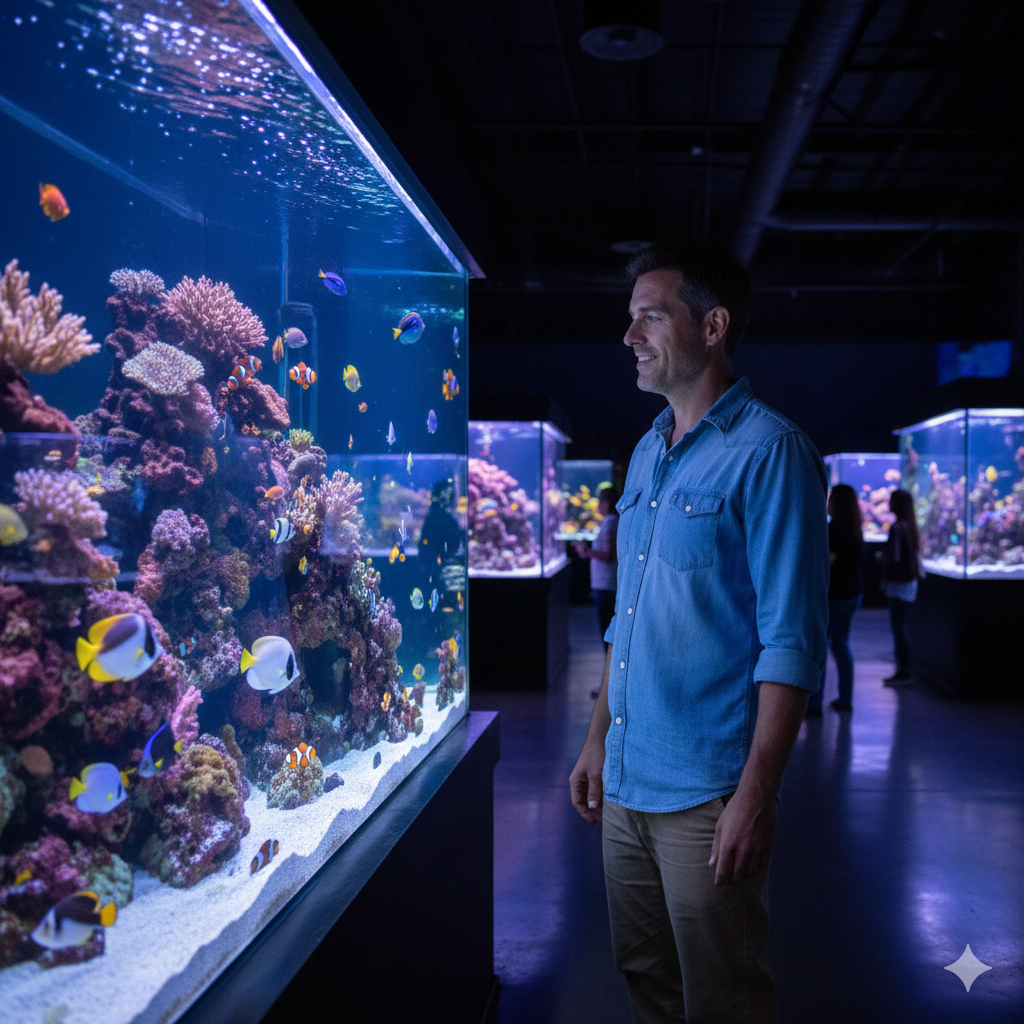
My name is Daniel Carter, I am 35 years old, and I live in the United States. I have been passionate about aquariums for many years, and what started as a simple hobby quickly became a lifelong interest in aquatic life, fish behavior, and responsible tank care.
Through TheBrightLance, I share real experiences, practical knowledge, and honest lessons learned from maintaining different types of aquariums. I enjoy testing equipment, studying fish behavior, improving maintenance routines, and helping beginners avoid common mistakes.
My goal is to make aquarism easier, more ethical, and more enjoyable for everyone — whether you are setting up your very first tank or looking to refine your techniques.