
If you had asked me five years ago what kind of coffee I liked, I would have looked at you with a blank stare.
My answer probably would have been something along the lines of, “Hot. And preferably in a very large mug.”
For the vast majority of my adult life, coffee was an entirely functional beverage. It was a tool. It was the dark, bitter liquid I needed to consume in order to transform from a grumpy zombie into a semi-functioning member of society. I didn’t care about the origin, I didn’t care about the roast profile, and I certainly didn’t care about the tasting notes.
I just cared about the caffeine.
I would walk down the supermarket aisle, grab whatever pre-ground dark roast was on sale, and throw it in my grocery cart. Every morning, I would scoop it into a drip machine, hit a button, and doctor the resulting harsh liquid with enough milk and sugar to mask the taste of ash.
I thought I liked coffee. But the truth was, I only liked what coffee did for me.
Switching to specialty coffee wasn’t something that happened overnight. It wasn’t a sudden flip of a switch. It was a slow, sometimes confusing, and incredibly eye-opening journey that completely changed my mornings forever.
Here is my honest experience of how I went from drinking stale supermarket dust to obsessing over roast dates and pour-over techniques.
The Wake-Up Call That Changed Everything
Every coffee enthusiast has an origin story. A specific moment where the illusion of bad coffee was shattered.
Mine happened entirely by accident.
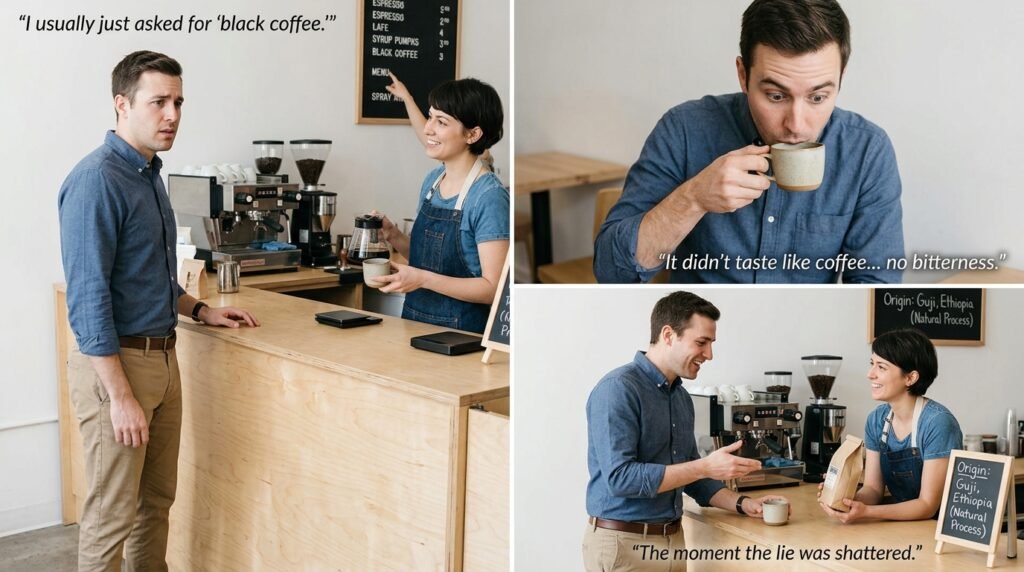
I was traveling for work and had a morning meeting at a local café. I didn’t choose the place; my client did. When I walked in, I immediately knew this wasn’t my usual spot. There were no giant syrup pumps on the counter. There were no frozen blended drinks on the menu.
Instead, there was a sleek counter, a minimalist menu, and a barista who was meticulously weighing coffee beans on a small digital scale.
I felt completely out of my depth. When it was my turn to order, I panicked and just asked for a black coffee.
The barista asked if I wanted the batch brew or a pour-over. I just nodded and said, “Whatever is fastest.” He handed me a glass carafe and a small ceramic mug.
I sat down, poured the coffee, and took a sip without thinking.
I stopped dead in my tracks. It didn’t taste like coffee. At least, not the coffee I was used to. There was absolutely no bitterness. It didn’t burn the back of my throat. It was incredibly smooth, almost tea-like in its texture.
But the most shocking part was the flavor. It was bursting with sweetness. I could vividly taste ripe blueberries, a hint of peach, and a floral aroma that reminded me of jasmine. I actually looked into the cup to see if someone had accidentally dropped a piece of fruit into it.
I went back to the counter and asked the barista what I was drinking. He smiled, clearly used to this reaction, and told me it was a naturally processed Heirloom variety from the Guji region of Ethiopia.
That single cup broke my brain. Realizing that a coffee bean could naturally produce those flavors was exactly What Nobody Told Me About Coffee Beans. I realized that the bitter, black sludge I had been drinking my entire life was a lie.
Falling Down the Rabbit Hole
When I got home from that trip, my usual supermarket coffee tasted like burnt cardboard. Once you experience the vibrant clarity of a freshly roasted specialty bean, your palate simply refuses to go backward.
I decided I needed to learn how to make that magical Ethiopian coffee at home.
I started researching. I quickly learned that “specialty coffee” isn’t just a marketing buzzword used to charge more money. It is an actual, rigorously graded agricultural standard.
I discovered the Specialty Coffee Association (SCA), an organization that grades coffee on a 100-point scale. To be officially classified as “specialty,” a coffee must score 80 points or above. This means the coffee has almost zero physical defects and exhibits distinct, complex flavors in the cup.
Less than 10% of all the coffee grown in the world meets this standard.
The stuff I used to buy at the supermarket? That was commodity coffee. It usually scores somewhere in the 60s or 70s. It’s grown for maximum yield, stripped of its unique characteristics, and roasted exceptionally dark to hide the fact that the beans are often defective, old, or moldy.
Learning this made me feel a mix of betrayal and excitement. I was excited because an entire world of flavor had just opened up to me. But I was also intimidated. The specialty coffee world is full of jargon: extraction yields, bloom times, bypass ratios, and burr alignments.
It felt like I needed a degree in chemistry just to brew my breakfast.
The Awkward Transition Phase (And the Mistakes I Made)
My first attempt at brewing specialty coffee at home was a complete disaster.
I went to a local roaster, bought a $22 bag of single-origin beans, brought them home, and threw them into a cheap blade grinder that I usually used for spices. I then dumped the wildly uneven grounds into my old automatic drip machine.
The result was terrible. It tasted sour, thin, and strangely salty.
I was frustrated. I thought I had wasted my money. But then I realized that buying specialty beans and treating them like commodity beans is like buying a Ferrari and putting lawnmower gas in it. The raw ingredient was incredible, but my execution was ruining it.
I had to upgrade my process.
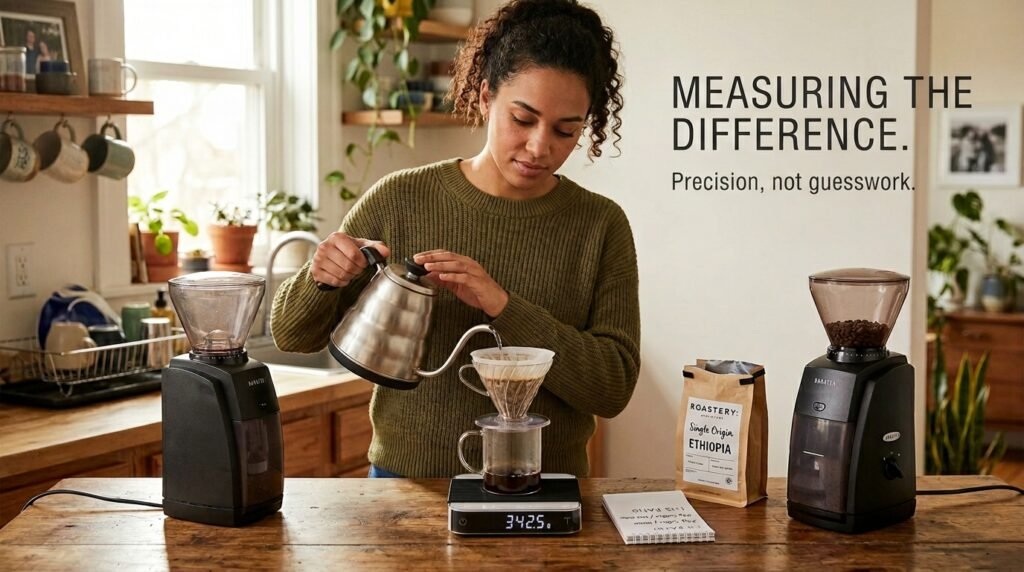
The first real investment I made wasn’t an expensive brewer; it was a good quality burr grinder. Blade grinders chop the beans randomly, leaving you with boulders and dust. Burr grinders crush the beans uniformly, which is essential for an even extraction.
Then, I bought a cheap digital kitchen scale. This was the biggest game-changer. I stopped scooping blindly and started actually measuring my coffee and my water. Finding The Simple Trick That Made My Coffee Taste Better usually comes down to basic math. By using a 1:15 ratio (15 grams of water for every 1 gram of coffee), I finally took the guesswork out of my mornings.
There was a learning curve. I made plenty of bad cups. I poured water too fast, I ground the beans too fine, and I used water that was too hot.
But unlike my old routine, where every cup was consistently bad, these new mistakes were educational. I was learning how to manipulate flavor.
The Physical Changes I Didn’t Expect
One of the most surprising parts of my experience switching to specialty coffee was how my body reacted to it.
When I drank cheap, dark-roast commodity coffee, I always felt a specific way. My stomach would often feel acidic or upset by mid-morning. I would get a massive, jittery spike of energy, followed by a crushing crash around 2:00 PM that left me practically crawling to the office coffee pot for a refill.
I thought that was just the reality of consuming caffeine.
But when I switched to specialty coffee, those symptoms vanished.
Because specialty coffee is typically roasted much lighter (to preserve the natural flavor of the bean rather than masking it), it tends to be much gentler on the stomach. The high-quality, defect-free beans simply digested better.
Furthermore, I stopped experiencing the violent caffeine crashes. I’m not a scientist, but I suspect it was because I stopped drowning my coffee in processed sugar and heavy cream just to make it drinkable. I was drinking my coffee black, savoring the natural sweetness of the beans.
It felt like a cleaner, more sustainable energy. I was drinking less coffee overall, but enjoying it infinitely more.
The Elephant in the Room: The Cost
Whenever I tell friends about my specialty coffee habit, the first question they ask is always about the price.
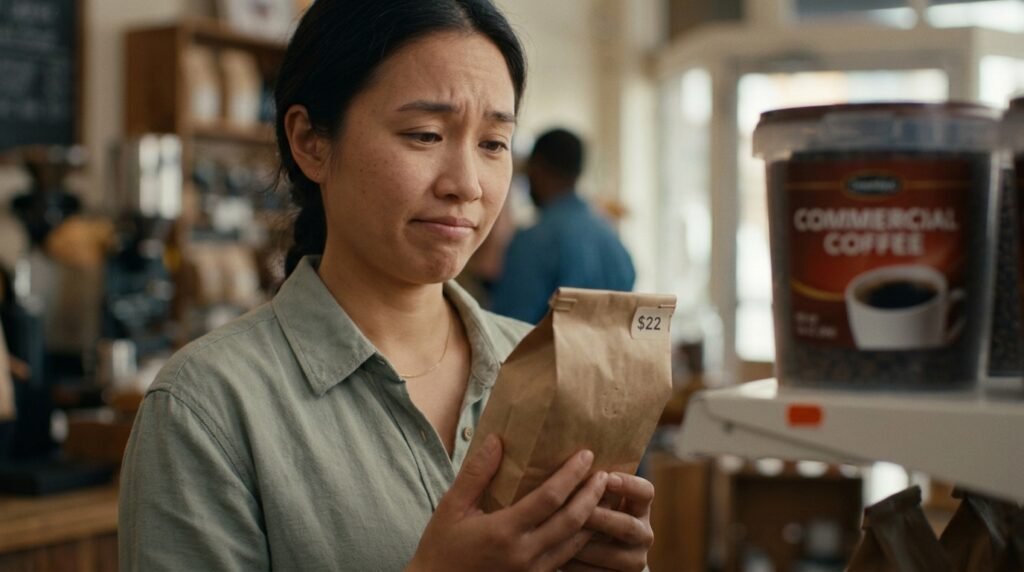
“Isn’t it ridiculously expensive to spend $20 or $25 on a bag of coffee?”
It is a fair question. When you are used to spending $8 on a massive tub of coffee that lasts a month, dropping $20 on a 12-ounce bag feels like financial sabotage.
But I had to reframe how I thought about the cost.
First, I looked at the cost per cup. A standard 12-ounce (340-gram) bag of specialty coffee yields about 18 to 20 generous cups of coffee. That brings the cost to roughly $1.10 to $1.30 per cup.
Compare that to going to a commercial drive-thru chain and spending $5 or $6 on a burnt latte. By making world-class coffee in my own kitchen, I was actually saving money compared to buying drinks out.
Second, I started viewing coffee not as a bulk grocery item, but as an artisanal experience. You wouldn’t expect a bottle of fine wine to cost the same as a box of mass-produced grape juice.
When you buy specialty coffee, you are paying for ethical sourcing. You are paying a premium that goes back to the farmers who meticulously hand-picked only the ripe cherries. You are paying for the skill of a roaster who carefully developed the flavor profile.
Once I understood the immense labor that went into that bag, $20 actually felt like a bargain.
A Journey Worth Taking
Looking back on my transition, the biggest change hasn’t been the equipment on my kitchen counter or the dent in my wallet.
The biggest change is how I view my mornings.
Before, making coffee was a chore. It was an automated, mindless task I did with half-open eyes.
Now, it is a ritual. Taking the time to weigh the beans, smelling the dry fragrance after grinding, carefully pouring the hot water, and watching the coffee bloom—it forces me to slow down. It gives me ten minutes of quiet focus before the chaos of the day begins.
When I sit down with that mug, I am actually tasting the world. Honestly, thinking back to The First Time I Tried Ethiopian Coffee (And Loved It), I am so grateful that I randomly walked into that café.
If you are currently standing in your kitchen, staring at a bag of pre-ground dark roast and wondering if there is something better out there, let me be the one to tell you: there is.
You don’t need a thousand-dollar espresso machine to start. You just need a bag of fresh beans from a local roaster, a simple grinder, and a willingness to taste your coffee, rather than just drinking it.
It might ruin cheap coffee for you forever, but trust me, it is an honest experience you will never regret.

My name is Daniel Carter, I am 35 years old, and I live in the United States. I have been passionate about aquariums for many years, and what started as a simple hobby quickly became a lifelong interest in aquatic life, fish behavior, and responsible tank care.
Through TheBrightLance, I share real experiences, practical knowledge, and honest lessons learned from maintaining different types of aquariums. I enjoy testing equipment, studying fish behavior, improving maintenance routines, and helping beginners avoid common mistakes.
My goal is to make aquarism easier, more ethical, and more enjoyable for everyone — whether you are setting up your very first tank or looking to refine your techniques.