
For ages, I thought coffee was just… coffee.
I grew up in a household where the morning routine was always the same: open a brightly colored bag of pre-ground dark roast, scoop a haphazard amount into a drip machine, and press a button. The result was always a steaming mug of something dark, bitter, and necessary for survival.
I didn’t drink it for the taste. I drank it because I needed to wake up.
When I started buying my own groceries, I noticed that some coffee bags proudly displayed the words “100% Arabica” in shiny gold letters. I assumed it was just a clever marketing gimmick. A way to charge me an extra two dollars for the exact same brown powder.
I would look at the shelf, shrug, and buy whatever was on sale.
But then, everything changed. I had an experience that completely shattered my understanding of what coffee could be. Looking back, if you read about My Honest Experience Switching to Specialty Coffee, you already know that this transition didn’t happen overnight. It was a slow awakening.
However, the specific realization of what makes coffee beans fundamentally different from one another—the great divide between Arabica and Robusta—happened on one very specific, very caffeinated Tuesday afternoon.
The Wake-Up Call at the Local Roastery
It started when I stumbled into a local third-wave coffee roastery to escape a sudden downpour.
The air inside didn’t smell like burnt toast or stale diner coffee. It smelled like toasted nuts, dark chocolate, and surprisingly, a basket of fresh berries. Behind the counter stood a barista who looked more like a chemist, meticulously pouring hot water over a glass carafe using a gooseneck kettle.
I ordered a black coffee, fully expecting to grimace through the first few sips.
Instead of grabbing a thermos, the barista asked me a question I had never been asked before: “Do you prefer something bright and floral, or something heavy and chocolatey?”
I was completely entirely confused. “I just want coffee,” I said.
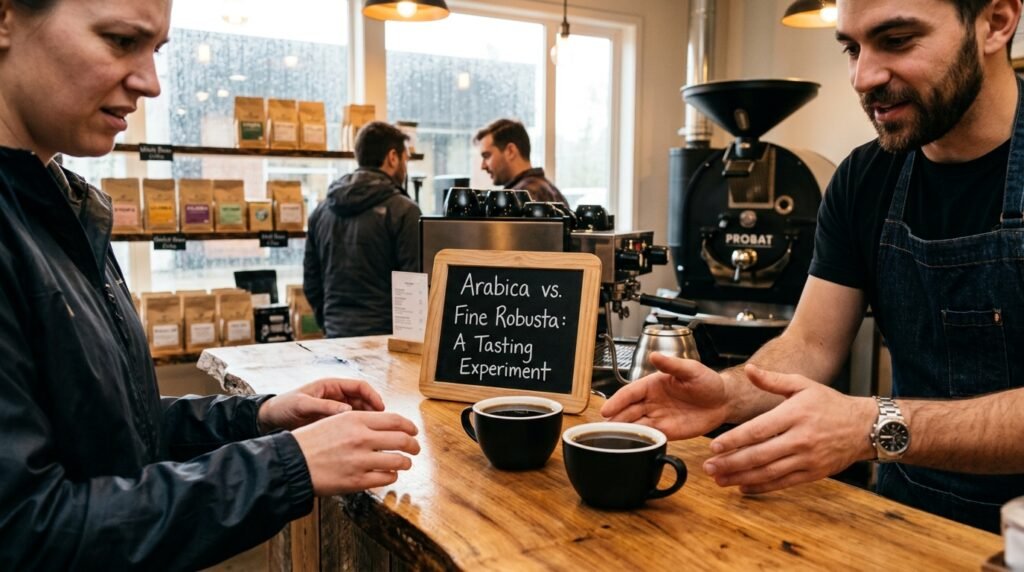
He smiled, understanding exactly where I was coming from. “Let’s do a little experiment,” he suggested. He placed two small, identical ceramic tasting cups on the wooden counter.
“One of these is a high-grade Arabica. The other is a premium Fine Robusta. I want you to tell me what you taste.”
Tasting Cup Number One: The Arabica Revelation
I picked up the first cup. As I brought it to my lips, the aroma hit me first. It didn’t smell heavy. It smelled delicate, almost like a tea.
I took a sip, letting the liquid coat my palate. My eyes widened. It was incredibly sweet, with a vibrant, juicy acidity that made my mouth water. There were distinct notes of jasmine, peach, and a lingering citrus finish. It was complex, dancing around on my tongue.
The barista watched my reaction. “That,” he said, “is a washed Heirloom variety from the Guji region of Ethiopia. It’s 100% Arabica.”
I was absolutely floored. It was nothing like the bitter dark liquid I was used to. It was elegant. This specific flavor profile is exactly Why I Keep Going Back to African Coffees, but at that moment, it was simply a revelation.
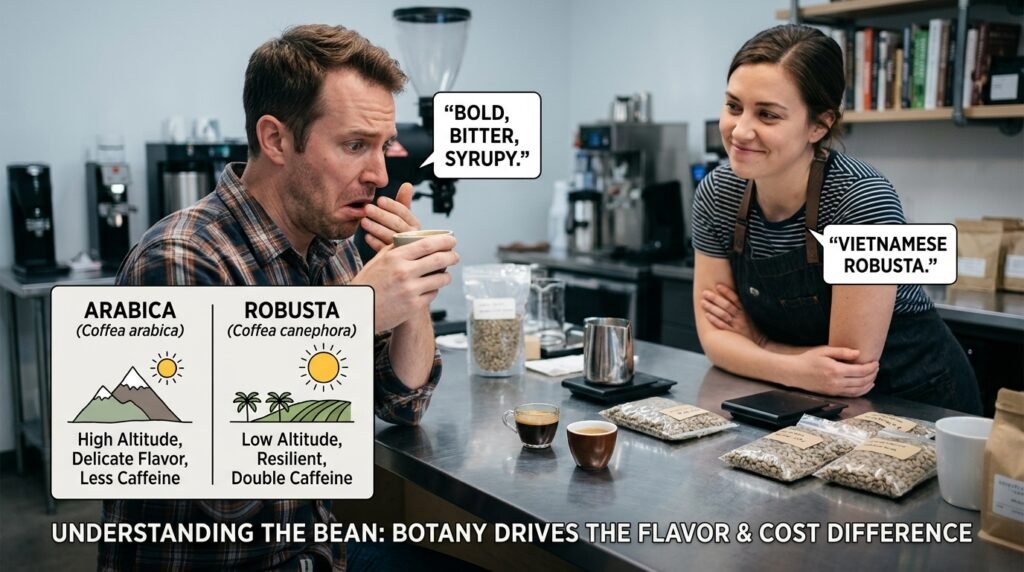
He explained that Arabica (Coffea arabica) is the prima donna of the coffee world. It is incredibly fragile, demanding specific growing conditions to thrive. It needs high altitudes—usually between 3,000 and 6,000 feet above sea level. It requires cool, consistent temperatures and plenty of shade.
Because it grows at such high altitudes, the coffee cherries mature much slower. This extended maturation period is the secret to Arabica’s magic. It gives the bean time to develop complex sugars, lipids, and organic acids.
When you drink Arabica, you are drinking a bean that has about 60% more lipids (fats and oils) and almost twice the amount of sugar as Robusta. That is why the Ethiopian Guji I was sipping tasted so sweet, so smooth, and so vibrantly floral.
But this complexity comes at a cost. Arabica plants are highly susceptible to pests and diseases, particularly the devastating coffee leaf rust. They yield fewer cherries per plant and require intense manual labor to harvest on steep mountain slopes.
That is why the “100% Arabica” label is a badge of honor. It tells the buyer: This was hard to grow, but the flavor is worth it.
Tasting Cup Number Two: The Robusta Heavyweight
Still processing the fruity explosion of the first cup, I picked up the second one.
The aroma was entirely different. It was pungent, deep, and earthy. There were no flowers here. Instead, it smelled almost like raw nuts, dark cocoa, and a hint of something woody.
I took a sip.
Boom. It hit the back of my throat with the force of a freight train. It was incredibly full-bodied, almost syrupy in texture. The flavor was bold, harsh, and deeply bitter, leaving a lingering taste of dark, unsweetened chocolate and toasted grain.
“Wow,” I coughed slightly. “That is strong.”
“That,” the barista grinned, “is a high-quality Robusta from Vietnam.”
Robusta (Coffea canephora) is exactly what its name implies: robust. It is the tough, resilient survivor of the coffee family. While Arabica demands pristine mountain air, Robusta is perfectly happy growing at lower altitudes, from sea level up to about 2,000 feet. It can handle hot climates, heavy rainfall, and direct sunlight.
But the most fascinating thing about Robusta is its built-in defense mechanism.
Robusta beans contain almost double the amount of caffeine compared to Arabica. While we humans love caffeine for the morning jolt, in nature, caffeine is a powerful pesticide. Bugs and insects hate it. Combined with a higher concentration of chlorogenic acid (an antioxidant that contributes to bitterness), Robusta is virtually immune to the pests and diseases that decimate Arabica crops.
The plant produces significantly more coffee cherries, and it does so faster and cheaper.
However, because it grows at lower altitudes and lacks the high sugar and lipid content of Arabica, the flavor profile is drastically different. It is generally less sweet, highly bitter, and lacks the nuanced, fruity notes.
For decades, Robusta got a terrible reputation in the specialty coffee world. It was viewed as the cheap filler bean—the stuff massive corporations used to bulk up their pre-ground supermarket tubs to save money.
But as I looked at the dark liquid in my cup, I realized that understanding this difference completely mirrored What I Noticed After Comparing Cheap vs Expensive Coffee at home. It wasn’t just about the price tag; it was about the fundamental botany of the bean.
The Magic of the Blend (And the Espresso Secret)
As I sat there, oscillating between the delicate Ethiopian Arabica and the punchy Vietnamese Robusta, the barista dropped another piece of knowledge that blew my mind.
“If Arabica tastes so much better,” I asked, “why does anyone even drink Robusta?”
He laughed and walked over to the shiny, chrome espresso machine sitting on the counter. “Because Robusta does something Arabica struggles to do.”
He explained that while 100% Arabica is the undisputed king of pour-overs and filter coffee, Robusta is the secret weapon of traditional Italian espresso.
Because of its lower oil content and specific cellular structure, Robusta produces the most incredible, thick, and resilient crema—that beautiful golden foam that sits on top of a perfect shot of espresso.
Furthermore, because espresso is often mixed with large amounts of milk and sugar (think cappuccinos, lattes, and flat whites), the delicate floral notes of a pure Arabica can easily get lost, tasting weak or sour. Robusta, with its heavy, punchy, chocolatey bitterness, cuts right through the milk. It stands its ground.
Many of the world’s most beloved espresso blends use a base of 80% to 90% Arabica for sweetness and complexity, and mix in 10% to 20% high-grade Robusta to add body, crema, and that classic “kick” of caffeine.
Suddenly, the coffee universe made perfect sense. Arabica wasn’t “good” and Robusta wasn’t “bad.” They were simply two entirely different tools designed for different jobs.
Arabica is the acoustic guitar solo—nuanced, emotional, and best enjoyed pure and unadulterated. Robusta is the bassline—heavy, driving, and essential for giving structure to a milk-heavy espresso drink.
How This Discovery Changed My Daily Routine
Walking out of that roastery, the rain had stopped, and my mind was racing. I felt like I had been drinking coffee with a blindfold on my entire life, and someone had finally untied the knot.
The next day, I went to the grocery store, but this time, I didn’t just look for the cheapest bag on the shelf. I picked up the bags and started actually reading the labels.
I looked for the words “100% Arabica.” But more than that, I looked for the origin. I looked for altitude information. I started paying attention to whether the tasting notes mentioned “berries and jasmine” or “dark chocolate and earthy.”
I stopped buying pre-ground coffee entirely. I bought a simple hand grinder and started buying whole beans, realizing that those precious Arabica lipids and sugars evaporate incredibly quickly once the bean is crushed.
I even bought a small bag of a specialty Robusta/Arabica blend specifically to use in my Moka pot at home, finally understanding why my previous attempts at making strong, Italian-style coffee had tasted so intensely sour when I used my fruity, high-altitude African beans.
The Bottom Line: Which One Is For You?
If you are standing in an aisle right now, overwhelmed by the choices, here is the personal cheat sheet I developed after my fateful tasting experiment:
Choose 100% Arabica if:
-
You drink your coffee black.
-
You use a pour-over (V60, Chemex), AeroPress, or French Press.
-
You enjoy flavors that are sweet, fruity, floral, or brightly acidic.
-
You prefer a smoother, less harsh morning cup.
Seek out a Robusta Blend if:
-
You are making traditional espresso at home.
-
You drink milk-heavy coffees like lattes or macchiatos and want the coffee flavor to punch through the dairy.
-
You specifically want a massive hit of caffeine to wake you up.
-
You love the thick, golden crema on top of an espresso shot.
-
You prefer tasting notes of dark cocoa, roasted nuts, and deep earthiness.
A New Respect for the Bean
Looking back, the day I finally understood the difference between Arabica and Robusta was the day coffee stopped being a mere vehicle for caffeine and became a lifelong hobby.
It taught me that agriculture is art. The slope of a mountain in Ethiopia, the shade of a canopy tree, the soil composition, and the genetic defense mechanisms of a plant all end up inside that warm mug in your hands.
Coffee is no longer just coffee to me. It is a story of survival, altitude, and chemistry.
And the best part? The journey of tasting and exploring has only just begun. I’ve realized that the more you learn about what’s in your cup, the better it tastes.
So, next time you brew a pot, take a second before that first sip. Smell it. Feel the weight of it on your tongue. Is it the delicate dance of Arabica, or the heavy punch of Robusta?
Trust me, once you know the difference, you can never go back to drinking it blindfolded again.

My name is Daniel Carter, I am 35 years old, and I live in the United States. I have been passionate about aquariums for many years, and what started as a simple hobby quickly became a lifelong interest in aquatic life, fish behavior, and responsible tank care.
Through TheBrightLance, I share real experiences, practical knowledge, and honest lessons learned from maintaining different types of aquariums. I enjoy testing equipment, studying fish behavior, improving maintenance routines, and helping beginners avoid common mistakes.
My goal is to make aquarism easier, more ethical, and more enjoyable for everyone — whether you are setting up your very first tank or looking to refine your techniques.