
If you have ever tried your hand at amateur woodworking, you probably learned a very harsh, very expensive lesson on your very first project.
Imagine you go to a lumber yard and buy several beautiful, premium planks of solid oak to build a dining room table. You bring the wood into your garage, pick up a handsaw, and start cutting the legs. But instead of using a tape measure and a pencil to mark your cuts, you just look at the wood and guess.
You think to yourself, That looks like about thirty inches. Close enough. You cut all four legs based entirely on visual intuition. You screw them into the tabletop, flip the heavy piece of furniture over, and step back to admire your work.
Immediately, you realize you have created a disaster. The table leans aggressively to the left. When you push on the corner, it wobbles violently. Because one leg is just a quarter of an inch shorter than the others, the entire piece of furniture is practically useless. You cannot eat on a wobbly table.
You ruined expensive, beautiful materials simply because you refused to measure them.
For the first few years of my specialty coffee journey, I was a terrible woodworker. I was buying incredible, premium ingredients, and I was completely ruining them every single morning because I was too stubborn to use a tape measure.
I relied on guesswork, intuition, and plastic scoops. And as a result, my morning cup was a wobbly, unstable, highly frustrating disaster.
Here is the honest, highly practical story of the one habit that improved my coffee every day, the massive culinary illusions I had to unlearn, and how committing to absolute precision finally gave me the flawless morning routine I had been chasing.
The Illusion of the Plastic Scoop
When I first started trying to make better coffee at home, I assumed that the secret was purely in the beans.
I started buying high-quality, freshly roasted, single-origin coffees. I was incredibly excited to taste the complex floral notes of a dense Ethiopian bean, or the heavy, chocolatey balance of a classic Colombian roast.
But my daily results were completely chaotic.
On Monday, the coffee would taste perfectly sweet and vibrant. On Tuesday, using the exact same bag of beans, the coffee would taste aggressively sour and weak. On Wednesday, it would be overwhelmingly bitter and thick.
I blamed the roaster. I thought the beans were defective. I didn’t realize that my measuring system was fundamentally flawed.
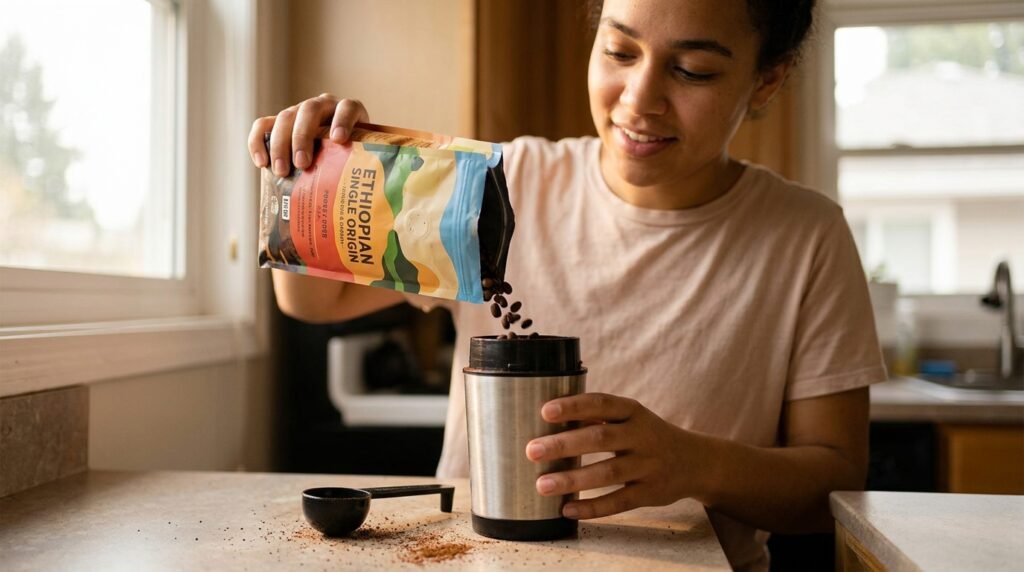
I was using the little plastic scoop that came with my coffee machine. The bag said “use two scoops,” so I blindly dumped two heaping mounds of coffee into my filter. I was measuring my coffee by volume.
In the culinary world, volume is an absolute liar.
The Physics of the Coffee Bean
To understand why the plastic scoop was ruining my life, you have to look at the physical anatomy of roasted coffee.
Coffee beans are an agricultural product, which means they are not uniform. A dense, high-altitude Ethiopian bean is incredibly small and heavy. But if you take a bean and roast it slightly darker, the intense heat causes the cellular structure to expand. It puffs up like popcorn. It becomes very large, but incredibly light and brittle.
If I took my plastic scoop and filled it with the dark, puffy roast, I might actually be holding 10 grams of coffee mass.
But if I took that exact same plastic scoop and filled it with the small, dense Ethiopian roast, I might be holding 16 grams of coffee mass.
I thought I was using the exact same amount of coffee every morning because the scoop looked full. But in reality, my recipe was fluctuating wildly. Recognizing this hidden chaos was the ultimate catalyst for (What I Do Differently Now When Making Coffee).
I realized I couldn’t trust my eyes. I needed a tape measure.
The Habit of the Digital Scale
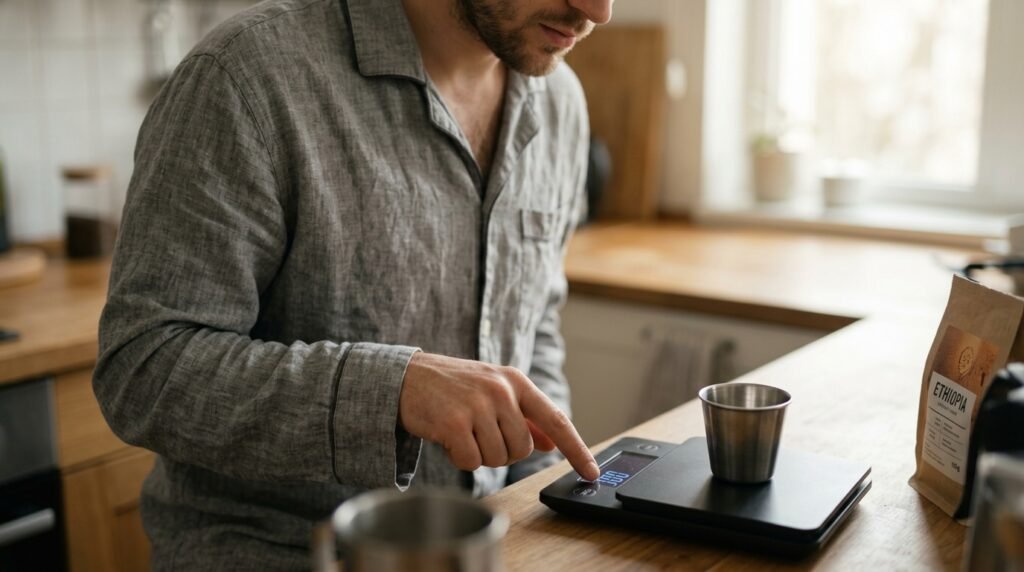
The single habit that completely revolutionized my coffee—the one non-negotiable step I now perform every single morning—is turning on a digital kitchen scale.
I threw the plastic scoop in the trash. I bought a cheap, fifteen-dollar digital scale that measures in grams.
Now, when I wake up, the very first thing I do is place my dosing cup on the scale and hit the “tare” button to zero it out. I pour my whole coffee beans into the cup until the digital screen reads exactly 15.0 grams.
It does not matter if the beans are large, small, light, dark, oily, or dry. Fifteen grams of mass is always exactly fifteen grams of mass. The physical volume is completely irrelevant.
The very first morning I established this habit, the wild, unpredictable swings in flavor instantly vanished. I finally cut all four legs of the table to the exact same length. The wobble was gone.
The Second Half of the Equation
But weighing the dry coffee beans was only the first half of the habit.
For a long time, even after I started weighing my beans, my coffee still lacked the absolute, pinpoint consistency of a professional cafe. I realized I was still “eyeballing” the other half of the chemical equation.
A cup of coffee is simply a ratio of roasted seed mass to liquid water mass.
I was weighing the seed perfectly, but then I was just taking my kettle and pouring hot water into my mug until it “looked full.” I was guessing the water volume based on where the liquid sat below the rim of the ceramic cup.
If I poured 220 grams of water one day, and 260 grams of water the next day, I was drastically altering the strength and extraction of the beverage.
I had to expand my new habit. I started putting my entire brewing apparatus—the glass V60 cone and my ceramic mug—directly onto the digital scale before I started pouring.
I zeroed the scale out again. As I poured the hot water from my gooseneck kettle, I watched the digital numbers climb. 200… 220… 240. The moment the screen hit exactly 240 grams, I stopped pouring.
Locking in both sides of the mathematical equation was the massive breakthrough behind (The Day I Finally Got My Coffee Ratio Right). It completely removed human error from the brewing process.
The Freedom of Restriction
When I try to convince my friends to start weighing their coffee and water every morning, they usually resist.
They tell me that using a digital scale feels too clinical. They say it feels like they are running a strict chemistry lab at seven in the morning. They want their coffee routine to feel romantic, intuitive, and relaxed.
I completely understand that sentiment, because I used to feel the exact same way. I thought that measuring things would drain the soul out of my morning ritual.
But I discovered a beautiful paradox: strict restriction actually creates total culinary freedom.
When you are constantly guessing your measurements, you are essentially driving blindfolded. If your coffee tastes violently bitter one morning, you have absolutely no idea why. Was it too much coffee? Was it too much water? Was the water too hot? You cannot fix a problem if you do not know which variable caused it.
But when you establish the habit of using a scale, you lock down your baseline.
If I brew exactly 15 grams of coffee with exactly 240 grams of water, and the resulting cup tastes slightly too sour, I know with 100% certainty that the ratio is not the problem. I can confidently look at the other variables.
I can say, “Okay, the ratio is perfect. Tomorrow, I will grind the coffee slightly finer to slow down the water.”
Because the scale removes the chaos, I am finally able to actually experiment. Embracing this level of precise control is exactly (The Small Changes That Made My Coffee Much Better). The scale doesn’t ruin the romance of coffee; it actually gives you the power to perfect it.
The Mental Peace of Predictability
Beyond the undeniable improvement in the actual flavor of the beverage, the habit of weighing my coffee gave me something much more profound.
It gave me mental peace.
Mornings are naturally stressful. We are waking up, thinking about our emails, our commute, and our daily responsibilities. The last thing you need at 7:00 AM is the anxiety of a ruined breakfast.
Before I used a scale, my morning coffee was a gamble. I would take a sip and hold my breath, waiting to see if I had accidentally brewed a harsh, bitter nightmare. It was a terrible way to start the day.
Now, my morning routine is an absolute guarantee.
When I turn on that digital scale, I know exactly what is going to happen. I know that the 15 grams of Ethiopian coffee will interact perfectly with the 240 grams of water. I know exactly how the extraction will flow, and I know exactly how sweet the final liquid will be.
There is a profound, grounding comfort in that daily predictability. The scale acts as a physical anchor in a chaotic world.

The Easiest Upgrade You Will Ever Make
We spend so much time searching for the magic bullet that will instantly make our coffee taste like it came from an elite, world-class roastery.
We convince ourselves that we need to spend a thousand dollars on a commercial espresso machine, or buy the most expensive, highly-rated beans on the internet. We look for complicated solutions to fundamental problems.
But the truth is remarkably simple.
You can buy the most beautiful, expensive oak wood on the planet, but if you do not use a tape measure, your table is going to wobble.
If you want to immediately, permanently improve your morning routine, you have to stop eyeballing your ingredients. Throw away the plastic volume scoop. Stop filling your mug until it “looks right.”
Spend fifteen dollars on a basic digital kitchen scale. Commit to the habit for just one week. Weigh your coffee beans, and weigh your pouring water.
When you finally remove the guesswork and embrace the strict, beautiful mathematics of extraction, your coffee will stop being a daily gamble. It will become a flawless, sweet, and perfectly balanced masterpiece, every single morning, without fail.

My name is Daniel Carter, I am 35 years old, and I live in the United States. I have been passionate about aquariums for many years, and what started as a simple hobby quickly became a lifelong interest in aquatic life, fish behavior, and responsible tank care.
Through TheBrightLance, I share real experiences, practical knowledge, and honest lessons learned from maintaining different types of aquariums. I enjoy testing equipment, studying fish behavior, improving maintenance routines, and helping beginners avoid common mistakes.
My goal is to make aquarism easier, more ethical, and more enjoyable for everyone — whether you are setting up your very first tank or looking to refine your techniques.