
If you walk into a massive, commercial department store to buy a pair of jeans, you know that the number printed on the cardboard tag is almost entirely meaningless.
You might wear a size 32 in one specific brand, but if you walk across the aisle and pick up a size 32 from a different designer, you won’t even be able to pull them past your knees. Alternatively, you might try on a third brand, and the size 32 will be so incredibly loose that they fall right off your waist.
This phenomenon is incredibly frustrating. It happens because clothing manufacturers use completely subjective measurements. Every brand cuts their fabric differently, uses different materials, and caters to a different idea of what a “size 32” actually means.
Because of this, you would never blindly buy a pair of expensive jeans just by looking at the tag. You have to take them into the fitting room. You have to feel the weight of the denim, check the stitching, and see how they actually fit your specific body.
For the first decade of my adult life, I was doing the culinary equivalent of buying jeans without ever trying them on.
I was walking into the grocery store and buying coffee based entirely on a completely subjective, highly misleading label. I was letting a single, meaningless word dictate my entire morning routine.
Here is the honest, slightly embarrassing story of the coffee buying mistake I used to make, the massive marketing illusion I had to unlearn, and how looking past the bold letters on the front of the bag completely revolutionized the quality of the beverage in my mug.
The Roast Level Trap
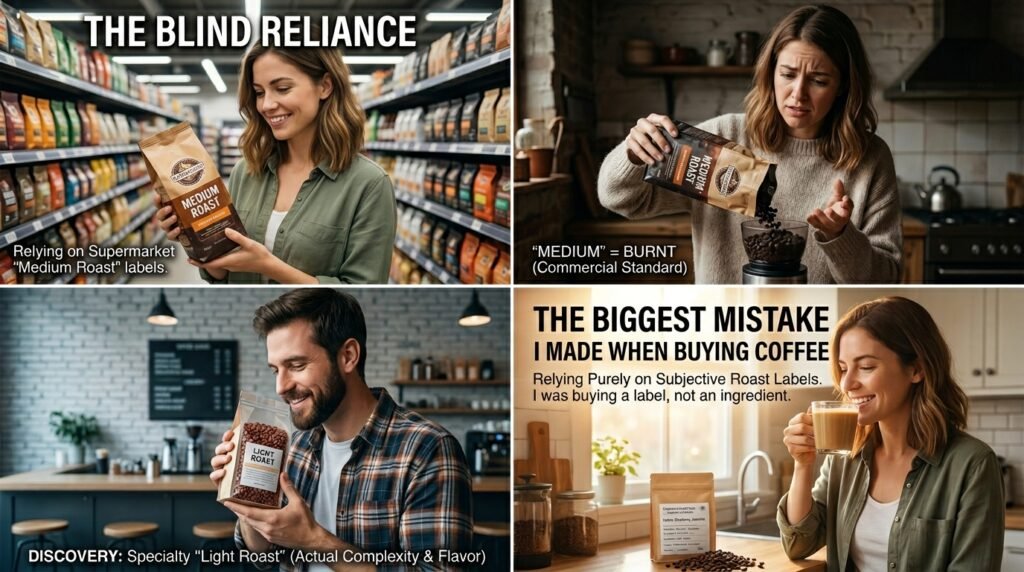
When you do not know very much about the intricate, complex world of specialty coffee, you rely on the only metric that the commercial industry provides for you: the roast level.
Every single bag of coffee in a commercial supermarket is aggressively categorized into one of three buckets. It is either a Light Roast, a Medium Roast, or a Dark Roast.
For years, I treated these three labels as absolute gospel.
I thought that the roast level was the definitive, scientific indicator of how the coffee was going to taste. I assumed that a “Medium Roast” from a massive corporate brand was the exact same chemical product as a “Medium Roast” from a small, local roastery.
I was completely, fundamentally wrong.
Just like the sizes of denim jeans, the concept of a “roast level” is entirely subjective. There is no international, legally binding standard for what constitutes a medium roast. It is entirely up to the discretion of the person operating the roasting machine.
A medium roast from a commercial factory is often roasted so heavily that a specialty artisan would consider it a burnt, pitch-black French Roast. A dark roast from a specialty cafe might actually look like a light roast to someone who is used to drinking commercial coffee.
Relying purely on these subjective words was destroying my mornings. Recognizing this blind spot was precisely (The Biggest Mistake I Made When Buying Coffee). I was buying a label, not an ingredient.
The “Bold and Strong” Illusion
My mistake was heavily compounded by a massive, widely accepted myth regarding caffeine and flavor.
During the most stressful years of my career, I was constantly exhausted. I wanted my morning coffee to be as strong, heavy, and highly caffeinated as physically possible. So, I exclusively bought the darkest roasts I could find.
I would look for bags labeled “Espresso Roast,” “Midnight Blend,” or “French Roast.” When I opened the bags, the beans were shiny, incredibly oily, and pitch black.
I assumed that because the beans were dark and the flavor was intensely bitter, I was getting a massive dose of premium caffeine.
I didn’t realize that I was actually experiencing a culinary illusion.
In reality, the roasting process actually burns away caffeine. The longer a coffee bean sits in a 400-degree roasting drum, the more of its complex chemical compounds—including caffeine—are physically destroyed. A light roast coffee bean actually contains slightly more caffeine than a dark roast bean, because it is significantly denser and has not been cooked to death.
Furthermore, I thought the heavy, bitter taste meant the coffee was “bold.”
But I wasn’t tasting the boldness of the coffee. I was tasting carbon. I was tasting the literal ash left behind by a massive industrial heating element. I was buying cheap, low-grade coffee that the roaster had deliberately burned to hide the taste of mold, dirt, and agricultural defects.
Seeking the Safe Middle Ground
Eventually, my stomach could no longer handle the harsh, acidic bitterness of the dark roasts. So, I decided to pivot.
I swung the pendulum back to the center and started buying exclusively “Medium Roast” coffee. I thought I had found the ultimate safe zone. I assumed a medium roast would give me the perfect balance of flavor and smoothness.
But I encountered the exact same problem as the clothing sizes.
One week, I would buy a medium roast, and it would taste thin, sour, and weak. The next week, I would buy a different brand’s medium roast, and it would taste exactly like the burnt dark roast I was trying to escape.
I was standing in the coffee aisle completely paralyzed by choice. I had absolutely no idea what I was actually putting into my shopping cart.
I needed to learn how to decipher the actual data on the bag. Overcoming this massive wave of consumer paralysis was the exact foundation of (How I Learned to Read Coffee Labels Without Confusion). I realized I had to stop looking at the massive, bold fonts, and start looking at the fine print.

The Processing Method Revelation
The ultimate breakthrough in my coffee buying journey happened when I stopped looking at how the coffee was cooked, and started looking at how it was harvested.
I walked into an independent specialty coffee shop and asked the barista for a recommendation. I told them I usually drank medium roasts but was tired of the unpredictable flavors.
The barista completely ignored my comment about the roast level. Instead, they asked me a question I had never heard before: “Do you prefer washed coffees or natural coffees?”
I stared at them blankly. I had no idea what they were talking about.
They patiently explained that coffee is not a dry bean that grows on a vine. It is the pit of a sweet, cherry-like fruit. Before a coffee bean can be roasted, the farmer has to remove the fruit from the seed. How they remove that fruit completely dictates the final flavor of the beverage.
If a farmer uses the “Washed Process,” they strip the fruit off the seed immediately using massive water tanks. The resulting coffee is incredibly clean, crisp, and bright. It often tastes like jasmine flowers, black tea, or crisp apples.
If a farmer uses the “Natural Process,” they leave the fruit completely intact and lay the cherries out in the sun to dry for weeks. The seed literally ferments inside the sweet fruit. The resulting coffee is heavy, complex, and explosive. It tastes like strawberry jam, dark chocolate, and red wine.
A New Way to Shop
Learning about processing methods completely shattered my previous worldview.
I realized that for my entire adult life, I had been shopping for coffee backward. I had been obsessing over the oven temperature (the roast) and completely ignoring the actual recipe (the processing method).
I immediately bought a bag of naturally processed coffee from Ethiopia. It was a light roast.
When I brought it home and brewed it in my glass V60 cone, I was absolutely floored. It didn’t taste bitter. It didn’t taste sour. It tasted like I had just bitten into a handful of fresh, ripe blueberries. It was the most incredible, vibrant cup of coffee I had ever experienced.
Realizing that this specific agricultural technique was the secret to the flavors I loved was exactly (How I Discovered My Favorite Type of Coffee).
From that day forward, I completely stopped looking at the generic “Roast Level” on the front of the bag.
The Checklist for Quality
Now, when I walk into a local roastery or browse for coffee online, I have a very strict, specific checklist in my head. I treat buying coffee exactly like buying a high-end bottle of wine.
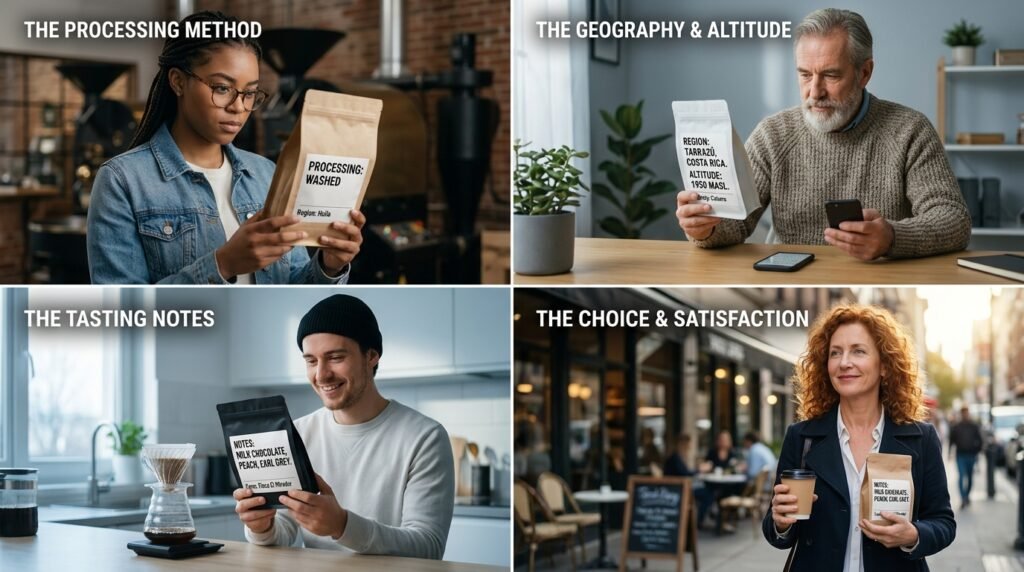
First, I look for the processing method. If the bag does not tell me if the coffee is washed, natural, or honey-processed, I immediately put it back on the shelf. If the roaster doesn’t know how the coffee was processed, they do not care about the product.
Second, I look for extreme geographical transparency. I do not want a bag that just says “South America.” I want a bag that tells me the coffee was grown in the specific region of Tarrazú, Costa Rica. I want to know the altitude of the farm. The more specific the geography, the higher the quality of the raw ingredient.
Third, I look for the tasting notes. Specialty roasters will list specific culinary notes on the bag, like “Milk Chocolate, Peach, and Earl Grey Tea.” These are not artificial flavorings added to the beans. They are the natural, inherent flavors of that specific crop, unlocked by a careful, deliberate roasting curve.
Trusting the Roaster, Not the Label
The final, most liberating lesson I learned from my past mistakes was to surrender control to the professionals.
When you buy cheap commercial coffee, you rely on the “Dark Roast” label because you do not trust the company. You just want a predictable, burnt flavor.
But when you start buying from high-quality, independent specialty roasters, you realize that they are highly trained culinary artisans. They buy incredibly expensive, beautiful green coffee seeds. They do not want to burn them. They will apply the exact perfect amount of heat required to unlock the natural sweetness of that specific bean.
I no longer demand a “Medium Roast.” I just buy a beautiful, naturally processed coffee from a farm in Colombia, and I trust that the roaster developed it perfectly.
Take Your Coffee into the Fitting Room
If you are currently standing in the grocery store aisle every week, staring blankly at a wall of foil bags, completely paralyzed by the generic labels of “Light,” “Medium,” and “Dark,” you are trapped in a massive culinary illusion.
You are buying clothes by staring at the size tag, completely ignoring the fabric, the cut, and the fit.
I challenge you to break the cycle. Stop buying coffee based on the color of the bean.
Walk into a local, independent specialty coffee shop. Talk to the barista. Ask them about the difference between a washed coffee from Guatemala and a natural coffee from Ethiopia. Look for bags that proudly list the name of the farmer and the altitude of the mountain.
When you finally stop obsessing over the generic roast level and start paying attention to the beautiful, complex agricultural reality of the seed, your entire morning routine will change. You will stop drinking a bitter, burnt chore, and you will finally experience the vibrant, incredible masterpiece that has been hiding from you this entire time.

My name is Daniel Carter, I am 35 years old, and I live in the United States. I have been passionate about aquariums for many years, and what started as a simple hobby quickly became a lifelong interest in aquatic life, fish behavior, and responsible tank care.
Through TheBrightLance, I share real experiences, practical knowledge, and honest lessons learned from maintaining different types of aquariums. I enjoy testing equipment, studying fish behavior, improving maintenance routines, and helping beginners avoid common mistakes.
My goal is to make aquarism easier, more ethical, and more enjoyable for everyone — whether you are setting up your very first tank or looking to refine your techniques.