
If you were to purchase a beautifully restored, incredibly expensive vintage sports car, you would likely go to great lengths to protect your investment.
You would rent a climate-controlled garage. You would buy a heavy, custom-fitted canvas cover. You would obsessively wax the paint to protect the clear coat.
But imagine if you bought that exact same classic car, drove it to a beach house, and simply parked it in the driveway, completely exposed to the elements, just fifty yards from the crashing ocean waves.
For the first few days, the car would look perfectly fine. But the salty sea breeze is an invisible, relentless enemy.
Day by day, microscopic salt particles would settle on the exposed metal. The humid ocean air would quietly begin to oxidize the steel. You wouldn’t notice the damage just by looking at it, but six months later, the undercarriage would be completely rusted through. The structural integrity of the beautiful machine would be permanently destroyed by an invisible chemical reaction.
For the first few years of my specialty coffee journey, I was essentially parking a vintage sports car on the beach.
I was spending premium money on incredible, high-quality, single-origin coffee beans. I was buying expensive burr grinders and gooseneck kettles. But because I fundamentally misunderstood the physical nature of the coffee bean, I was leaving my expensive investment completely exposed to the elements.
I destroyed hundreds of dollars’ worth of incredible coffee through sheer ignorance.
Here is the honest, slightly embarrassing story of what I learned about coffee storage the hard way, the catastrophic mistakes that ruined my morning routine, and the strict environmental rules I now follow to protect the delicate chemistry of the bean.
The Rock Solid Delusion
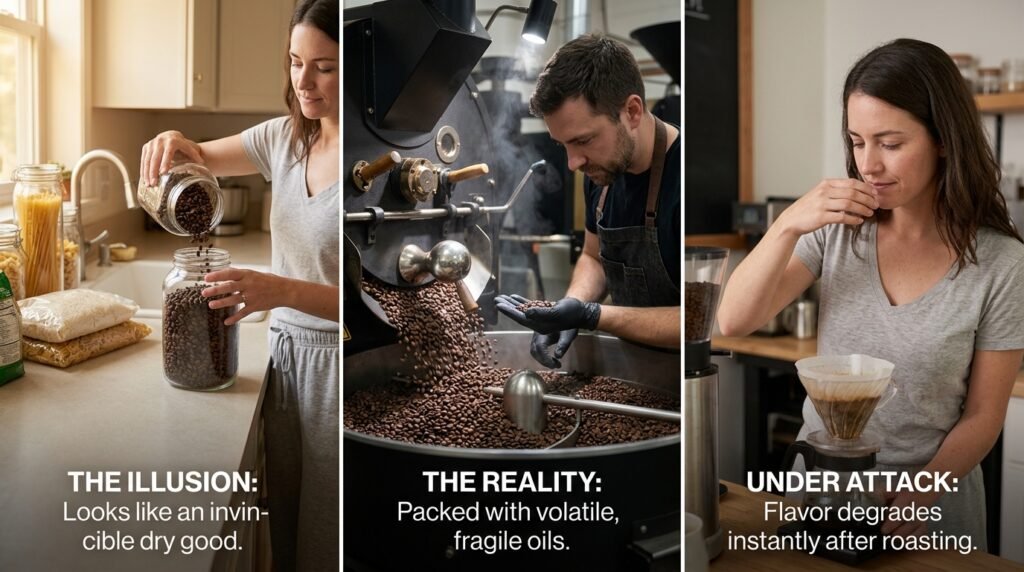
To understand why I made so many storage mistakes, you have to understand the optical illusion of the roasted coffee bean.
When you pick up a handful of dark, roasted coffee beans, they feel incredibly hard. They feel like tiny pebbles. They do not look like a fresh agricultural product. Because they are dry and hard, our brains naturally categorize them in the same culinary family as dried pasta, white rice, or canned soup.
We assume that because they are a “dry good,” they are invincible.
This is a devastating culinary delusion. A roasted coffee bean is actually one of the most fragile, volatile, and chemically unstable food products in your entire kitchen.
During the intense heat of the roasting process, the cellular structure of the seed expands, creating hundreds of complex, highly sensitive aromatic oils. These oils are the sole reason your coffee tastes like sweet blueberries, rich chocolate, or bright jasmine.
But the exact second the beans leave the roasting drum, those oils are under constant, invisible attack from the ambient environment.
Hard Lesson One: The Bulk Buy Disaster
The very first storage mistake I made was driven by a desire to save a few dollars.
I found a local roaster that I absolutely loved. They were selling a beautiful, naturally processed Ethiopian coffee. A standard 12-ounce bag was twenty dollars, but they offered a massive, two-pound wholesale bag for fifty dollars.
I did the math in my head, realized I was getting a discount, and proudly bought the massive bag. I brought it home, opened it, and started brewing.
During the first week, the coffee was spectacular. It was vibrant, sweet, and explosive.
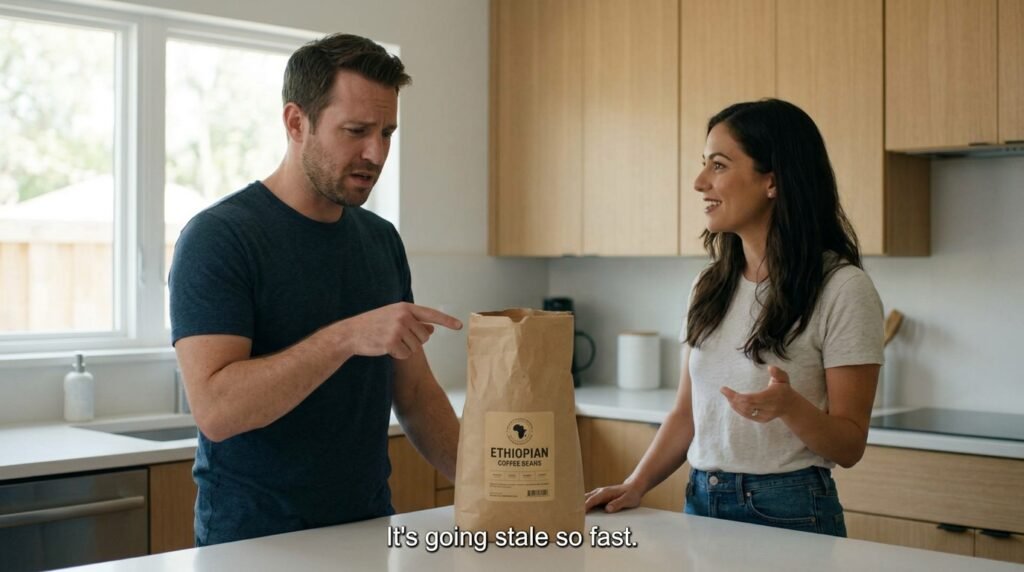
But because I lived alone, it took me nearly two months to get through that massive two-pound bag. By the start of the fourth week, I noticed that the explosive berry flavor was completely gone. The coffee tasted flat. By the sixth week, it tasted like stale cardboard and dusty wood.
I thought the roaster had given me a bad batch.
I didn’t understand the concept of oxidation. Every single morning, when I opened that massive bag to scoop out my beans, I was introducing a fresh wave of oxygen. The oxygen was physically attacking the aromatic oils, drying them out, and turning them rancid.
Understanding this invisible ticking clock was precisely (What I Wish I Knew Before Buying My First Coffee Beans). I learned that buying coffee in bulk is never a bargain if you end up throwing the last quarter of the bag into the trash because it tastes like sawdust.
Hard Lesson Two: The Refrigerator Catastrophe
When I complained to a friend that my bulk coffee was going stale before I could finish it, they confidently gave me the absolute worst piece of advice on the entire internet.
They told me to put my coffee beans in the refrigerator.
The logic seemed flawless to my uneducated brain. We put milk, vegetables, and meat in the refrigerator to slow down the decay process. Why wouldn’t it work for coffee?
I tightly rolled up the paper bag of Ethiopian beans and placed it on the middle shelf of my fridge, right next to a container of leftover takeout food.
Three days later, I took the bag out, ground the cold beans, and brewed my morning cup. I took one sip and nearly spit it out onto my kitchen counter. The coffee tasted aggressively like raw onions, garlic, and stale plastic.
I had completely ignored the physical anatomy of the bean.
Roasted coffee beans are incredibly porous. They act exactly like a box of baking soda. They are microscopic organic sponges that will violently absorb any ambient odors in their environment. By putting them in the fridge, I had forced them to absorb the smell of every single piece of food I owned.
Even worse, every time I took the cold bag out of the fridge into my warm kitchen, the sudden temperature shift created invisible condensation. Microscopic water droplets formed on the surface of the beans, instantly degrading the oils and completely ruining the cellular structure.
This devastating morning was (The Biggest Mistake I Made When Buying Coffee). It was a harsh reminder that a refrigerator is a death trap for a porous, dry agricultural product.
Hard Lesson Three: The Pinterest Aesthetic
After the refrigerator disaster, I decided to keep my coffee on the kitchen counter. But I hated the look of the crinkled foil bags.
I wanted my kitchen to look like a rustic, aesthetic café. So, I went to a home goods store and bought a beautiful, clear glass mason jar with a heavy metal clasp and a rubber gasket. I poured my freshly roasted beans into the clear jar and placed it proudly on my counter, right next to the window where the afternoon sun poured in.
It looked incredibly beautiful. I felt like a true coffee professional.
But within ten days, the coffee started tasting incredibly harsh, bitter, and completely devoid of any sweetness. I looked closely at the glass jar and noticed that the inside of the glass was coated in a greasy, brown film.
I had accidentally introduced my coffee to its most destructive enemy: ultraviolet radiation.
Coffee beans are highly photosensitive. When you expose them to direct sunlight, the UV rays act like a microscopic laser beam. The intense light physically agitates the delicate organic compounds inside the bean, forcing the aromatic oils to sweat out onto the surface of the bean and onto the glass walls of the jar.
Once those oils hit the surface, the light bleaches them, turning them instantly rancid.
I was literally baking the flavor out of my expensive coffee. I realized that coffee does not want to be a display piece. It wants to hide in the dark.
The Illusion of the Plastic Clip
After ruining three separate batches of expensive coffee through bulk buying, refrigeration, and UV exposure, I finally realized that I needed to change my entire storage philosophy.
I started keeping the coffee in its original, opaque foil bag to protect it from the light. I kept it in a dark cabinet to protect it from temperature swings.
But I was still making one final, critical error. I was sealing the bag by simply rolling the top down and attaching a cheap plastic chip clip.
I assumed this was making the bag airtight. But a rolled-up bag with a plastic clip is essentially a wide-open door for microscopic oxygen molecules. The ambient air in my cabinet was still constantly flowing in and out of the bag, slowly but surely oxidizing my beans.
To actually preserve the coffee, I had to completely lock the oxygen out.
Finding the correct hardware to accomplish this was the turning point of (How I Stopped Wasting Good Coffee). I stopped relying on cheap plastic clips and finally invested in a specialized, professional-grade coffee storage container.
The Ultimate Storage Solution
I threw away the glass mason jars. I stopped trying to hack the system.
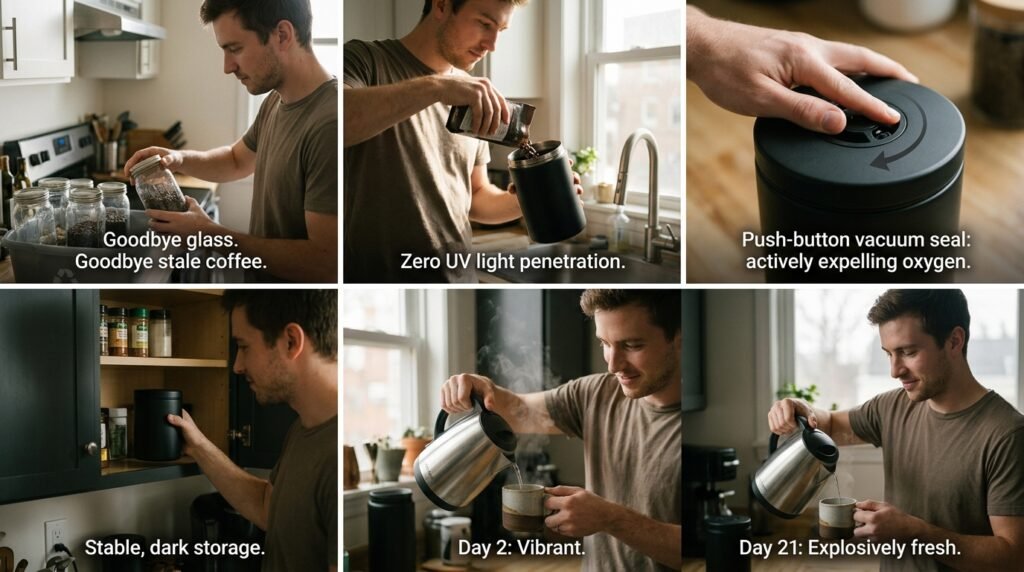
I bought an opaque, matte black stainless steel coffee canister. Because it is completely solid metal, absolutely zero ultraviolet light can penetrate the walls. My coffee is perfectly protected from the sun, even if the canister sits on the counter.
But the true engineering marvel is the lid.
When you pour your fresh beans into the canister and push the lid down, a mechanical one-way valve actively forces all the ambient oxygen out of the container. It creates a near-vacuum environment.
The oxygen is expelled, the light is blocked, and because I keep the canister in a cool, dark cabinet away from my oven, the temperature remains perfectly stable.
The very first month I used this vacuum canister, the results were staggering. The cup of coffee I brewed on day twenty-one tasted almost exactly as vibrant, sweet, and explosive as the cup I brewed on day two. The rust had finally been stopped.
The Law of Frequent Purchasing
Even with the most advanced vacuum canister on the planet, you cannot completely freeze time. Coffee is a decaying organic product. It will eventually lose its life.
The final lesson I learned about storage wasn’t about equipment at all. It was about consumer habits.
I completely stopped buying massive bags of coffee. I now strictly buy standard 12-ounce bags from local independent roasters. I only buy exactly enough coffee to last me ten to fourteen days.
By the time the coffee naturally begins to degrade inside the vacuum canister, the canister is already empty, and I am heading back to the roastery to buy a fresh, warm batch directly from the source.
Stop Sabotaging Your Mornings
If you are spending your hard-earned money on specialty coffee, you have already done the hardest part. You have sourced an incredible ingredient.
But if you bring that ingredient home and treat it like a bag of dry pasta, you are burning your own money.
I challenge you to audit your kitchen today. Look at where your coffee is sitting. Is it in the fridge next to yesterday’s leftovers? Is it in a clear glass jar soaking up the afternoon sun? Is it sitting in a massive, rolled-up two-pound bag secured with a rubber band?
If so, you are actively destroying the flavor profile of your morning routine.
Stop parking your classic car on the beach. Respect the fragile, beautiful chemistry of the roasted bean. Buy an opaque, vacuum-sealed canister. Keep it in a cool, dark cabinet. Buy smaller bags more frequently.
When you finally eliminate these invisible enemies and start storing your coffee the right way, you will never have to drink a stale, woody, disappointing cup of coffee ever again. The vibrant, sweet life of the bean will be waiting for you, flawlessly preserved, every single morning.

My name is Daniel Carter, I am 35 years old, and I live in the United States. I have been passionate about aquariums for many years, and what started as a simple hobby quickly became a lifelong interest in aquatic life, fish behavior, and responsible tank care.
Through TheBrightLance, I share real experiences, practical knowledge, and honest lessons learned from maintaining different types of aquariums. I enjoy testing equipment, studying fish behavior, improving maintenance routines, and helping beginners avoid common mistakes.
My goal is to make aquarism easier, more ethical, and more enjoyable for everyone — whether you are setting up your very first tank or looking to refine your techniques.