
When I receive a new digital photograph for a complex editing or retouching project, the very first thing I do is entirely invisible to the average viewer.
Before I look at the lighting, before I check the composition, and before I start masking out backgrounds or adjusting colors, I open the file properties and I look at the EXIF data.
To a casual observer, a photograph is just a picture on a screen. But the EXIF metadata contains the hidden, invisible narrative of exactly how that image was born. It tells me the specific camera model, the exact focal length of the lens, the shutter speed, the ISO sensitivity, and even the precise GPS coordinates of where the photographer was standing.
It tells me if the image was captured in a fraction of a second during a bright, chaotic afternoon, or if it was a slow, deliberate, ten-second exposure taken in the dead of night.
The metadata tells the true story behind the pixels.
For the first decade of my adult life, my morning coffee routine was the culinary equivalent of a compressed, pixelated image that had been completely stripped of its original data. I had absolutely no idea where it came from, how it was created, or who was responsible for it.
I just drank the dark liquid and went to work.
But when I finally started digging into the specialty coffee world, I uncovered a staggering global narrative. Here is the honest, eye-opening exploration of the hidden stories behind every cup of coffee, the massive human chain required to produce a single bean, and how learning to read the “metadata” of my morning mug changed my life forever.
The Era of the Stripped File
To understand how profound these hidden stories are, I have to admit how ignorant I used to be about the agricultural reality of coffee.
During my early twenties, I bought my coffee at the massive chain supermarket down the street. I would walk down the aisle and grab a heavy, vacuum-sealed plastic brick of pre-ground dark roast.
The label on the front was entirely useless. It usually just said “French Roast” or “Morning Blend,” accompanied by a generic stock photo of a steaming mug.
There was no metadata. There was no date to tell me when it was roasted. There was no country of origin listed. There was certainly no mention of the specific farm, the altitude, or the processing method.
It was a completely anonymous, faceless commodity. I treated it exactly like a cheap, disposable product because the packaging deliberately erased the history of the ingredient. I assumed it was just manufactured in a massive industrial factory somewhere.
Discovering the Physical Metadata
The massive shift in my perspective happened the first time I walked into an independent, specialty coffee roastery and picked up a bag of premium, light-roast whole beans.
The bag did not have a generic stock photo on it. Instead, it was covered in highly specific, granular data.
It told me that the coffee was from the Huila region of Colombia. It told me it was grown at an altitude of 1,750 meters above sea level. It listed the specific biological varietal of the plant, which was “Pink Bourbon.” It even printed the actual name of the farmer who owned the plot of land.
I was absolutely stunned. For the first time in my life, I was holding a bag of coffee that had a clear, verifiable origin.
Understanding that a simple beverage could be traced back to a specific set of coordinates on a map was the exact foundation of (Why I Now Pay Attention to Coffee Origin and Type). It completely rewired my brain. I was no longer drinking a manufactured product; I was drinking a piece of geography.
The Story Begins in the Soil
Once I realized that the data was available, I fell down a massive research rabbit hole. I wanted to know the entire story of how that specific Pink Bourbon bean made it from a high-altitude mountain in Colombia to my kitchen counter.
The hidden story of a cup of coffee starts years before you ever take a sip.
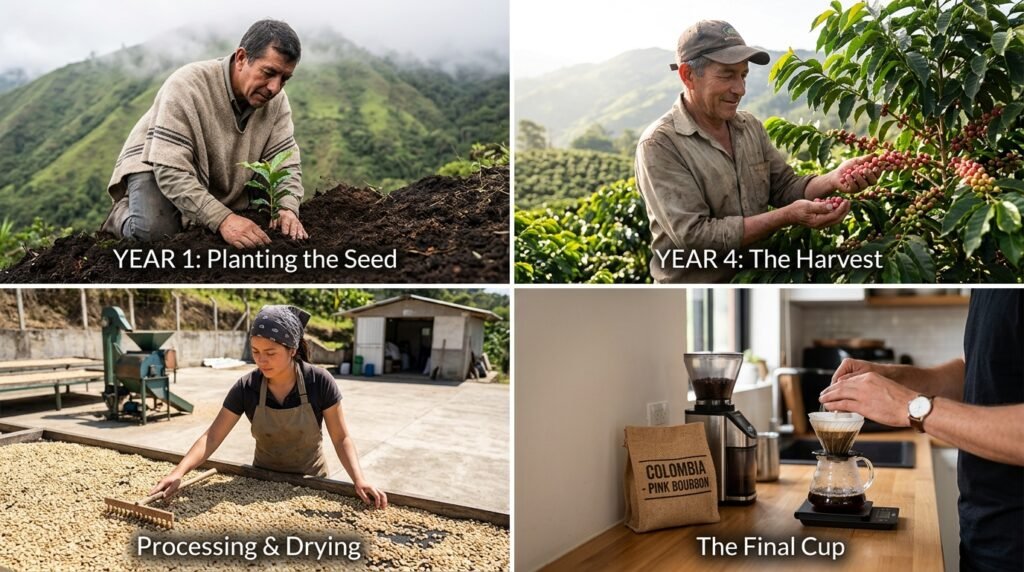
It begins with a farmer planting a fragile Coffea arabica seed into rich, volcanic soil. Unlike a quick cash crop that can be harvested in a few months, a coffee tree is a massive, long-term investment.
The farmer has to carefully nurture that small seedling for three to four entire years before the tree will produce its very first viable crop of fruit. During those years, the farmer must protect the delicate tree from extreme weather, invasive pests, and aggressive leaf rust diseases.
They invest years of intense physical labor and financial risk without seeing a single dollar of return.
The Hand-Picked Reality
When the tree finally matures, it begins to produce small, green clusters of fruit. Over the course of several months, those green fruits slowly ripen into deep, vibrant red or purple “cherries.”
This is where the hidden human story becomes truly staggering.
In massive, commercial coffee farms located on flat terrain, giant machines drive through the fields, violently stripping everything off the branches—ripe cherries, unripe green cherries, leaves, and twigs—all mixed together to be processed into cheap supermarket coffee.
But specialty coffee grows on steep, high-altitude mountainsides where machines physically cannot operate.
Every single coffee cherry inside a bag of premium specialty coffee is picked by a human hand.
Workers have to hike up incredibly steep, dangerous inclines. They must visually inspect the branches and meticulously pick only the perfectly ripe, deep red cherries, leaving the unripe green ones on the branch to be picked weeks later.
Realizing the sheer volume of manual labor required to fill a single burlap sack is exactly (What I Discovered About Coffee Farming Around the World). I suddenly understood why specialty coffee costs more than the generic bricks at the supermarket.
The Delicate Science of Processing
Once the ripe cherries are carried down the mountain in heavy baskets, the hidden story transitions from physical labor to delicate, biological science.
The coffee bean that we roast and grind is actually the seed hidden deep inside the center of that fruity cherry. To get to the seed, the farmers have to “process” the fruit.
If they use the Washed Process, they use mechanical depulpers to strip the fruit skin away. Then, the sticky, mucilage-covered seeds are placed in massive water tanks to ferment. The fermentation breaks down the sugars, leaving a perfectly clean, dense green seed. This process results in coffee that is incredibly crisp, clean, and tea-like in your mug.
If they use the Natural Process, they do not remove the fruit. They lay the entire, intact cherry out on raised drying beds under the hot tropical sun. The fruit slowly ferments and dries like a raisin, allowing the intense, wild sugars of the fruit flesh to physically absorb into the seed over several weeks.
This process requires workers to manually rake and rotate the drying cherries every few hours to prevent mold. It is a painstaking, exhausting process that results in coffee that tastes violently of wild blueberries and heavy strawberry jam.
The Long Ocean Voyage
After the green seeds are dried, rested, and separated from their protective parchment layer, the global logistics of the story take over.
The raw, unroasted green coffee beans are packed tightly into heavy, 60-kilo jute bags. These bags are loaded onto transport trucks, driven down winding, dangerous mountain roads, and delivered to major shipping ports.
The green coffee is then loaded into massive, steel shipping containers and placed on ocean freighters.
These freighters cross the globe, spending weeks navigating rough oceans and unpredictable weather, carrying thousands of tons of raw agricultural potential. The green coffee is highly sensitive to moisture and temperature changes during this voyage.
If a shipping container gets too hot and humid, the entire crop can be ruined by mold before it ever reaches the destination port. The sheer fact that these delicate seeds survive the journey across the world is a modern logistical miracle.
The Translator: The Local Roaster
When the massive shipping containers finally arrive at a port in the United States or Europe, the green coffee beans are transported to local specialty roasteries.
At this stage, the hidden story relies entirely on the skill of a single artisan.
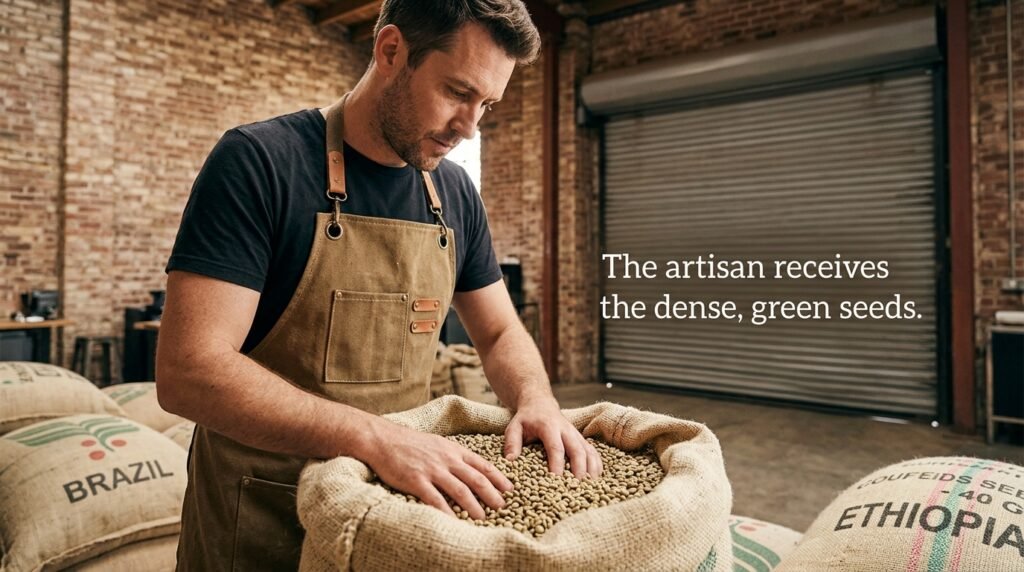
Raw, green coffee beans smell like dry grass and hay. They are rock hard and completely undrinkable. The local roaster is the translator. Their job is to apply the exact perfect amount of thermal energy to unlock the chemical potential hidden inside that dense seed.
The roaster drops the green beans into a massive, rotating steel drum heated to over 400 degrees Fahrenheit. Over the course of about ten to twelve minutes, a violent chemical transformation called the Maillard reaction occurs.
The beans turn from green to yellow, and then to a light, cinnamon brown. The complex amino acids and natural sugars break down, caramelize, and create the explosive aromatic oils that give coffee its incredible flavor.
If the roaster leaves the beans in the machine for thirty seconds too long, the delicate fruit notes will ignite and burn into pure, bitter carbon. It is a high-stakes, highly technical performance that requires absolute focus.
The Final Chapter in My Kitchen
The incredible, exhausting human chain of the coffee story spans years of time and thousands of miles of geography. But the final chapter is written entirely by me, standing alone in my kitchen on a quiet Tuesday morning.
When I hold a bag of specialty coffee, I am holding the final baton in a massive, global relay race.
I have a profound responsibility to not ruin the ending of the story.
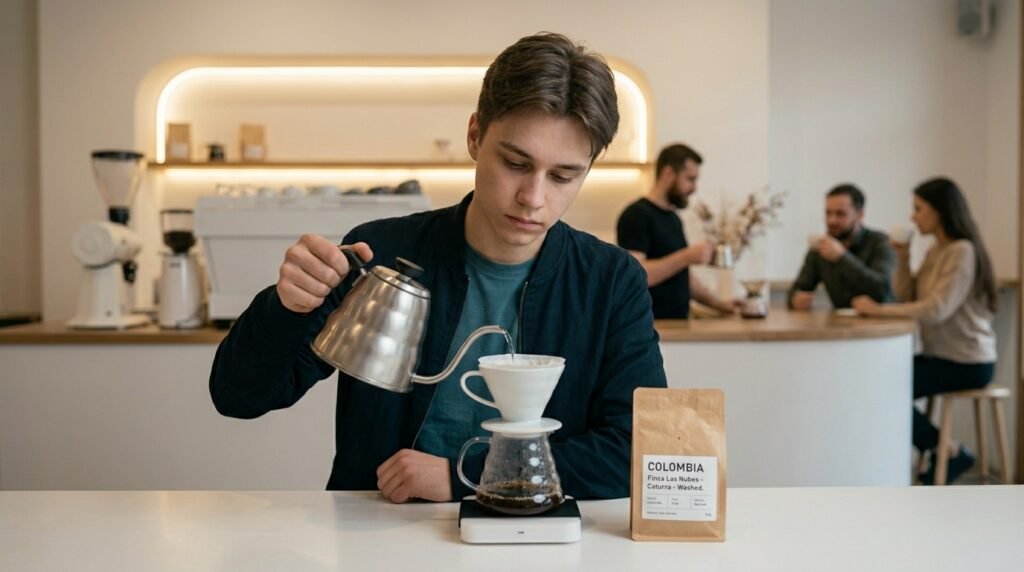
I place my glass V60 pour-over cone on my digital scale. I use my manual burr grinder to crush the beans into a perfectly uniform, sandy texture. I heat my filtered water to exactly 200 degrees Fahrenheit, ensuring that I do not scorch the delicate oils that the roaster worked so hard to develop.
I gently pour the water in slow, hypnotic circles. I watch the coffee bed bubble and bloom as it releases the carbon dioxide gas that was trapped inside the roasting drum just a week prior.
Allowing this deep appreciation to slow me down and dictate my technique is exactly (How Exploring Coffee Origins Made Me Enjoy Coffee More). I am no longer just making a drink; I am honoring a massive collaborative effort.
Reading the True Metadata
We spend so much of our lives interacting with anonymous, faceless products. We buy food wrapped in plastic, clothes manufactured by machines, and digital goods that possess absolutely no physical weight.
It is incredibly easy to forget that the physical world still requires human hands to operate.
The next time you make a cup of coffee, I challenge you to look past the dark liquid in your mug. I challenge you to look at the metadata.
Read the label on the bag. Think about the farmer who spent four years nurturing the tree. Think about the laborers who hiked up a steep, muddy mountain to hand-pick the ripe cherries. Think about the grueling weeks of fermentation, the massive ocean voyage, and the local roaster who carefully applied the heat.
When you finally realize that your simple morning beverage is actually the result of an epic, beautiful, and staggering global human effort, the coffee will physically taste better. You will never treat it as a cheap, disposable commodity ever again, because you will finally understand the hidden story resting in the palm of your hand.
My name is Daniel Carter, I am 35 years old, and I live in the United States. I have been passionate about aquariums for many years, and what started as a simple hobby quickly became a lifelong interest in aquatic life, fish behavior, and responsible tank care.
Through TheBrightLance, I share real experiences, practical knowledge, and honest lessons learned from maintaining different types of aquariums. I enjoy testing equipment, studying fish behavior, improving maintenance routines, and helping beginners avoid common mistakes.
My goal is to make aquarism easier, more ethical, and more enjoyable for everyone — whether you are setting up your very first tank or looking to refine your techniques.