
Reading a coffee bag should not feel like trying to decipher an ancient, cryptic language.
Yet, there I was a few years ago, standing in the middle of a beautifully decorated, trendy boutique café, squinting at a label that seemed specifically designed to confuse me. The bag was gorgeous. It was a matte, dark blue color with elegant gold foil stamping. It featured a minimalist drawing of a bird flying over a mountain.
It looked expensive. It felt premium. It cost me twenty-six dollars.
I bought it purely based on the aesthetics and the vague promise printed on the front: “A bold, rich experience for the modern morning.”
I took that beautiful bag home, ground the beans in my brand-new burr grinder, carefully heated my water, and brewed a pour-over with absolute precision. I poured the steaming liquid into my favorite mug, sat down at my kitchen table, and took a sip.
It was awful.
It tasted like burnt rubber mixed with stale dirt. There was no richness. There was no bold experience. It was just an aggressively bitter, flat cup of dark liquid that made me physically wince.
I grabbed the beautiful blue bag and started reading the fine print on the back, desperately trying to figure out where I had gone wrong.
That was the exact moment I realized I hadn’t done anything wrong in the kitchen. I had made the mistake at the cash register. The bag told me absolutely nothing about the actual agricultural product inside. It hid behind marketing fluff, pretty colors, and meaningless adjectives.
I swore to myself right then and there that I would never be tricked by a graphic design team again.
Here is the honest, unfiltered story of why I no longer buy coffee without checking the details, and the strict mental checklist I run through before I ever hand over my hard-earned money.
The End of Blind Trust
To completely change your buying habits, you have to acknowledge how the industry operates.
Commercial coffee companies, and even some sneaky “boutique” brands, rely entirely on consumer ignorance. They know that most people are busy, tired, and just want a quick caffeine fix. They know that if they put the word “Gourmet” or “Artisan” on a bag, 90% of shoppers will just trust the label and put it in their cart.
I used to be part of that 90%. I trusted the big, bold letters.
But once you experience the massive difference between a mass-produced, burnt commodity and a carefully cultivated, gently roasted specialty bean, that blind trust completely evaporates.
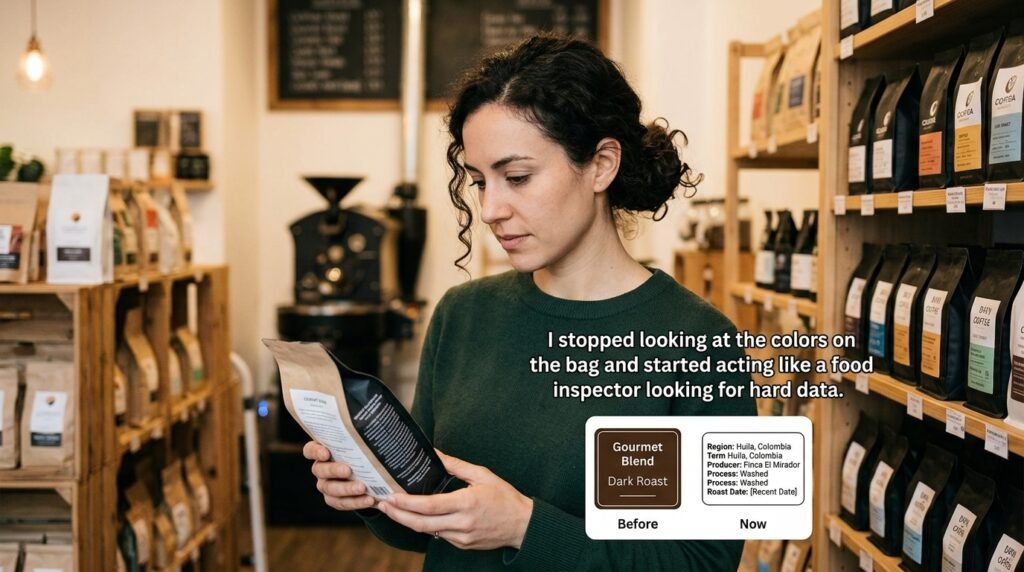
I decided to treat buying coffee the same way I treat buying fresh seafood or high-end produce. I needed traceability. I needed accountability. Mastering this mindset was the biggest hurdle, and understanding the psychology behind it is exactly (How I Finally Learned to Choose Good Coffee at the Store). I stopped looking at the colors on the bag and started acting like a food inspector looking for hard data.
If a coffee roaster is proud of their product, they will print the data loud and clear. If they are hiding something, the label will be full of vague poetry.
Detail #1: The Geography Must Be Specific
The very first detail I look for on any bag of coffee is the origin. But I am not just looking for a country name.
A label that says “100% Colombian Coffee” or “African Blend” is an immediate red flag for me.
Countries like Colombia, Brazil, and Ethiopia are massive. They have wildly different microclimates, soil types, and farming practices. Saying a coffee is “from Colombia” is about as helpful as saying a wine is “from Earth.”
I demand micro-geography.
When I pick up a bag, I want to see the specific region. Even better, I want to see the name of the actual farm, the cooperative, or the washing station where the beans were processed.
If I am craving the vibrant, floral sweetness of my absolute favorite coffee, I am actively scanning the label for the word “Ethiopia,” but I won’t stop reading until I see the word “Guji” or “Yirgacheffe.” I know that the specific soil and high-altitude forests in the Guji region produce those incredible peach and jasmine notes I love so much.
Understanding how deeply the soil impacts the bean is the core of (What Makes Coffee Taste Different Around the World?). The dirt matters. The microclimate matters. If the roaster cannot tell me exactly which farm the beans came from, it usually means they bought a massive, anonymous bulk container of cheap, blended leftovers. I put those bags right back on the shelf.
Detail #2: The Altitude Promise
Once I have verified the specific farm or region, my eyes immediately jump to the numbers on the label.
Specifically, I am looking for the acronym MASL (Meters Above Sea Level), or simply “Elevation.”
A few years ago, I would have thought this was just useless trivia. Why should I care how high up a mountain a farmer planted a tree?
It turns out, altitude is one of the greatest predictors of flavor in the entire coffee world.
Coffee plants that grow at lower altitudes (under 1,000 meters) grow very fast in the warm, tropical heat. Because they grow so fast, the seeds inside the cherries don’t have time to develop dense, complex cellular structures. They usually taste very earthy, bland, and lack any pleasant acidity.
But when a coffee plant is forced to grow high up in the mountains (usually between 1,500 and 2,200 MASL), it struggles. The cool mountain air, especially at night, drastically slows down the maturation of the fruit.
This slow growth is a beautiful thing. It forces the plant to push massive amounts of complex sugars and organic acids deep into the seed.
When I look at a bag of my favorite Ethiopian Heirloom coffee, I always check the altitude. If I see 2,000 MASL printed on the label, I smile. That number is a biological guarantee that the coffee in my mug is going to be incredibly sweet, bright, and full of complex fruit notes. If a bag omits the altitude entirely, I assume it was machine-harvested on a flat, hot, low-altitude commercial farm.
Detail #3: The Botanical Variety
This is the detail that separates the casual coffee drinkers from the passionate hobbyists.
I no longer accept the word “Arabica” as a sign of quality. Arabica is just a massive species category. It is the bare minimum requirement for specialty coffee.
I want to know the specific genetic variety of the plant.
Imagine walking into a grocery store to buy apples, but the sign just says “100% Apples.” You wouldn’t know if you were buying a tart Granny Smith, a sweet Honeycrisp, or a mushy Red Delicious. You need to know the variety to know how it will taste.
Coffee is exactly the same.
If a label tells me the variety is Bourbon or Typica, I know I am in for a very classic, clean, and sweet cup. If the label says Gesha, I know I am holding a rare, incredibly floral, and tea-like coffee that will probably cost a premium.
And if the label says Heirloom—the wild, ancient genetics native to the Ethiopian forests—I know I am about to experience that explosive, complex fruit flavor that changed my mornings forever.
When a roaster lists the specific botanical variety on the back of the bag, they are showing immense respect for the agricultural science of the beverage. They are proving that they care about the genetics of flavor.
Detail #4: The Processing Method
If there is one detail that can completely alter the destiny of a coffee bean, it is the processing method.
I used to ignore words like “Washed,” “Natural,” or “Honey” because I thought they were just manufacturing terms. I didn’t realize they described how the farmer removed the fruit from the seed.
Now, I check this detail religiously because it dictates the texture and the intensity of my morning cup.
If I wake up on a Tuesday morning and want a clean, refreshing, highly structured cup of coffee with a crisp acidity, I exclusively look for the word Washed. This means the cherry was stripped off the bean immediately, leaving a very clean, pure genetic flavor.
If it is a lazy Sunday morning and I want something wild, syrupy, and bursting with intense, jammy fruit flavors, I look for the word Natural. This means the coffee cherry was left intact and dried in the hot sun, allowing the rotting fruit sugars to ferment directly into the bean.
Buying a Natural coffee when you expect a Washed coffee is a jarring experience. It can taste almost too fermented or funky if you aren’t prepared for it. By checking the processing method, I maintain absolute control over the sensory experience I am about to have.
Detail #5: The Ultimate Dealbreaker (The Date)
I have saved the most critical, non-negotiable detail for last.
I can forgive a missing altitude. I can sometimes overlook an unlisted variety. But I will never, under any circumstances, buy a bag of coffee if it fails this final test.
I must see a “Roasted On” date.
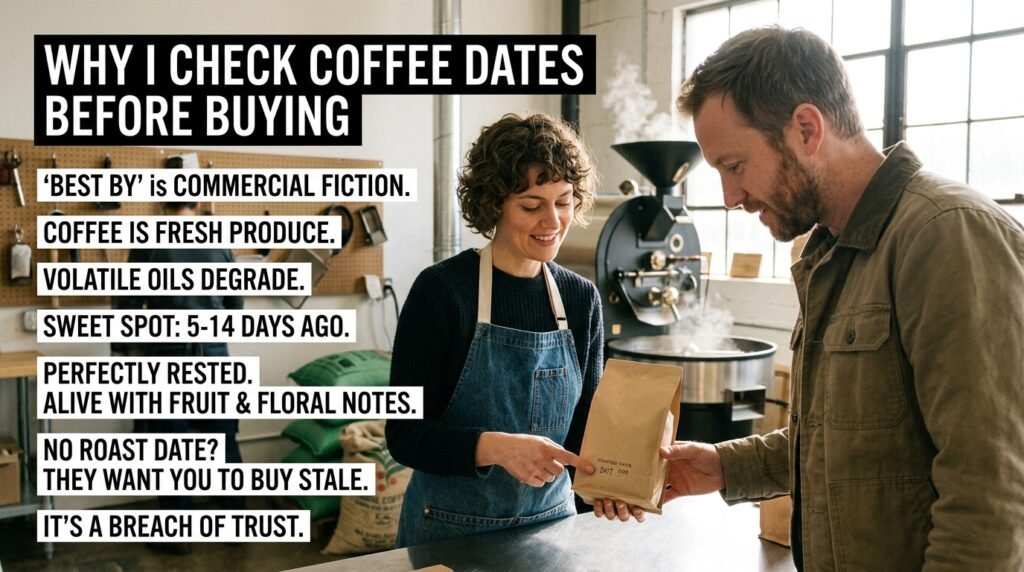
The biggest scam in the commercial coffee industry is the “Best By” date. It is a legal fiction designed to give a product an artificially long shelf life. A bag that says “Best By December 2026” tells me absolutely nothing about when that coffee was actually cooked.
Coffee is a fresh, baked good. It is full of volatile aromatic oils that evaporate rapidly when exposed to oxygen.
If I cannot verify the exact day the beans came out of the roasting machine, the bag is dead to me. Knowing this timeline is the exact reason (Why I Check Coffee Dates Before Buying) with absolute, unwavering strictness.
When I hold a bag in a specialty shop, I turn it around and hunt for the date stamp.
I want to see a date that is somewhere between five and fourteen days ago. This is the ultimate “sweet spot.” It means the coffee has had enough time to rest and release its aggressive carbon dioxide (degassing), but it hasn’t sat around long enough for oxygen to destroy its beautiful floral and fruit notes.
If a roaster does not proudly display the roast date, it means they want you to buy stale coffee without realizing it. It is the ultimate breach of trust.
Demystifying the Tasting Notes
The final detail I check on the label is the tasting notes, but I now read them with a completely different mindset.
When I was a beginner, I thought tasting notes like “Peach, Bergamot, and Black Tea” meant the coffee was artificially flavored. I avoided those bags because I wanted pure coffee.
Now, I understand that these notes are simply sensory metaphors. The roaster is trying to guide my palate. They are identifying the natural chemical compounds developed during the high-altitude growth and the gentle roasting process.
I use the tasting notes as a compass.
If a bag says “Dark Cocoa, Molasses, and Toasted Pecan,” I know the roaster applied a bit more heat, resulting in a heavy, comforting, low-acidity cup. It’s a great profile for a cold winter morning.
But if the bag says “Lemon Zest, Jasmine, and Honey,” my heart beats a little faster. I know the roaster used a very light touch, preserving the delicate, vibrant acids of the fruit. I know it is going to be a lively, awakening experience.
The Empowerment of the Informed Buyer
Checking all of these details might sound exhausting. It might sound like it takes the fun out of a simple morning beverage.
But for me, it did the exact opposite.
Learning to read the details empowered me. It transformed the coffee aisle from a confusing, anxiety-inducing wall of marketing hype into a fascinating library of global agriculture.
I no longer waste my money on pretty packaging that hides burnt, stale, untraceable beans. I don’t experience that specific feeling of betrayal at my kitchen table anymore.
When I buy a bag of coffee today, I know exactly what I am getting. I know the farmer’s region, the altitude they climbed, the genetics of the plant they nurtured, and the exact day the roaster finished the job.
I respect the immense human labor that goes into a bag of specialty coffee, and checking the details is how I honor that work.
If you want to permanently upgrade your mornings, stop trusting the bold adjectives on the front of the bag. Turn it around. Look for the farm. Look for the process. Look for the date.
Once you stop buying coffee blindly, you will finally start tasting the truth in your mug. And I promise you, the truth tastes incredibly sweet.
My name is Daniel Carter, I am 35 years old, and I live in the United States. I have been passionate about aquariums for many years, and what started as a simple hobby quickly became a lifelong interest in aquatic life, fish behavior, and responsible tank care.
Through TheBrightLance, I share real experiences, practical knowledge, and honest lessons learned from maintaining different types of aquariums. I enjoy testing equipment, studying fish behavior, improving maintenance routines, and helping beginners avoid common mistakes.
My goal is to make aquarism easier, more ethical, and more enjoyable for everyone — whether you are setting up your very first tank or looking to refine your techniques.