
There is a strange phenomenon that happens when you start getting into specialty coffee: you become a bit of a purist.
When I first started upgrading my morning routine, I fell hard for single-origin coffees. I wanted to taste the pure, unadulterated flavor of a specific farm in Colombia or a distinct mountainside in Kenya. I viewed blends—coffees mixed from different regions or countries—as something inferior. I thought blends were just a way for large companies to hide cheap, low-quality beans by mixing them with slightly better ones.
For a long time, I refused to buy them. If a bag didn’t have the exact GPS coordinates of the farm printed on the label, I didn’t want it.
But a few months ago, I was chatting with a head roaster at a local café. He challenged my perspective. He told me that while roasting a great single-origin is like letting a talented soloist play the violin, creating a perfect blend is like conducting an entire symphony. It requires a deep understanding of chemistry, flavor balance, and crop seasonality.
I was intrigued. Was I missing out on an entire world of flavor because of my own coffee snobbery?
I decided to find out. I set a challenge for myself: over the course of a couple of months, I would buy and test 10 different coffee blends from various roasters right in my own kitchen. I wanted to see if they could hold up to the single-origins I loved so much.
The experiment completely changed how I look at my morning cup. Here is exactly what I learned after trying 10 different coffee blends at home.
The Setup: Keeping the Variables Constant
Before I dive into the flavor revelations, I need to explain how I conducted this personal experiment. If you change too many things at once, you never really know what is affecting the taste of your coffee.
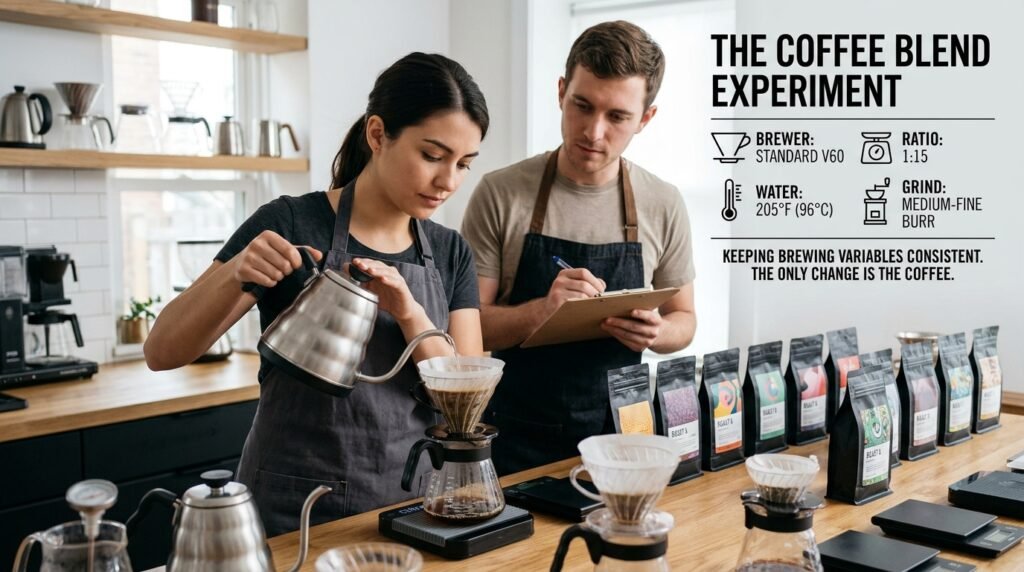
To give these 10 blends a fair fight, I had to keep my brewing variables aggressively consistent.
-
The Brewer: I used a standard V60 pour-over for every single cup. It produces a clean, filter-style coffee that highlights both the body and the delicate notes of a bean.
-
The Ratio: I stuck to my golden rule of 1:15 (15 grams of water for every 1 gram of coffee).
-
The Water Temperature: Exactly 205°F (96°C).
-
The Grinder: I used the same manual burr grinder on the same medium-fine setting.
By locking in these parameters, the only variable left was the coffee itself. If a cup tasted different, I knew it was entirely because of the roaster’s blending choices.
Lesson 1: The Anatomy of a Great Blend (The Base)
The very first thing I realized after tasting the first three blends was that a blend is not a random mixture. It is a carefully constructed recipe.
Almost every high-quality blend I tried had a “base” bean. This base usually makes up about 50% to 60% of the bag. Its job is not to be flashy or overly complex. Its job is to provide the foundation: the body, the mouthfeel, and the comforting, recognizable “coffee” flavor.
In my tests, I found that roasters heavily rely on beans from South or Central America for this foundation. Brazilian and Colombian coffees were incredibly common as the base. They provide those rich, heavy notes of milk chocolate, toasted almonds, and caramel.
When you have a strong, sweet foundation, the coffee feels anchored. It prevents the final cup from tasting too thin or too sour. This foundational concept made so much sense, especially when I recalled an earlier experiment where I Compared Coffees From 5 Countries — Here’s What I Found, realizing that South American beans naturally possess this crowd-pleasing, chocolatey weight.
Lesson 2: The Magic is in the “Accent” Beans
If the base bean is the cake, the accent beans are the frosting. This is where the roaster gets to show off their artistic skills.
Once the chocolatey or nutty foundation is laid down, a roaster will add smaller percentages (usually 15% to 30%) of highly aromatic, acidic, or fruity coffees to make the blend pop.
Blend number four was a perfect example of this. It was a “Breakfast Blend” from a reputable specialty roaster. The first sip was smooth and sweet, full of praline and cocoa. But as I swallowed, there was a sudden, vibrant burst of jasmine and fresh berries that lingered on the roof of my mouth.
I looked at the bag’s component list. The roaster had used a washed Heirloom variety from the Guji region of Ethiopia as the accent bean, making up just 20% of the bag.
It was a lightbulb moment. If that Ethiopian Guji had been brewed on its own, it might have been too floral or too acidic for a sleepy Tuesday morning. But combined with a heavy Brazilian base, it was pure magic. The Brazil gave it weight; the Ethiopia gave it life.
This completely shattered my belief that blends were just “average” coffees. A well-crafted blend takes the best characteristics of completely different regions and layers them together in a way nature could never do on a single farm.
Lesson 3: The Danger of “Kitchen Sink” Blends
Not all of the 10 blends were masterpieces. In fact, a couple of them were downright confusing.
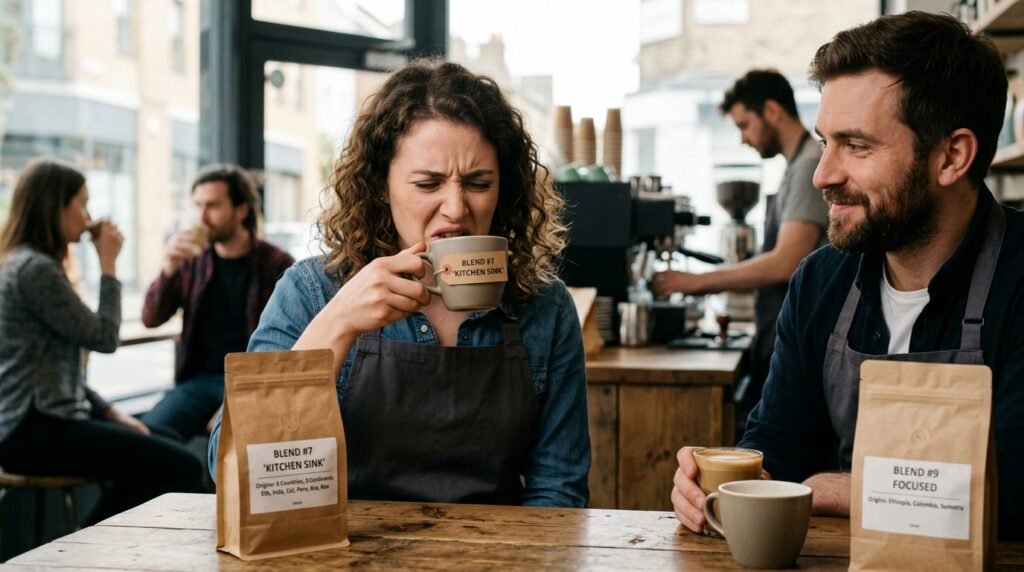
Around blend number seven, I tried what I like to call a “Kitchen Sink” blend. The bag proudly proclaimed that it contained beans from six different countries across three continents. It sounded impressive on the packaging, but in the cup, it was a disaster.
When you mix too many different origins together, the distinct flavors start to cancel each other out. The bright acidity of an African bean fights with the earthy, spicy notes of an Indonesian bean, while the Central American beans get entirely lost in the noise.
The resulting coffee didn’t taste complex; it just tasted muddy. It lacked identity.
I learned that the best blends I tried were incredibly focused. They rarely contained more than three different coffees. A base, a mid-palate sweetener, and a high-note accent. Anything more than that, and it felt like the roaster was just trying to get rid of leftover green coffee inventory by mixing it all together.
Lesson 4: Freshness Matters Even More in Blends
One of the most surprising discoveries of my 10-blend experiment was how drastically the flavor profile changed as the beans aged.
With a single-origin coffee, as the beans get older, the flavor slowly fades. It becomes a bit flatter and a bit duller, but it still fundamentally tastes like the same coffee.
Blends, however, are highly volatile. Because you have two or three different types of beans in the bag, they often age at different rates. They release their trapped carbon dioxide (a process called degassing) differently based on their density and how they were roasted.
I had a fantastic Mocha-Java style blend (a historic pairing of fruity Ethiopian beans and earthy Indonesian beans) for blend number five. On day four after roasting, it was perfectly balanced. By day fourteen, the fruity notes had almost entirely vanished, and the earthy, woody notes completely took over the cup. It tasted like a completely different brand of coffee.
This reinforced a golden rule I had previously established in my coffee journey. Realizing this volatility is exactly The Simple Change That Improved My Coffee Instantly, which involves buying smaller bags more frequently and obsessively checking the roast date. If you are buying a complex blend, you want to drink it within that magic window of 7 to 21 days post-roast to ensure the roaster’s intended balance is actually intact.
Lesson 5: Blends Are the Ultimate Test of a Roaster’s Skill
By the time I reached the final blend in my experiment, my respect for coffee roasters had skyrocketed.
Agriculture is unpredictable. A farm in Colombia might produce a coffee that tastes like milk chocolate one year, and dark chocolate with a hint of orange the next year, depending entirely on the rainfall and climate.
But consumers who buy a specific house blend from a café expect it to taste exactly the same every single morning. They want consistency.
How does a roaster provide a consistent flavor profile using an agricultural product that changes every season? They have to constantly tweak the recipe. If the Brazilian base crop is a little less sweet this year, the roaster has to source a different bean, or slightly alter the roast profile, or change the percentages, just to maintain that signature flavor.
It is a monumental task. When I drank a beautifully balanced house blend from a local roaster, I wasn’t just tasting coffee; I was tasting hours of cupping, testing, failing, and tweaking behind the scenes.
Finding the Perfect Balance for Espresso
While I conducted this experiment primarily with a V60 pour-over, I occasionally ran some of these blends through my home espresso machine. This is where blends truly dominate.
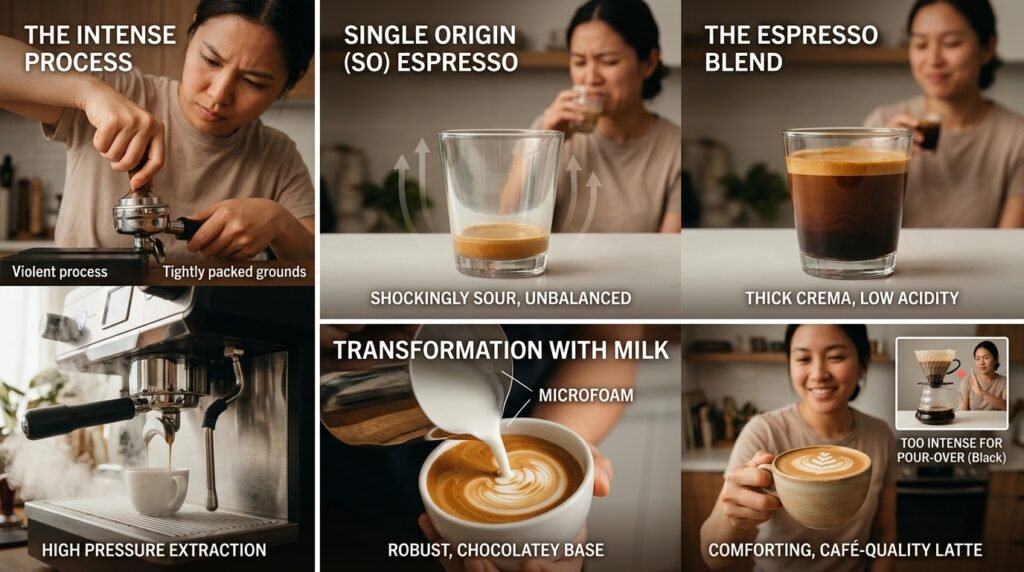
Extracting espresso is an intense, violent process. Hot water is forced through tightly packed grounds under immense pressure. When you use a delicate, highly acidic single-origin bean for espresso, the resulting shot is often shockingly sour and unbalanced.
But blends are built to withstand the pressure. A well-designed espresso blend usually features beans with lower acidity and higher oil content, creating that thick, gorgeous layer of crema on top.
During my testing, I found that blends specifically labeled as “Espresso Blends” were often too heavy and intense to enjoy as a black pour-over, but when pulled as a shot and mixed with steamed milk, they transformed. The robust, chocolatey foundation punched right through the milk, creating a comforting, café-quality latte right in my kitchen.
The Final Verdict: Do I Still Buy Single Origins?
After 10 bags, countless cups, and way too much caffeine, my experiment finally came to an end.
So, did this journey cure me of my single-origin snobbery? Absolutely.
I learned that blends are not a dumping ground for bad coffee; they are a canvas for a master roaster. They offer a level of balance, consistency, and complex layering that is incredibly difficult to find in a single crop.
Does this mean I will never buy a single-origin again? Of course not. There is still an undeniable thrill in tasting the unique, wild, and sometimes challenging flavors of a single farm in Kenya or a specific micro-lot in Panama. Exploring those distinct regional profiles is a huge part of How I Discovered My Favorite Type of Coffee, and I will always dedicate space on my shelf for those solo performances.
But I no longer view blends as second-class citizens. My daily coffee habit has become much more democratic.
On a slow Sunday morning, when I have the time to sit and dissect every subtle flavor note, I will still reach for a complex, bright single-origin pour-over.
But on a chaotic Tuesday morning, when I just need a reliable, comforting, perfectly balanced cup of coffee that tastes like a warm hug? I am reaching for a blend.
Your Turn to Experiment
If you have been stuck in a coffee rut, or if you, like me, used to avoid blends out of a misplaced sense of coffee purity, I highly encourage you to try your own version of this experiment.
Go to your favorite local roaster and buy their signature house blend. Don’t look at the components right away. Brew it carefully, take a sip, and try to isolate what you are tasting. See if you can find the heavy chocolate base. Try to locate the bright, fruity accent notes dancing on top.
You might just discover that a well-conducted symphony of beans is exactly what your morning routine has been missing all along.

My name is Daniel Carter, I am 35 years old, and I live in the United States. I have been passionate about aquariums for many years, and what started as a simple hobby quickly became a lifelong interest in aquatic life, fish behavior, and responsible tank care.
Through TheBrightLance, I share real experiences, practical knowledge, and honest lessons learned from maintaining different types of aquariums. I enjoy testing equipment, studying fish behavior, improving maintenance routines, and helping beginners avoid common mistakes.
My goal is to make aquarism easier, more ethical, and more enjoyable for everyone — whether you are setting up your very first tank or looking to refine your techniques.