
The Secret to a Thriving Aquarium: It’s All About the Little Things
I’ve been keeping freshwater aquariums for over a decade now, and if there’s one thing I’ve learned, it’s that the secret to a healthy and beautiful tank isn’t some grand, sweeping gesture. It’s not about buying the most expensive equipment or the rarest fish. It’s about the small, consistent maintenance habits that you incorporate into your routine. These seemingly insignificant actions add up over time, creating an environment where your fish can thrive and your plants can flourish.
Think of it like this: it’s like brushing your teeth. You don’t brush your teeth once a month for three hours straight. You brush them twice a day for a few minutes. The consistency is what matters. The same principle applies to aquarium keeping. Neglecting the small things will eventually lead to bigger problems down the road, from algae blooms to sick fish.
My Top Small Maintenance Habits for a Healthy Aquarium
Over the years, I’ve developed a set of small maintenance habits that I swear by. These are the things I do regularly to keep my tanks in top condition. They’re not complicated or time-consuming, but they make a world of difference.
1. The Daily Visual Inspection: More Than Just Enjoying the View
Every single day, I take a few minutes to just observe my tanks. I’m not just admiring the pretty fish; I’m actively looking for any signs of trouble. Are the fish behaving normally? Are they eating properly? Do their fins look healthy? Are there any signs of disease, like white spots or clamped fins? Are the plants growing well, or are they showing signs of nutrient deficiencies?
This daily visual inspection is crucial for catching problems early. The sooner you identify an issue, the easier it is to address it. For example, if I notice a fish acting lethargic or refusing to eat, I can immediately isolate it and start treatment. If I see a few spots of algae starting to appear, I can take action to prevent it from spreading. Don’t underestimate the power of observation – it’s your first line of defense against aquarium problems.
I remember one time, I noticed one of my neon tetras had a slightly swollen belly. At first, I thought nothing of it, but I kept an eye on it. The next day, it was even more swollen, and I noticed it was having trouble swimming. I immediately quarantined the fish and treated it for dropsy. Because I caught it early, the fish made a full recovery. If I hadn’t been doing my daily visual inspection, I might not have noticed the problem until it was too late.

2. The Weekly Water Change: Dilution is the Solution
This is probably the most important maintenance habit of all: the weekly water change. I know it can seem like a chore, but it’s absolutely essential for maintaining water quality. Over time, uneaten food, fish waste, and decaying plant matter accumulate in the tank, releasing harmful substances like ammonia, nitrite, and nitrate. These substances can stress your fish and make them more susceptible to disease.
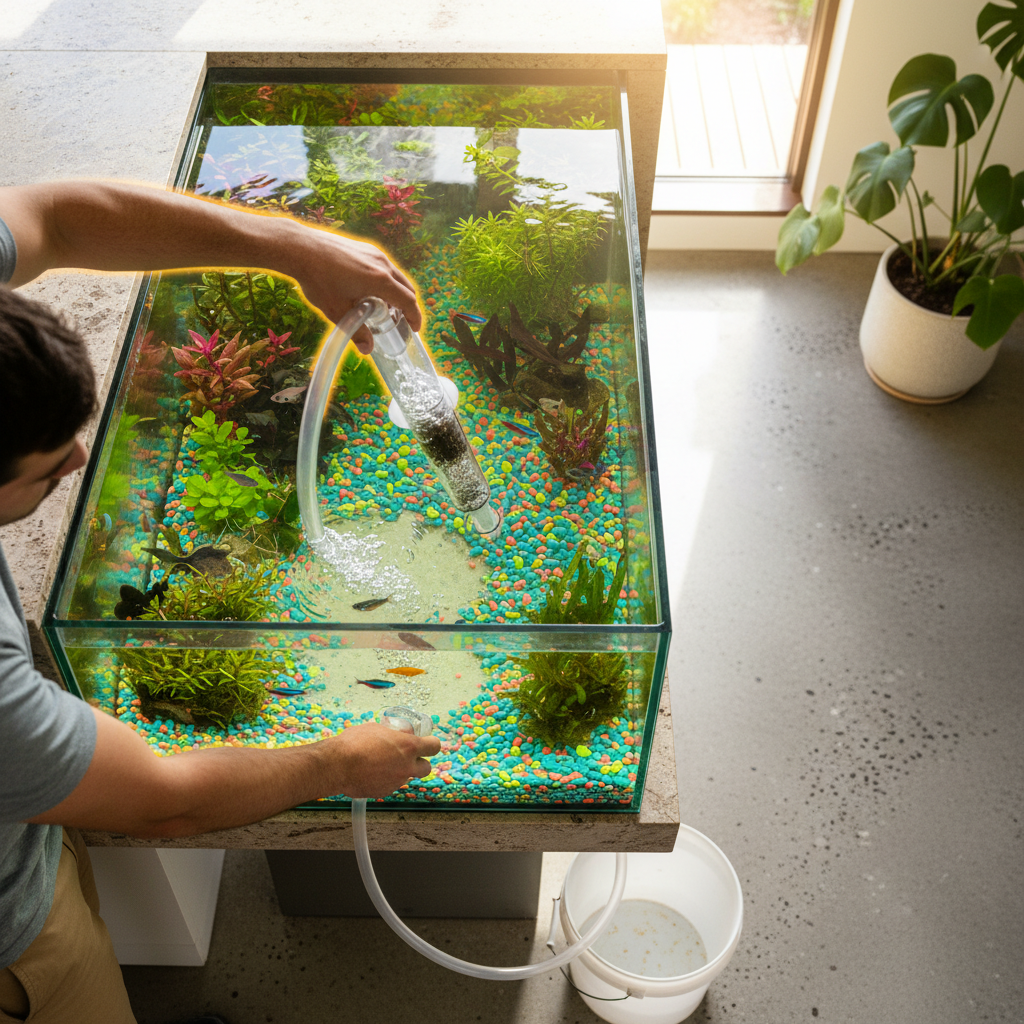
A weekly water change removes these harmful substances and replenishes essential minerals. I typically change about 25% of the water each week. It’s a simple process: I use a siphon to remove the old water, vacuuming the gravel at the same time to remove any debris. Then, I refill the tank with fresh, dechlorinated water.
Make sure the temperature of the new water is close to the temperature of the tank water to avoid shocking your fish. I use a thermometer to check the temperature before adding the water. I also add a water conditioner to neutralize any chlorine or chloramine in the tap water. Chlorine is toxic to fish and can damage their gills.
I’ve experimented with different water change schedules over the years, and I’ve found that weekly water changes are the sweet spot. They’re frequent enough to keep the water quality high, but not so frequent that they disrupt the tank’s ecosystem. I once tried doing water changes every two weeks, and I noticed a significant increase in algae growth and a decrease in the overall health of my fish. I quickly went back to weekly water changes, and the problems disappeared.
3. Filter Maintenance: Keeping the Engine Running Smoothly
Your filter is the heart of your aquarium. It removes debris, breaks down harmful substances, and keeps the water clean and clear. But a filter can only do its job if it’s properly maintained. I clean my filter every month or so, depending on the type of filter and the bioload of my tank.
The process is simple: I remove the filter media and rinse it in a bucket of old aquarium water. Never use tap water to clean your filter media! Tap water contains chlorine, which can kill the beneficial bacteria that live in the filter. These bacteria are essential for breaking down ammonia and nitrite. By rinsing the filter media in old aquarium water, you remove the debris without killing the beneficial bacteria.
Don’t clean the filter media too thoroughly. You want to remove the large particles of debris, but you don’t want to completely sterilize the media. A light rinsing is all that’s needed. I also inspect the filter impeller and clean it if necessary. A dirty impeller can reduce the filter’s flow rate and make it less effective.
I’ve seen firsthand the consequences of neglecting filter maintenance. One time, I forgot to clean my filter for several months, and the flow rate dropped to almost nothing. The water became cloudy, and my fish started to act stressed. It took me several weeks of water changes and thorough filter cleaning to get the tank back to normal. Lesson learned: don’t neglect your filter!
4. Algae Control: A Constant Battle, But Worth Fighting
Algae is the bane of every aquarist’s existence. It can quickly turn a beautiful tank into an unsightly mess. While some algae is normal and even beneficial, excessive algae growth can be a sign of imbalance in the tank. Too much light, too many nutrients, or poor water circulation can all contribute to algae blooms.
I use a variety of methods to control algae in my tanks. First, I make sure my tanks aren’t getting too much light. I use a timer to control the lighting schedule, and I avoid placing my tanks in direct sunlight. Second, I regularly test my water for nitrates. High nitrate levels can fuel algae growth. If my nitrate levels are too high, I do a water change to lower them.
Third, I use algae-eating fish and invertebrates to help control algae. Otocinclus catfish are excellent algae eaters, as are Nerite snails. These little guys constantly graze on algae, keeping it under control. Finally, I manually remove algae with an algae scraper or a toothbrush. I clean the glass and decorations regularly to prevent algae from building up.
One of my biggest challenges with algae was a persistent outbreak of green spot algae. This type of algae forms tiny, hard spots on the glass and is difficult to remove. I tried everything: reducing the light, increasing water changes, adding more algae eaters. Nothing seemed to work. Finally, I discovered that the problem was a lack of phosphate. Green spot algae thrives in low-phosphate environments. I started adding a small amount of phosphate fertilizer to my tank, and the green spot algae disappeared within a few weeks. It just goes to show that understanding the specific needs of your tank is crucial for controlling algae.

5. Plant Maintenance: Pruning and Fertilizing for Lush Growth
Healthy plants not only make your aquarium look beautiful, but they also play a vital role in maintaining water quality. Plants absorb nitrates, produce oxygen, and provide shelter for fish. But plants, like any living thing, require care and maintenance to thrive. I regularly prune my plants to remove dead or dying leaves and to encourage new growth. I also fertilize my plants with a liquid fertilizer to provide them with the nutrients they need.
The type of fertilizer you use will depend on the type of plants you have. Some plants are heavy feeders and require a lot of nutrients, while others are more self-sufficient. I use a combination of liquid fertilizer and root tabs to provide my plants with a balanced diet. Root tabs are slow-release fertilizers that are placed near the roots of the plants.
I also pay attention to the lighting in my tank. Different plants have different lighting requirements. Some plants need strong light to thrive, while others prefer low light. If your plants aren’t getting enough light, they will become leggy and pale. If they’re getting too much light, they may develop algae or become stunted.
I remember when I first started keeping planted aquariums, I struggled to keep my plants alive. They would always turn yellow and die. I tried everything: different fertilizers, different lighting schedules, different substrates. Nothing seemed to work. Finally, I realized that the problem was a lack of carbon dioxide (CO2). Plants need CO2 to photosynthesize. I started injecting CO2 into my tank with a CO2 system, and my plants exploded with growth. It was a game-changer.
6. Substrate Vacuuming: Keeping the Base Clean
The substrate, whether it’s gravel or sand, acts as a filter and a home for beneficial bacteria. However, it also accumulates fish waste, uneaten food, and decaying plant matter. If you don’t vacuum your substrate regularly, these organic materials can break down and release harmful substances into the water, leading to poor water quality and algae blooms.
I vacuum my substrate during my weekly water changes. I use a gravel vacuum, which is a siphon with a wide tube that allows you to stir up the substrate and suck up the debris without removing the substrate itself. I gently push the gravel vacuum into the substrate, stirring it up slightly to release any trapped debris. I then move the vacuum along the bottom of the tank, sucking up the debris and the old water.
Be careful not to vacuum too deeply into the substrate, as this can disrupt the beneficial bacteria that live there. Also, avoid vacuuming around the roots of your plants, as this can damage them. If you have a planted tank, you may want to use a special substrate vacuum that is designed for planted tanks. These vacuums have a wider tube and a gentler suction, which helps to protect the plants.
I once neglected to vacuum my substrate for several months, and the buildup of debris was incredible. The water became cloudy, and my fish started to act lethargic. When I finally got around to vacuuming the substrate, the amount of gunk that came out was shocking. It took me several water changes to get the tank back to normal. Now, I make sure to vacuum my substrate religiously every week.
7. Equipment Checks: Ensuring Everything is Working Properly
Your aquarium relies on a variety of equipment to function properly, including filters, heaters, lights, and air pumps. It’s important to regularly check your equipment to make sure it’s working correctly. A malfunctioning heater can overheat your tank, killing your fish. A clogged filter can lead to poor water quality. A broken light can stunt plant growth.
I check my equipment at least once a week. I make sure my heater is maintaining the correct temperature. I check the flow rate of my filter. I inspect my lights to make sure they’re working properly. I also clean my air pump and air stone to ensure they’re providing adequate aeration.
I also keep spare parts on hand for my equipment. This way, if something breaks down, I can quickly replace it without having to run to the store. I keep spare heaters, filters, lights, and air pumps on hand. It’s always better to be prepared.
I once had a heater malfunction and overheat my tank. I didn’t realize it until it was too late. By the time I discovered the problem, the water temperature was over 90 degrees Fahrenheit. I lost several fish that day. It was a devastating experience. Since then, I’ve made it a point to check my equipment regularly to prevent similar problems from happening again.
Why Small Habits Matter: The Long-Term Benefits
It’s easy to get caught up in the excitement of setting up a new aquarium and forget about the long-term maintenance. But neglecting the small maintenance habits will eventually catch up with you. Poor water quality, algae blooms, sick fish, and stunted plant growth are all consequences of neglecting the small things.
By incorporating these small maintenance habits into your routine, you can create a healthy and thriving aquarium that will bring you years of enjoyment. Your fish will be healthier, your plants will be more vibrant, and your tank will be more beautiful. Plus, you’ll save yourself a lot of headaches and money in the long run by preventing problems before they start. Think of it as preventative medicine for your aquarium.
These small habits aren’t just about keeping your tank clean and healthy. They’re also about connecting with your aquarium and observing the subtle changes that occur within its ecosystem. By taking the time to observe your fish, plants, and water quality, you’ll gain a deeper understanding of how your aquarium works. This understanding will allow you to make informed decisions about how to care for your tank and ensure its long-term health and beauty.
Aquarium keeping is a journey, not a destination. There will be ups and downs along the way. But by focusing on the small maintenance habits, you can create a stable and thriving ecosystem that will provide you with years of enjoyment and learning. So, take a few minutes each day to observe your tank, perform your weekly water changes, clean your filter, control algae, prune your plants, vacuum your substrate, and check your equipment. Your aquarium will thank you for it.

Ultimately, the small maintenance habits are about more than just keeping your aquarium clean. They’re about creating a sustainable ecosystem where your fish, plants, and beneficial bacteria can thrive. It’s a delicate balance, and it requires consistent effort and attention to detail. But the rewards are well worth it. A thriving aquarium is a source of beauty, relaxation, and endless fascination.
My name is Daniel Carter, I am 35 years old, and I live in the United States. I have been passionate about aquariums for many years, and what started as a simple hobby quickly became a lifelong interest in aquatic life, fish behavior, and responsible tank care.
Through TheBrightLance, I share real experiences, practical knowledge, and honest lessons learned from maintaining different types of aquariums. I enjoy testing equipment, studying fish behavior, improving maintenance routines, and helping beginners avoid common mistakes.
My goal is to make aquarism easier, more ethical, and more enjoyable for everyone — whether you are setting up your very first tank or looking to refine your techniques.