
If you ever decide to redesign your living room, you might go to a high-end hardware store and spend a massive amount of money on premium, designer paint.
You pick out the perfect, sophisticated shade of gray. You buy the expensive, professional-grade rollers and the high-quality synthetic brushes. You carry everything into your living room, completely motivated to transform your space into a masterpiece.
But because you are excited and impatient, you decide to skip a crucial step.
You look at the roll of blue painter’s tape you bought, and you toss it aside. You convince yourself that taping the baseboards, the window frames, and the edges of the ceiling is a tedious, boring waste of time. You assume you have a steady enough hand to just paint the edges perfectly without any guidance.
By the end of the weekend, you step back to look at your work, and your heart sinks.
The room is an absolute disaster. The expensive gray paint is smeared carelessly across the white ceiling. There are drips all over your wooden baseboards. You took premium, beautiful materials, and because you skipped the foundational preparation, the room looks sloppy, chaotic, and worse than when you started.
For a very long time, my morning coffee routine was the exact equivalent of painting a room without using painter’s tape.
I was buying incredible, highly rated, expensive coffees from Ethiopia, Colombia, and Guatemala. I had a beautiful glass pour-over cone. But because I was completely ignoring the invisible, foundational rules of extraction, my coffee always tasted muddy, bitter, and aggressively disappointing.
Here is the honest, highly technical, and deeply practical story of why my coffee improved after fixing these mistakes, the lazy habits I had to unlearn, and how applying the “painter’s tape” to my morning routine finally unlocked the flawless flavor I had been chasing.
Mistake One: The Arrogance of Eyeballing
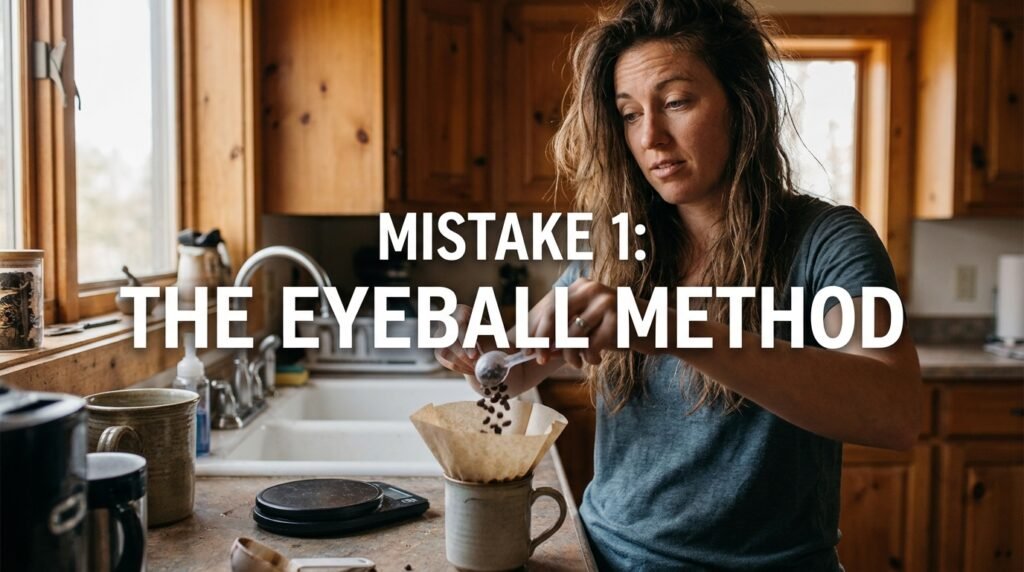
The very first mistake that was smearing paint all over my ceiling was my absolute refusal to measure my ingredients properly.
When you watch a professional barista make coffee, their movements are so fluid and natural that it looks like an art form. I wanted my mornings to feel like that. I didn’t want to feel like a scientist in a laboratory, meticulously weighing every single drop of water.
So, I relied on my intuition.
I would take my bag of premium coffee, grab a plastic spoon, and dump what looked like a “good amount” into the paper filter. Then, I would take my kettle and pour hot water until the ceramic mug looked reasonably full.
I was completely destroying the chemical equation of coffee.
Coffee extraction is a strict mathematical relationship between the mass of the roasted seed and the mass of the liquid water. Because different coffee beans have vastly different densities, a visual scoop of a dark roast weighs completely different than a visual scoop of a light roast.
By eyeballing my ingredients, I was essentially changing the recipe every single day.
One morning, the coffee would be weak and sour. The next morning, it would be overwhelmingly thick and bitter. Realizing that I had to surrender my intuition to strict mathematics was the core lesson of (The Simple Brewing Mistakes I Used to Make Every Day).
I finally bought a digital scale. I started weighing exactly 15 grams of coffee and exactly 240 grams of water. The wild, chaotic unpredictability instantly vanished.
Mistake Two: Brewing With Dead Water
Once I locked in my ratio with a digital scale, I noticed my coffee was consistent, but it still tasted incredibly flat. It lacked the vibrant, sparkling acidity that I tasted when I bought a cup from a local specialty cafe.
I blamed the beans. I thought the roaster had given me an old batch.
But the real culprit was hiding inside my stovetop kettle.
Because I am naturally lazy in the mornings, I used to leave leftover water in my kettle overnight. The next morning, I would just walk into the kitchen, turn the stove on, and re-boil the water from yesterday.
I did not understand the chemistry of dissolved oxygen.
Fresh water contains a significant amount of dissolved oxygen molecules. These microscopic oxygen bubbles act as a vehicle for flavor extraction. They help pull the volatile aromatic oils out of the coffee grounds and carry them to your palate.
When you boil water, you physically force a massive amount of that dissolved oxygen out of the liquid. The water becomes “flat.”
If you leave that boiled water in the kettle overnight and then boil it a second time the next morning, you are essentially brewing your coffee with completely dead, deoxygenated water. It strips the coffee of its brightness and makes the entire cup taste heavy, muddy, and lifeless.
Now, I completely empty my kettle every single morning. I only use fresh, cold, filtered water for every single brew. The sparkling acidity immediately returned to my mug.
Mistake Three: The Unseen Thermal Crash
Even with fresh water and a digital scale, I still had a massive problem with the actual temperature of the beverage I was drinking.
I would spend ten minutes meticulously grinding, weighing, and brewing a beautiful cup of coffee. The liquid falling from the glass cone was steaming hot. But by the time I walked to my living room, sat down on the couch, and took my first sip, the coffee was already lukewarm and disappointing.
I thought my apartment was just drafty.
I was completely ignoring the unforgiving laws of thermodynamics. I was brewing 200-degree coffee directly into a heavy ceramic mug that had been sitting in a cold kitchen cabinet all night.
A heavy, cold ceramic mug is a thermal vampire.
The exact second the hot coffee hits the cold ceramic walls, the mug aggressively absorbs the heat energy from the liquid in order to warm itself up. It physically steals the heat from your beverage.
Fixing this invisible temperature drop perfectly illustrates (How I Made Better Coffee With Simple Changes). The fix cost absolutely nothing and required zero new equipment.
Before I brew my coffee, I pour an ounce of hot water from my kettle directly into my empty ceramic mug. I let it sit there for thirty seconds while I grind my beans. The hot water pre-heats the heavy clay.
When I dump the waste water and brew my actual coffee, the liquid falls into a thoroughly heated environment. It stays piping hot for twenty minutes, allowing me to actually sit back, relax, and enjoy the morning.
Mistake Four: The Agitation Overload
My next mistake was born purely out of a desire to be overly involved in the brewing process.
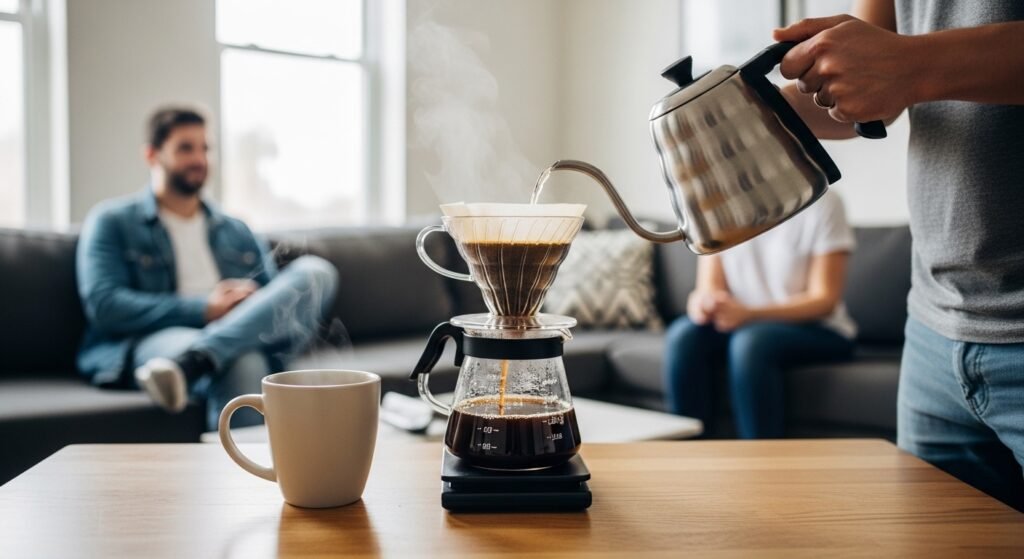
I had read online that “agitation” helps extract more flavor from the coffee grounds. So, while my coffee was brewing in the glass V60 cone, I would take a metal spoon and aggressively stir the wet coffee slurry. I would violently churn the grounds, thinking I was helping the water reach every single particle.
Instead, I was causing a massive mechanical failure.
When you aggressively stir a bed of ground coffee, physics takes over. The heavier, larger coffee particles float to the top, while all of the microscopic, powdery “fine” particles sink directly to the bottom.
Those fines settle directly against the paper filter, creating an impenetrable layer of wet cement.
Suddenly, the water could not drain. A brew that was supposed to take three minutes would completely stall, taking five or six minutes to painfully drip into my mug. Because the water was trapped in the grounds for so long, it severely over-extracted the coffee, pulling out harsh, dry, astringent tannins that made my mouth feel like I had just chewed on an old piece of wood.
I stopped touching the coffee entirely.
I put the spoon away. Now, I just pour my water in slow, gentle, concentric circles. I let gravity and the gentle flow of the kettle do all the work. The water drains perfectly on time, and the harsh, dry astringency has completely disappeared from my life.
Mistake Five: The Microwave Crime
The final mistake I made was the most egregious, offensive culinary crime a coffee drinker can possibly commit.
Because I worked from home, I used to brew a massive, 32-ounce French Press of coffee at 7:00 AM. I would drink one mug, and I would leave the rest sitting on the counter for hours.
By 1:00 PM, I would want a midday caffeine boost. I would pour the ice-cold, leftover coffee into a mug, place it in the microwave, and aggressively nuke it for two minutes.
I knew it didn’t taste great, but I had absolutely no idea how chemically destructive this habit was.
Coffee is absolutely packed with chlorogenic acids. When coffee is freshly brewed, these acids are highly stable and contribute to the bright, crisp flavor profile.
But when coffee cools down to room temperature, and then you violently blast it with microwave radiation to reheat it, a horrific chemical reaction occurs. The chlorogenic acids break down and convert into quinic acid and caffeic acid.
Quinic acid is intensely, violently bitter. It is the exact same chemical compound that makes old diner coffee taste like stale stomach acid.
You cannot reheat coffee without destroying it. Once the temperature drops, the chemical composition permanently changes.
Learning to brew smaller, fresher batches was exactly (How I Stopped Wasting Good Coffee).
I completely stopped using a massive French Press. I only brew exactly the amount of coffee I am going to drink right now. If I want a second cup of coffee at 1:00 PM, I go back to the kitchen, grind fresh beans, and brew a brand new cup.

The Masterpiece Revealed
When you first dive into the world of specialty coffee, it is incredibly easy to be blinded by the expensive equipment.
We convince ourselves that we need a more expensive grinder, a fancier kettle, or a higher-rated bag of beans to fix our frustrating mornings. We keep buying more expensive paint, completely ignoring the fact that we are smearing it all over the ceiling.
But the truth is, a perfect cup of coffee is rarely achieved by opening your wallet.
It is achieved by auditing your own lazy habits. It is achieved by recognizing the small, invisible mistakes you are making every single morning, and taking the time to correct them.
If your coffee is currently tasting bitter, flat, or unpredictable, I challenge you to put the tape on the baseboards tomorrow morning.
Empty your kettle and use fresh water. Turn on your digital scale and actually weigh your coffee. Pour some hot water into your mug to pre-heat the ceramic. Put the spoon away and stop stirring the grounds. And for the love of all things culinary, never put your coffee in the microwave.
When you finally eliminate these careless mistakes and respect the delicate physics of the extraction process, you will step back, look at your morning routine, and realize that you have finally created an absolute masterpiece.

My name is Daniel Carter, I am 35 years old, and I live in the United States. I have been passionate about aquariums for many years, and what started as a simple hobby quickly became a lifelong interest in aquatic life, fish behavior, and responsible tank care.
Through TheBrightLance, I share real experiences, practical knowledge, and honest lessons learned from maintaining different types of aquariums. I enjoy testing equipment, studying fish behavior, improving maintenance routines, and helping beginners avoid common mistakes.
My goal is to make aquarism easier, more ethical, and more enjoyable for everyone — whether you are setting up your very first tank or looking to refine your techniques.