
If you were to purchase a three-hundred-dollar bottle of vintage, highly celebrated champagne for a special occasion, you would treat it with an immense amount of respect.
You would wait for the perfect Friday evening. You would carefully untwist the wire cage, pop the cork, and pour a beautiful, effervescent glass of golden wine. You would smell the complex notes of toasted brioche and green apple, and you would marvel at the sharp, aggressive bubbles dancing on your tongue.
But imagine if, after drinking that single glass, you simply left the open bottle sitting on your kitchen counter.
Imagine you went to sleep, woke up on Saturday, left the bottle there all weekend, and then tried to pour yourself another glass on Wednesday afternoon.
What would that expensive champagne taste like?
It would be completely ruined. The carbonation would be entirely gone. The complex, vibrant flavors would have oxidized into a flat, sour, lifeless puddle of stale grape juice. You wouldn’t blame the winemaker for the terrible taste; you would blame yourself for leaving the bottle open.
Yet, when it comes to specialty coffee, millions of us commit this exact same culinary crime every single week.
We buy incredible, expensive, highly complex coffee beans, and we essentially leave the bottle uncorked on the counter. We watch the flavor evaporate into thin air, and then we wonder why our morning mug tastes so flat and disappointing.
Here is the honest, highly practical story of how I learned to store coffee without losing flavor, the invisible evaporation I had to stop, and how treating my coffee beans like an open bottle of vintage champagne completely transformed my daily routine.
The Invisible Effervescence
The absolute biggest hurdle I had to overcome in my coffee journey was fundamentally changing how I viewed the physical coffee bean.
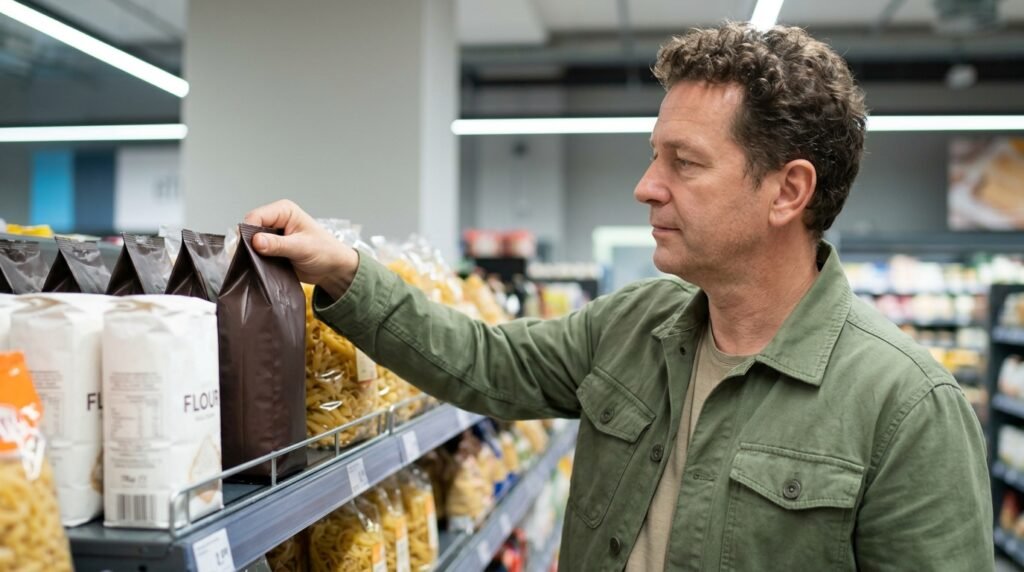
Because we buy coffee in the same grocery aisle as dried pasta, canned beans, and white flour, we are psychologically conditioned to view it as a dry, non-perishable pantry staple. We look at the hard, brown seed and assume it is practically invincible.
This is a massive, devastating illusion.
A roasted coffee bean is actually a fragile, highly volatile vessel containing hundreds of complex aromatic oils. During the intense heat of the roasting process, the cellular structure of the seed expands, creating these delicate flavor compounds.
If you buy a high-quality Colombian or a bright, naturally processed Ethiopian coffee, those oils are the exact reason the coffee tastes like milk chocolate or wild blueberries.
But the exact second the coffee leaves the roasting drum, it begins to release carbon dioxide gas, and those delicate oils begin to aggressively interact with the oxygen in the air.
Coffee has an invisible effervescence. It is constantly evaporating. Understanding this fast-paced chemical reality was the massive turning point of (What I Wish I Knew Before Buying My First Coffee Beans). I realized that my coffee was literally disappearing into thin air while it sat in my kitchen.
The Illusion of the Paper Bag
For the first few years of my specialty coffee obsession, my storage method was completely thoughtless.
I would buy a beautiful bag of freshly roasted Guatemalan coffee from a local artisan shop. The bag was made of thick, rustic craft paper, lined with a thin layer of foil.
Every morning, I would open the bag, weigh out my beans, and then simply roll the top of the paper down. I would secure it with the flimsy little wire tie attached to the bag, or sometimes I would just use a plastic chip clip. I would throw the bag into my pantry and assume the coffee was safe.
I was completely ignoring the microscopic reality of oxygen.
Rolling down a paper bag and clipping it does absolutely nothing to stop the ambient air in your kitchen from circulating through the coffee. Oxygen molecules are microscopic. They easily slip past the plastic clip, constantly washing over the beans, drying out the aromatic oils, and accelerating the staling process.
By the end of the second week, my vibrant, expensive Guatemalan coffee tasted like dusty cardboard.
I was furious because I thought the roaster had given me a bad batch. But I was actually just suffocating my own ingredients. I had to abandon the rustic paper bag entirely if I wanted to preserve the sweetness.
The Aesthetic Glass Trap
Once I realized the paper bag was allowing my coffee to oxidize, I made a very common, very expensive pivot.
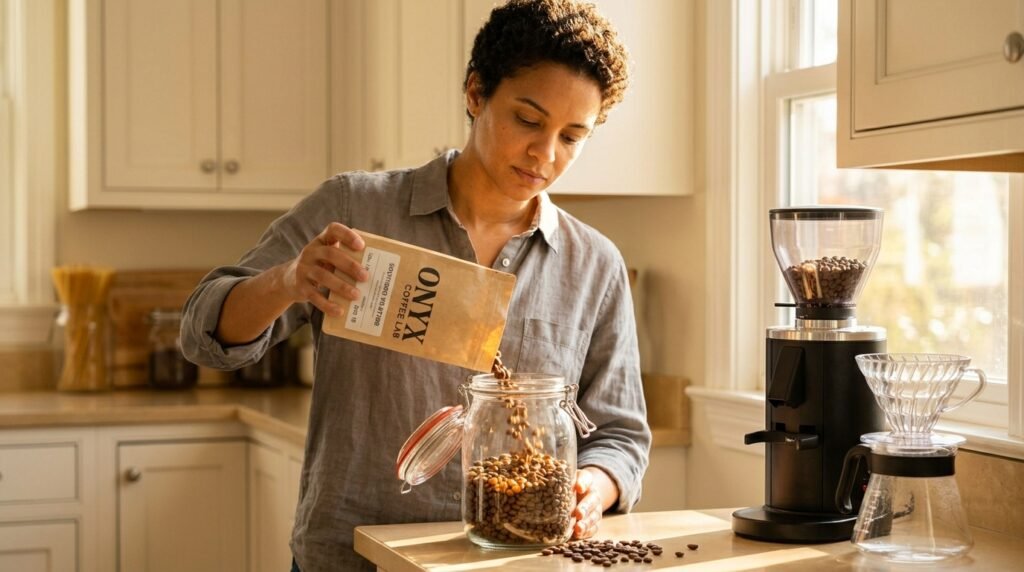
I wanted to completely seal the coffee away from the air. I also wanted my kitchen counter to look like a beautiful, high-end barista station. So, I went to a home goods store and purchased a heavy, clear glass mason jar with a thick rubber gasket and a metal locking clasp.
It was perfectly airtight. I poured my freshly roasted beans into the glass jar and placed it proudly on my counter, right next to my burr grinder and my glass pour-over cone.
I had successfully locked out the oxygen. But I had accidentally invited a much more aggressive enemy into the jar.
Ultraviolet light.
Coffee beans are highly photosensitive. When you place them in a clear glass jar on a sunlit kitchen counter, the ultraviolet rays from the window act like a magnifying glass. The light physically agitates the delicate organic compounds inside the bean.
It forces the aromatic oils to sweat out onto the surface of the bean, where they immediately turn rancid and bleach under the sunlight.
Within ten days, my coffee tasted incredibly harsh, bitter, and completely hollow. Realizing why this happened was a massive part of (Why Some Coffees Taste So Different (My Personal Discovery)). I learned that coffee does not want to be a display piece. It is a vampire. It needs to live in the dark.
The Refrigerator Catastrophe
When I complained to a coworker that my coffee was still going stale, they offered me a piece of advice that is repeated on almost every casual coffee blog on the internet.
They told me to put my coffee in the freezer or the refrigerator to “preserve” the freshness.
The logic seems completely sound. If we want to keep vegetables, meat, and dairy fresh, we lower the temperature to slow down the biological decay. Why wouldn’t we do the exact same thing for a roasted seed?
I placed my next bag of coffee directly into the refrigerator.
Three days later, I ground the beans and brewed my morning cup. I took one sip and immediately poured the entire mug down the kitchen sink. The coffee tasted aggressively like chopped garlic, leftover onions, and stale plastic.
I had completely forgotten that roasted coffee beans are highly porous. They act exactly like microscopic sponges. If you place them in a refrigerator, they will violently absorb every single ambient odor floating around in that confined space.
Even worse, every time I took the cold bag of coffee out of the fridge and opened it in my warm, humid kitchen, I subjected the beans to instant thermal shock.
Microscopic condensation immediately formed on the surface of the cold beans. This moisture instantly attacked the fragile oils, destroying the cellular integrity of the coffee and inviting invisible mold. The refrigerator is the absolute fastest way to completely destroy a premium bag of coffee.
The Ultimate Vault: Opaque and Vacuum-Sealed
After ruining hundreds of dollars’ worth of incredible coffee through oxidation, UV exposure, and condensation, I finally decided to stop guessing.
I needed to build a perfect, impenetrable vault for my morning routine.
Taking this final step was the exact moment (How I Stopped Wasting Good Coffee). I stopped relying on cheap kitchen hacks and finally invested in a professional-grade storage solution.
I threw away the clear glass jars and the plastic clips. I purchased a specialized, matte black stainless steel coffee canister.
Because the canister is made of solid, opaque metal, absolutely zero ultraviolet light can penetrate the walls. I can leave it sitting right on my kitchen counter in the afternoon sun, and the beans inside remain in pitch-black darkness, perfectly protecting their photosensitive oils.
But the true genius of the canister is hidden in the lid.
When I pour my fresh coffee beans into the steel container and press the lid down, a mechanical one-way valve actively forces all of the ambient air out of the chamber. It creates a near-vacuum environment.
The Reward of Preservation
The very first month I used this vacuum-sealed, opaque canister, the results completely defied my expectations.
I bought a beautiful, bright Ethiopian roast. I drank it every single morning for three weeks.
In my old life, by day twenty-one, that coffee would have tasted like weak, bitter wood. But because I had locked out the oxygen, blocked the sunlight, and kept the beans at a stable room temperature, the degradation was almost entirely halted.
The cup I brewed on the twenty-first day tasted almost exactly as explosive, sweet, and complex as the cup I brewed on the second day. The delicate jasmine notes were still there. The bright blueberry acidity was fully intact.
I had finally figured out how to put the cork back in the champagne bottle.
The Law of Purchase Volume
Even with the greatest storage technology on the planet, there is one final, unavoidable law of physics you must accept.
You cannot reverse the flow of time.
A vacuum canister will drastically slow down the staling process, but it cannot stop it permanently. Coffee is an organic, decaying agricultural product. Eventually, the aromatics will fade, even in the dark.
This realization forced me to change not just how I stored my coffee, but how I bought it.
I completely stopped buying massive, two-pound bulk bags to save a few dollars. I realized that the “discount” of buying in bulk was completely negated by the fact that I was drinking terrible, stale coffee for the last two weeks of the bag.
Now, I strictly purchase standard 12-ounce bags from local independent roasters. I only buy exactly the amount of coffee I know I will consume within a fourteen-to-twenty-one-day window.
By the time the coffee naturally reaches the end of its peak flavor window, the canister is already empty. I am never forced to drink stale coffee, because I never allow my supply to outlive its freshness.
Protect Your Investment
We work incredibly hard for our money. We spend massive amounts of time researching the best burr grinders, perfecting our pouring techniques, and sourcing the highest quality, ethically grown specialty coffee beans from around the world.
If you are doing all of this heavy lifting, you absolutely must protect your investment once it enters your home.
Do not let the bottle of champagne go flat.
I challenge you to audit your kitchen today. Look at how you are treating your coffee. Is it rolled up in a paper bag? Is it sitting in a clear jar soaking up the sun? Is it sitting next to the leftover takeout in your refrigerator?
Stop sabotaging your own mornings. Invest in an opaque, vacuum-sealed canister. Keep it away from the fridge, the oven, and the sunlight. Buy smaller batches more frequently.
When you finally start storing your coffee with the respect it actually deserves, you will stop fighting against bitter, hollow flavors. You will unlock the true, vibrant, and incredibly sweet potential of the bean, and your morning mug will reward you with a flawless performance, every single time.

My name is Daniel Carter, I am 35 years old, and I live in the United States. I have been passionate about aquariums for many years, and what started as a simple hobby quickly became a lifelong interest in aquatic life, fish behavior, and responsible tank care.
Through TheBrightLance, I share real experiences, practical knowledge, and honest lessons learned from maintaining different types of aquariums. I enjoy testing equipment, studying fish behavior, improving maintenance routines, and helping beginners avoid common mistakes.
My goal is to make aquarism easier, more ethical, and more enjoyable for everyone — whether you are setting up your very first tank or looking to refine your techniques.