
A viewer might look at the finished artwork and see a cyberpunk character standing on a rain-slicked street under a dramatic, stormy sky. It looks like one seamless reality.
But as the digital artist, I know the invisible truth. I know that the image is actually a global Frankenstein.
The photograph of the stormy sky was pulled from an asset library shot in Iceland. The neon-lit, rain-slicked street was sourced from a photograph taken in Tokyo. The human model was photographed in a bright studio in São Paulo, Brazil.
I spent hours meticulously matching the lighting, adjusting the color curves, and blending the pixels until those three completely different corners of the earth merged into a single, unified frame. The final image is an illusion of locality; it is actually a global collaboration.
For the vast majority of my adult life, my perception of my morning coffee was trapped in that exact same illusion of locality.
Because I bought it at a local supermarket, brewed it in my local kitchen, and drank it in my local neighborhood, I subconsciously assumed it was a local product. I never stopped to think about the source assets.
But when I finally peered behind the layers and looked at the raw data of the bean, my entire worldview shifted. Here is the honest, awe-inspiring story of the moment I realized coffee is a global experience, the staggering human chain required to fill a single mug, and how this realization completely changed the way I interact with the world every morning.
The Illusion of the Drive-Thru
To understand the magnitude of this shift, you have to understand how completely detached I used to be from the food and beverages I consumed.
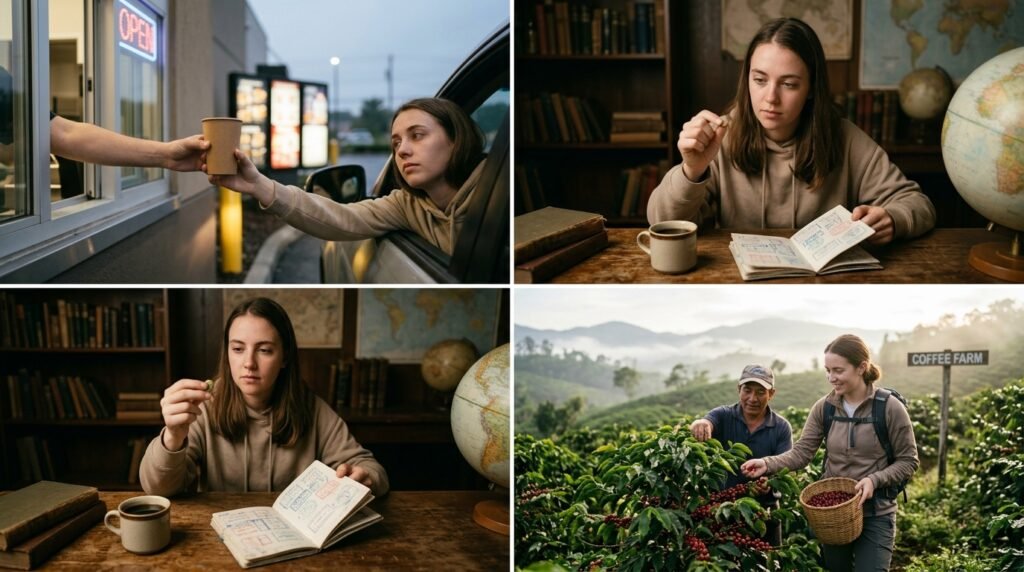
In the modern Western world, convenience is the ultimate goal. We are completely insulated from the agricultural reality of our diets. If we want coffee, we drive up to a window, speak into a plastic microphone, hand a few dollars to a teenager, and receive a steaming paper cup in return.
The entire transaction takes less than forty-five seconds.
Because the process is so fast, sterile, and automated, it is incredibly easy to believe that coffee is simply manufactured in the back room of that building. We treat it like a synthetic soda.
I lived in this comfortable, localized bubble for years. I drank bitter, dark roast coffee purely for the caffeine, completely unaware that the liquid in my cup had a passport with more stamps than my own.
The Clue on the Label
The illusion finally shattered the day my cheap automatic coffee maker broke, forcing me to buy a bag of premium whole beans from a local, independent specialty roastery.
I was standing in my kitchen, preparing to grind the beans, when I actually took a moment to read the back of the bag.
It didn’t just say “Morning Blend.” It was packed with specific, geographical data.
It told me the coffee was grown in the Tarrazú region of Costa Rica. It told me the farm was located 1,500 meters above sea level. It even told me the name of the specific family cooperative that had processed the beans.
I stared at the label, and my brain completely stalled.
I suddenly realized that the small, hard, brown seed resting in the palm of my hand was not a manufactured product. It was a piece of tropical agriculture. It had physically grown in the dirt on a steep mountain in Central America, thousands of miles away from my apartment.
Tasting the Coordinates
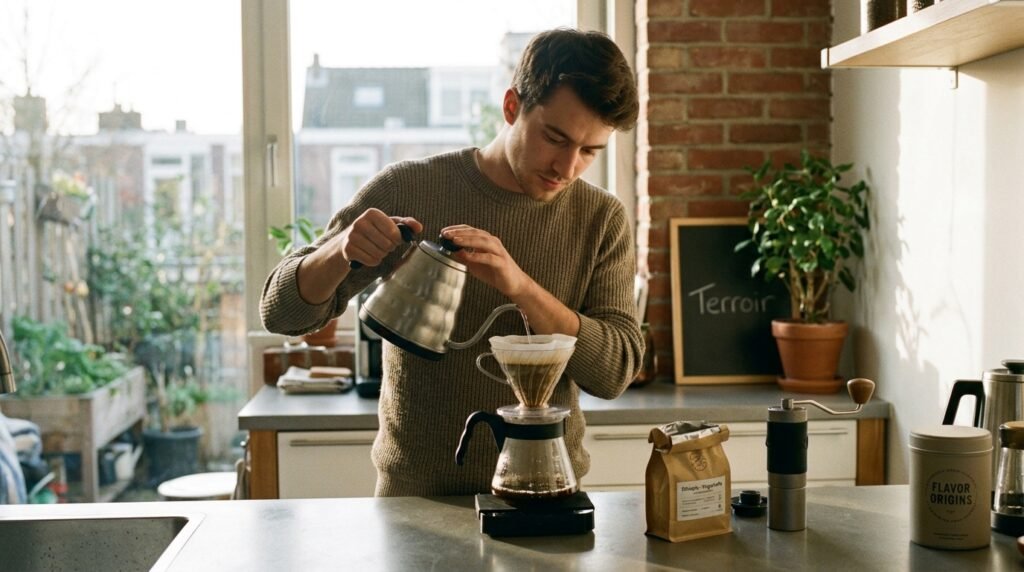
That morning, I brewed the coffee with a level of attention I had never applied before. I weighed the beans, ground them manually, and carefully poured hot water over them using a glass V60 cone.
When I took a sip, the physical reality of that geographical data hit my palate.
The coffee did not taste like the generic, ashy bitterness I was used to. It was incredibly bright. It tasted like sweet honey, crisp green apples, and milk chocolate. It was vibrant, complex, and alive.
I realized that I wasn’t just tasting the roast level. I was physically tasting the specific environment where that seed was born.
Grasping this deep connection between location and flavor was the exact foundation of (What I Learned From Drinking Coffee From Different Regions). I understood that a bean from Ethiopia would taste wildly different from a bean from Indonesia, entirely because of the earth it grew in.
The Invisible Magic of Terroir
As I fell deeper into the specialty coffee rabbit hole, I learned about a French agricultural concept called terroir.
Terroir is the idea that the complete natural environment in which a particular crop is produced—including factors such as the soil, topography, and climate—imparts its characteristic taste and flavor directly into the plant.
When you drink a cup of high-altitude Kenyan coffee, you are experiencing the aggressive, bright acidity created by the massive temperature swings between the hot African days and the freezing mountain nights.
When you drink a cup of Sumatran coffee, you are tasting the heavy, earthy, spicy notes imparted by the rich, volcanic soil of Indonesia and the intense, humid tropical climate.
Understanding this biological mechanism is exactly (What Makes Coffee Taste Different Around the World?). The coffee bean is essentially a tiny, organic hard drive that records the weather, the soil, and the altitude of its birthplace.
The Staggering Human Chain
But the global experience of coffee goes far beyond geography and biology. The most staggering realization occurred when I started researching the human logistics required to move that tiny seed across the planet.
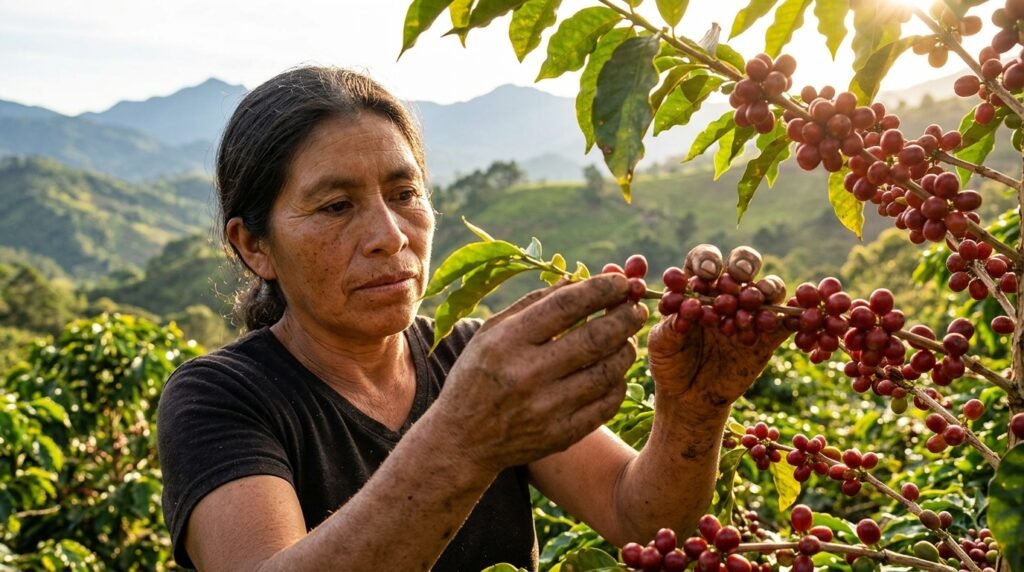
Specialty coffee cannot be harvested by massive industrial machines. Because it grows on incredibly steep, dangerous mountainsides, every single cherry must be picked by hand.
I sat in my kitchen, looking at a 15-gram pile of ground coffee, and did the math.
I realized that a human being—a farmer thousands of miles away—had to physically walk through a dense forest, visually inspect the branches of a tree, and meticulously pluck the ripe red cherries one by one.
Those workers had to carry incredibly heavy baskets of fruit down treacherous mountain paths.
The Processing and the Voyage
The global collaboration does not stop at the harvest.
The cherries have to be carefully washed, fermented in massive water tanks, and spread out on raised beds to dry under the tropical sun for weeks. Workers have to rake the drying seeds every few hours to prevent mold.
Once the green seeds are stable, they are packed into heavy burlap sacks. They are loaded onto transport trucks, driven down winding rural roads, and delivered to major international shipping ports.
These massive, 60-kilo bags of raw agricultural potential are loaded into steel shipping containers and placed on ocean freighters. They cross the equator, navigating unpredictable weather and rough seas for weeks at a time.
If the humidity inside the shipping container shifts slightly, the entire crop can be ruined before it ever reaches the destination. It is a terrifyingly fragile, massively complex global supply chain.
The Final Translation
When the green beans finally arrive at a port in my country, the global relay race is handed off to the local artisans.
A local roaster purchases the green seeds. Their job is not to manufacture flavor, but to act as a translator. They place the seeds in a massive steel drum and apply the exact, mathematically perfect curve of heat required to unlock the sugars hidden inside.
If they roast the beans for thirty seconds too long, they will completely destroy the delicate fruit notes that the farmer spent four years cultivating.
And finally, I purchase the roasted bag, bring it into my kitchen, and use hot water to finish the job.
When you finally step back and look at the entire, unedited composite image, the realization is profoundly overwhelming.
Recognizing this massive, invisible web of human effort perfectly illustrates (Why Coffee Brings People Together). The simple act of drinking my morning mug means I am participating in a collaborative effort spanning dozens of people, multiple continents, and thousands of miles.
Shrinking the World
In my digital profession, I can instantly connect with a client on the other side of the planet with a single click. We live in an era where the world feels incredibly small, but also incredibly synthetic.
We can see the entire globe through our screens, but we rarely feel it.
Coffee is the ultimate analog antidote to that digital isolation. It is a physical, tactile reminder of our deep connection to the rest of the planet.
When I hold a warm ceramic mug in my hands, I am holding the direct result of an Ethiopian farmer’s dedication, an ocean freighter captain’s navigation, and a local roaster’s scientific precision.
It is the single most collaborative object in my entire house.
Re-Evaluating the Morning Ritual
Once you realize the sheer magnitude of the global experience sitting inside your coffee cup, it becomes physically impossible to treat the beverage with disrespect.
I no longer view my morning routine as a chore. I view it as an enormous privilege.
I do not rush the grinding process. I do not blindly dump boiling water over the grounds. I use my digital scale, I watch the timer, and I pour with intention, because I refuse to be the person who ruins the final step of a 10,000-mile journey.
If you currently feel disconnected from your morning coffee—if it just feels like a generic, bitter liquid you buy from a drive-thru window to survive the workday—I highly encourage you to look at the source files.
Stop buying anonymous, mass-produced coffee. Find a local specialty roaster. Buy a bag of single-origin beans and read the label. Find the country on a map. Read about the altitude and the processing method.
Take ten extra minutes tomorrow morning to brew it manually. Smell the dry grounds. Watch the bloom. Take a sip of the black coffee and actively look for the fruit, the chocolate, and the floral notes hidden inside.
When you finally realize that you are not just drinking a beverage, but rather experiencing a deeply intimate, global collaboration, your entire perspective will shift. You will stop drinking coffee just to wake up, and you will start drinking coffee to connect with the world.
My name is Daniel Carter, I am 35 years old, and I live in the United States. I have been passionate about aquariums for many years, and what started as a simple hobby quickly became a lifelong interest in aquatic life, fish behavior, and responsible tank care.
Through TheBrightLance, I share real experiences, practical knowledge, and honest lessons learned from maintaining different types of aquariums. I enjoy testing equipment, studying fish behavior, improving maintenance routines, and helping beginners avoid common mistakes.
My goal is to make aquarism easier, more ethical, and more enjoyable for everyone — whether you are setting up your very first tank or looking to refine your techniques.