
I vividly remember the first time I walked into a genuine, third-wave specialty coffee shop.
I was completely overwhelmed. The walls were covered in intricate maps of South America and Africa. The baristas were weighing grounds on high-tech digital scales and timing their pours with stopwatches. Sitting on the counter was a massive, colorful chart called the “Coffee Taster’s Flavor Wheel,” filled with descriptors like “bergamot,” “pipe tobacco,” “grapefruit,” and “maple syrup.”
I stood in line, looked at the menu, and felt a deep sense of imposter syndrome.
I just wanted a good cup of coffee. I didn’t have a degree in chemistry, and I certainly didn’t possess a certified, highly trained palate. I thought that in order to truly understand and recognize good coffee, you had to be an absolute expert. I assumed you needed years of sensory training just to tell the difference between a decent brew and a spectacular one.
Because of this intimidation, for a long time, I just nodded along. I would buy expensive bags of beans, brew them at home, and pretend I could taste the “notes of honeysuckle” printed on the label, even when all I tasted was hot, brown water.
But eventually, the facade broke. I wanted to actually know what I was paying for.
I decided to stop pretending and start paying real attention to what was happening in my mug. And what I discovered was incredibly liberating. You do not need to be an industry professional, a Q-Grader, or a seasoned barista to recognize high-quality coffee. You just need to trust your own senses and look for a few incredibly simple clues.
Here is exactly how I started recognizing good coffee without being an expert, and how you can train yourself to do the same starting tomorrow morning.
Step 1: The “Aroma” Awakening
Before I ever changed how I brewed my coffee, I changed how I smelled it.
For decades, my morning routine involved ripping open a vacuum-sealed brick of pre-ground supermarket coffee. I never really bothered to smell it. If I did, it smelled faintly of stale chocolate, roasted wood, and sometimes, a little bit like cardboard. It smelled like a generic waiting room.
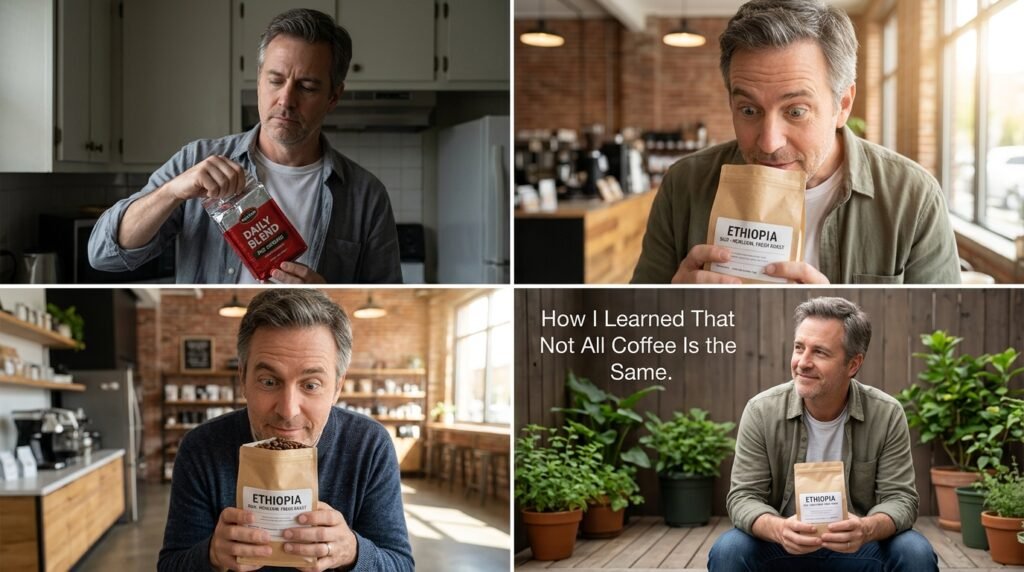
The first non-expert trick I learned was simply sticking my nose into a bag of freshly roasted, whole-bean specialty coffee.
The difference is not subtle. It is violent.
When you open a bag of high-quality coffee that was roasted just a few days ago, the aroma should practically punch you in the face. It should fill the entire kitchen within seconds. It shouldn’t just smell like “coffee”; it should smell like food.
I remember the specific moment this clicked for me. I had purchased a bag of washed Heirloom beans from the Guji region of Ethiopia. I ripped off the seal, opened the bag, and inhaled. My eyes widened. It smelled vividly like a basket of fresh peaches and jasmine flowers. I didn’t need a flavor wheel to tell me that. I didn’t need an expert to validate my experience. My brain instantly recognized the smell of fruit.
If you open a bag of coffee and you have to bury your nose deep inside just to catch a faint, dusty scent, it is not good coffee. It is stale. Recognizing this single factor was a massive turning point, and it perfectly illustrates (How I Learned That Not All Coffee Is the Same) simply by trusting my own nose before the water even touched the beans.
Step 2: The Label Transparency Test
As a beginner, trying to navigate the coffee aisle is terrifying. Every single bag uses the exact same marketing buzzwords. They all claim to be “Premium,” “Gourmet,” “Artisan,” and “Rich.”
How do you tell the good from the bad without tasting them all? You look at the transparency of the label.
I realized that good coffee roasters have nothing to hide. In fact, they are incredibly proud of the agricultural journey of their beans. Bad coffee roasters, on the other hand, want to hide as much information as legally possible.
I developed a simple, non-expert checklist for the grocery store. If a bag of coffee does not pass this test, I put it back on the shelf.
1. Is there a specific origin? If the bag just says “100% Colombian Coffee” or “South American Blend,” it is a red flag. A whole country is too broad. Good coffee will tell you the specific region, the farm, or the cooperative. Once I understood this, I realized exactly (Why I Now Pay Attention to Coffee Origin and Type) to guarantee I was getting a traceable, high-quality agricultural product.
2. Is there an altitude listed? Specialty coffee grows high in the mountains. If the bag proudly states “Grown at 1,800 MASL” (Meters Above Sea Level), it means the roaster cares about the slow maturation and sweetness of the bean. If altitude isn’t mentioned, it was likely machine-harvested in a flat, low-altitude field.
3. Is there a “Roasted On” date? This is the ultimate dealbreaker. Coffee is a fresh fruit seed. It goes stale. If a bag only has a “Best By” date set for the year 2028, it means the coffee has been sitting in a warehouse for months, completely devoid of its natural oils and flavors. Good coffee will always tell you the exact day it came out of the roasting machine.
Step 3: The Cooling Trick (My Ultimate Secret Weapon)
This is, without a doubt, the most powerful tool I discovered for recognizing coffee quality, and it requires zero sensory training.
It is called the Cooling Test.
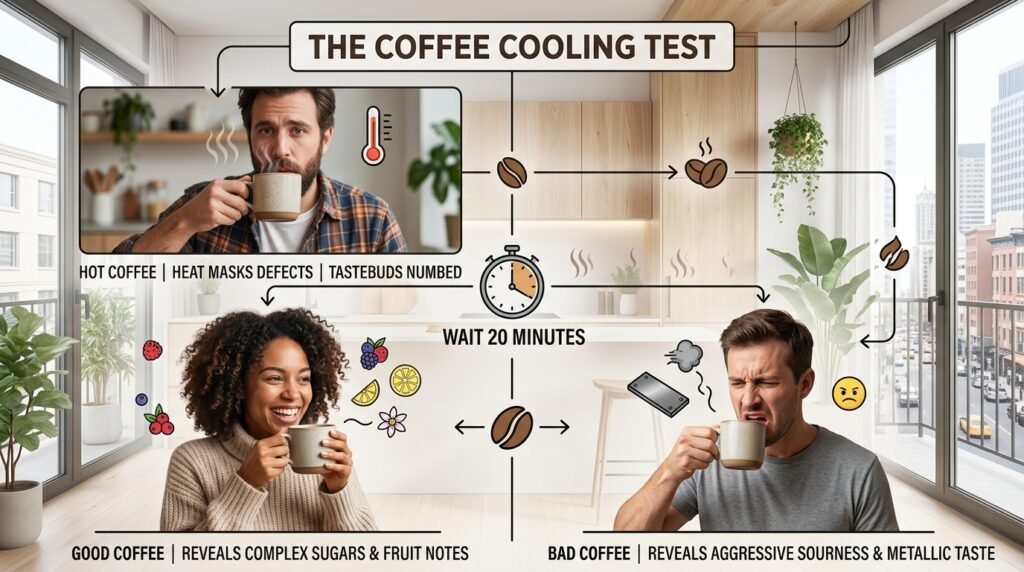
When coffee is piping hot—like, physically burning your tongue hot—your tastebuds cannot perceive flavor accurately. The heat essentially numbs your palate. This is why cheap diners and fast-food chains serve their coffee at near-boiling temperatures. If it is hot enough to melt your mouth, you can’t taste how terrible, stale, and defective the beans actually are.
For years, I would drink my coffee as fast as possible while it was steaming. But one morning, I got distracted by an urgent email. My cup of freshly brewed specialty coffee sat on my desk for thirty minutes.
When I finally took a sip, it was completely room temperature. I braced myself, expecting it to taste like battery acid.
Instead, it tasted like a sweet, vibrant fruit juice.
As high-quality coffee cools down, it should actually get better. The heat dissipates, allowing your tongue to finally access the complex sugars, the delicate floral notes, and the bright, clean acidity of the bean.
Conversely, if you take a cup of low-grade, commercial dark roast and let it cool to room temperature, it becomes completely undrinkable. The heat is no longer masking the defects. As it cools, it will taste incredibly harsh, ashy, metallic, and aggressively sour.
You don’t need to be an expert to do this test. Brew a cup of coffee. Drink a third of it hot. Wait twenty minutes. Drink the rest. If you have to force yourself to swallow the cool coffee, you are drinking low-quality beans. If the cool coffee makes you want to immediately brew a second pot because it is so refreshing and sweet, you have found the good stuff.
Step 4: Stripping Away the Armor
We all have our comfort zones. Mine was milk and sugar.
When I first started trying to figure out what good coffee tasted like, I kept making the same mistake: I was trying to evaluate the beans while they were drowning in dairy and sweeteners.
It is mathematically impossible to tell if a coffee roaster did a good job if you are actively masking their work with three pumps of vanilla syrup. It is like trying to critique the architectural details of a house while wearing a blindfold.
I knew that if I wanted to recognize quality, I had to taste the naked ingredient.
I started forcing myself to drink my coffee completely black. The first week was rough. My brain was so addicted to the sugar that the absence of it felt like a punishment.
But by the second week, a massive shift occurred. Because there was no heavy cream coating my tongue, I started noticing the texture of the coffee. I noticed that some coffees felt heavy and syrupy in my mouth, while others felt light and clean, like drinking a fine tea.
I started noticing the difference between an earthy, chocolatey bean and a bright, acidic bean. I wasn’t using the fancy terminology from the flavor wheel, but I was mentally categorizing them: This one tastes like breakfast dessert, and this one tastes like a morning garden. Learning to drink it black was the necessary foundation. Realizing that the additives were ruining the experience is the core reason (Why I No Longer Buy Coffee Without Checking the Details), because if I am going to drink it pure, the raw ingredient has to be flawless.
Step 5: The Power of the Side-by-Side Comparison
The human brain is terrible at remembering exact flavors over a long period of time.
If I drank a Colombian coffee on Monday and an Ethiopian coffee on Friday, I could generally tell you that I liked one more than the other, but I couldn’t tell you why. The memory of the flavor was too blurry.
To overcome this lack of expert memory, I started doing side-by-side comparisons in my own kitchen.
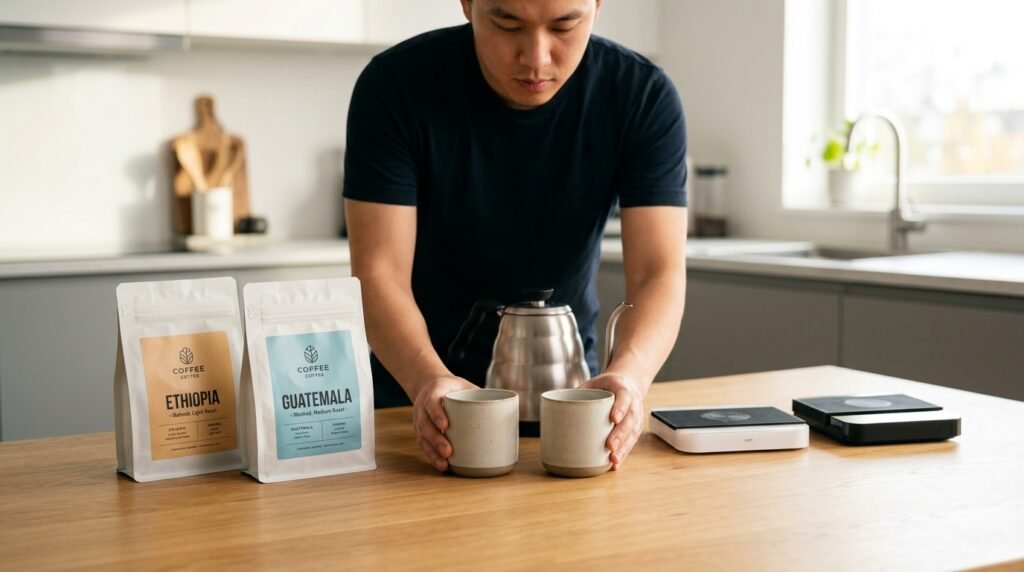
I would go to a local roaster and buy two completely different bags of coffee. One might be a naturally processed, light-roast African bean, and the other might be a washed, medium-roast Central American bean.
On Saturday mornings, I would brew a small cup of both simultaneously, using the exact same water temperature and the exact same ratio.
I would put the two mugs side by side on my table. I would take a sip of the first one, rinse my mouth with water, and immediately take a sip of the second one.
This is the fastest way to become an amateur expert.
When you taste them seconds apart, the contrast is mind-blowing. The nuances that you usually miss suddenly become incredibly obvious. You instantly feel how the African coffee dances on the sides of your tongue with bright acidity, while the Central American coffee sits heavily on the back of your palate with rich chocolate notes.
You don’t need a certificate to notice contrast. You just need two mugs.
Step 6: Trusting the Lack of Bitterness
The final, and perhaps most important, lesson I learned about recognizing good coffee was redefining my relationship with bitterness.
Society has taught us that coffee is supposed to be bitter. We associate that harsh, wincing sensation with “strength” and “caffeine.”
But the truth is, extreme bitterness is a flaw. It is a sign of either a terrible, defective bean, a severely over-roasted batch, or a flawed brewing technique that over-extracted the coffee.
High-quality, specialty-grade Arabica coffee, when roasted properly and brewed correctly, is not inherently bitter. It is complex. It can be acidic, it can be sweet, it can be earthy, but it should never make your face twist in discomfort.
When I started drinking truly good coffee, the most surprising thing wasn’t the presence of blueberry or jasmine notes; it was the absolute absence of the harsh, ashy bitterness I had grown up with. It went down smooth. It was gentle on the stomach.
I realized that recognizing good coffee isn’t about finding the most intense, aggressive flavor. It is about finding harmony.
You Are Already Qualified
If you have ever felt intimidated by the specialty coffee world, I want you to know that your palate is already perfectly equipped to recognize quality.
You know the difference between a fresh, ripe strawberry and a plastic, artificial strawberry candy. You know the difference between a burnt piece of toast and a perfectly golden slice of sourdough.
Coffee is no different. It is just food.
You don’t need to memorize the flavor wheel to enjoy your mornings. You just need to start paying a little bit of attention.
Smell the beans before you grind them. Look for the roast date on the bag. Let your mug cool down for ten minutes before you finish it. Taste the contrast.
Once you give yourself permission to trust your own tongue, the anxiety of the coffee shop fades away, and the pure, simple joy of drinking a beautiful cup of coffee takes over. And honestly? That is the only expert opinion that actually matters.

My name is Daniel Carter, I am 35 years old, and I live in the United States. I have been passionate about aquariums for many years, and what started as a simple hobby quickly became a lifelong interest in aquatic life, fish behavior, and responsible tank care.
Through TheBrightLance, I share real experiences, practical knowledge, and honest lessons learned from maintaining different types of aquariums. I enjoy testing equipment, studying fish behavior, improving maintenance routines, and helping beginners avoid common mistakes.
My goal is to make aquarism easier, more ethical, and more enjoyable for everyone — whether you are setting up your very first tank or looking to refine your techniques.